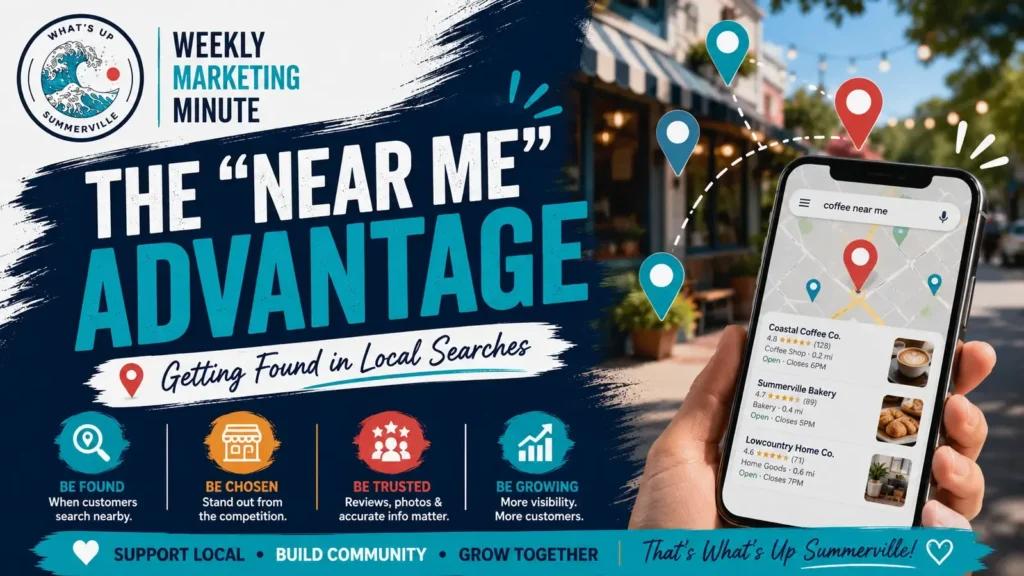
Every day, people search for businesses they need right now. Whether it’s “coffee near me,” “plumber near me,” “bakery near me,” or “restaurants near me,” those searches represent customers who are actively looking for a place to visit, call, or buy from today.
Those two little words—”near me”—can be some of the most valuable searches your business ever appears in because they represent customers who are actively looking to visit, call, or buy from a business today.
The question is simple:
Will they find your business—or your competitor’s?
“Near me” searches aren’t just about location—they’re about trust, relevance, and visibility.

It’s About More Than Distance
Many business owners assume Google simply shows the businesses closest to the person searching.
Location absolutely matters—but it’s only one piece of the puzzle.
Google’s goal is to show the result that’s most helpful—not simply the one that’s closest.
Search engines also evaluate signals that help determine which businesses are the best match, including:
- Accurate business information
- Complete business profiles
- Customer reviews
- High-quality photos
- Relevant website content
- Proper business categories
- Overall online presence
A business that’s a few miles farther away—but has a stronger online presence—can often appear above one that’s physically closer.
Search engines don’t just rank businesses by distance. They rank them by distance, relevance, and prominence.
That means a complete, trusted business profile can make a real difference.
Five Simple Ways to Improve Your Chances

1. Keep Your Business Information Accurate
Your business name, address, phone number, website, and hours should be consistent everywhere they appear online.
This is commonly called NAP consistency (Name, Address, Phone).
Imagine someone searches for a hardware store at 5:30 PM. Your listing says you’re open until 6:00—but you actually closed at 5:00.
That customer wastes a trip.
Accurate information builds trust with both customers and search engines.
2. Choose the Right Categories
Specific beats general.
If you’re a bakery, don’t stop at “Restaurant.”
If you’re an electrician, don’t simply choose “Contractor.”
Most business profiles allow a primary category along with secondary categories. The more accurately you describe your business, the easier it becomes for search engines to match you with the right searches.
For example, a bakery that also serves coffee should consider whether adding Coffee Shop as a secondary category accurately reflects its business. Choosing the most appropriate categories helps search engines understand exactly what you offer.
3. Encourage Customer Reviews
Reviews build confidence with potential customers, and they also signal to search engines that your business is active and engaged.
You don’t need hundreds overnight.
A steady flow of genuine reviews over time is far more valuable.
Even better, respond to them.
A simple “Thanks for stopping by!” tells customers—and search engines—that your business is engaged with the local community.
4. Keep Adding Fresh Photos
Show people your storefront.
Show your products.
Show your team.
Show completed projects.
Real photos help customers recognize your business before they ever walk through the door.
They also show search engines that your business remains active and up to date.
Businesses that regularly add new photos often appear more active than those with profiles that haven’t been updated in years.
5. Build Your Local Presence
Your business shouldn’t exist in only one place online.
The more trusted places your business appears, the stronger your local visibility becomes.
That includes:
- Local business directories (including What’s Up Summerville)
- Community websites
- Chamber of Commerce listings
- Event calendars
- Local news coverage
- Community partnerships
One of the best places to start is your Google Business Profile. If you haven’t claimed or optimized yours yet, check out our step-by-step guide to getting started.
Every quality mention reinforces that your business is genuinely part of the community.
Think Beyond Google
While Google is often the starting point, it isn’t the only place people discover local businesses. Community websites, event calendars, local directories, social media, and personal recommendations all influence where customers decide to spend their money.
That includes local resources like the What’s Up Summerville Business Directory and Events Calendar, where residents regularly discover businesses, community events, and organizations throughout the Flowertown area.
The Bottom Line
Local search isn’t about trying to outsmart an algorithm.
It’s about making it easy for both customers and search engines to understand who you are, what you do, and where they can find you.
A complete online presence, accurate information, fresh content, and positive customer experiences all work together to improve your visibility.
Sometimes, a few small improvements are all it takes to help the next customer find your business instead of someone else’s.
Weekly Marketing Minute
Helping local businesses grow one practical tip at a time.
At What’s Up Summerville, we believe great local businesses deserve to be discovered. Whether someone finds you through a search engine, a community directory, or a recommendation from a neighbor, visibility starts with providing accurate, complete, and helpful information wherever your business appears. If you’re ready to strengthen your local visibility, explore the What’s Up Summerville Business Directory and make sure your business is easy for customers to find.