A potential customer lands on your website, opens your social profile, or catches a glimpse of your booth at the Summerville Farmers Market.
In that moment, the clock starts.
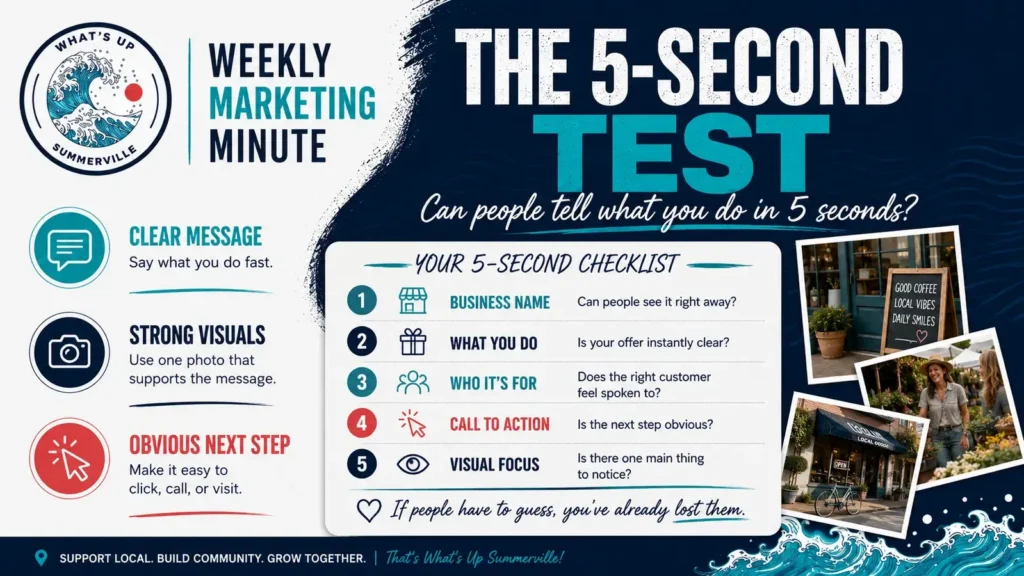
You have about five seconds to answer three basic questions:
– What does this business offer?
– Who is it for?
– What should I do next?
If the answers are not immediately clear, people rarely stop to investigate. They scroll, click away, or walk toward the next vendor.
In a world filled with distractions, clarity is one of your strongest competitive advantages.
Why Five Seconds?
Your customers are busy. They may be searching between errands, checking Instagram during a lunch break, or walking through a crowded community event surrounded by dozens of signs, conversations, and displays.
When they encounter your marketing, they should not have to work to understand it.
A confusing message creates friction. The customer has to pause, decode your wording, and decide whether your business is even relevant to them. Most people will not make that effort when another option is only a tap, click, or a few steps away.
That does not necessarily mean your business looks unprofessional. In fact, some beautifully designed websites fail the five-second test because the message is trying to be clever, inspirational, and informative all at once.
Five seconds is not a rigid scientific deadline. It is a simple way to test whether your message communicates quickly enough for someone who is distracted, hurried, or unfamiliar with your business.
Try the Five-Second Test Yourself
Open your website, Facebook page, Instagram profile, Google Business Profile, or online listing and view it as though you have never encountered the business before.
Better yet, check it on your phone, since that is where many local searches begin.
Do not carefully read every paragraph. Look at the page for five seconds, close it, and ask:
- Can I explain what this business sells or provides?
- Can I tell where it is located or whom it serves?
- Is there an obvious next step?
- Do I know whether I should call, visit, order, book, or request a quote?
For a more honest test, show the page to someone unfamiliar with your business. Give them five seconds, then ask:
- “Based only on what you saw, what do you think this business does?”
Their first response may tell you more than another hour spent adjusting colors, fonts, or photographs.
Clear Beats Clever
Business owners know their own work so well that they sometimes assume customers understand it too. This can lead to vague taglines, industry jargon, or poetic descriptions that sound pleasant but provide very little useful information.
Consider a bakery that describes itself as: “Handcrafted traditions made with love and a dash of history.”
That sounds warm, but it does not tell a new customer what the business actually sells. Is it sourdough? Wedding cakes? Cookies? Catering?
A clearer message might be: “Small-batch sourdough breads and local treats, baked fresh in Summerville.”
The personality is still there, but the essential information comes first. Within seconds, the customer knows:
- What: Sourdough bread and treats
- Where: Summerville
- Why: Fresh, local, and small-batch
The same principle applies to service businesses. Instead of: “Bringing your vision to life,” try: “Residential painting and drywall repair for homeowners in Summerville and the Lowcountry.”
Customers should not have to decode your tagline before understanding your offer.

Make the First Screen Do the Heavy Lifting
The first portion of a website—the area visible before someone scrolls—is often called the “above-the-fold” section. That is some of your most valuable marketing space.

For most local businesses, the first screen should communicate four things:
- Your Core Product or Service: What is the main thing you want customers to remember? Lead with the clearest description of what you provide.
- Your Customer: Who is your product or service meant for? (e.g., homeowners, parents, local businesses).
- Your Location or Service Area: Use clear phrases such as “Serving Summerville,” “Locally baked,” or “Visit us in Downtown Summerville.”
- Your Next Step: What should the customer do after understanding your offer? The answer should be obvious.
You do not need to explain your entire business history on the first screen. You only need to provide enough clarity and confidence to encourage the customer to continue.
The Test Applies Offline, Too
The five-second test is not limited to websites and social media. It applies anywhere someone first encounters your business.
- Market Banners and Booth Signs: At a busy farmers market or festival, a beautiful booth may attract attention, but a clear sign tells people why they should stop walking. Can someone walking by quickly tell what you sell?
- Vehicle Graphics: If your business name and logo are displayed on a vehicle, can someone understand what you do while stopped at a traffic light? A logo alone may not be enough.
- Flyers and Business Cards: Is the most important information easy to find, or is it buried beneath a wall of text?
- Storefront Signs: Can a person passing your location tell what is inside and whether it is relevant to them?

Clear messaging acts as a beacon. It helps the right people recognize that your business is meant for them.
Give Customers One Obvious Next Step
Once customers understand what you do, make the next action effortless. Avoid presenting several competing calls to action at the same time. Choose the one action that matters most at that moment:
- Order Online
- Book an Appointment
- Request a Quote
- View the Menu
- Visit Our Store
- Call Today
You can provide additional options farther down the page. The first impression should guide the customer instead of overwhelming them.
A Local Example: Laila’s Lowcountry Sourdough
Laila’s Lowcountry Sourdough is a strong example of clear local positioning. The business name immediately tells customers what it offers and connects the brand to the Lowcountry. Its listing also gives visitors an obvious next step: browse current offerings, preorder online, and pick up at the market.
View Laila’s Lowcountry Sourdough and preorder
This Week’s Marketing Minute
Choose one place where customers first discover your business—your homepage, Instagram bio, Google listing, market banner, or storefront sign—and give it the five-second test.
Ask someone unfamiliar with your business: “Based only on what you saw for five seconds, what do you think we do?”
If their answer is incomplete, unclear, or different from what you intended, simplify the message. Your business probably does not need more words. It needs the right words, in the right place, before those five seconds are gone.
Grow Your Local Visibility
What’s Up Summerville helps local businesses connect with the community through business listings, events, guides, local content, and promotional opportunities.
Visit What’s Up Summerville to explore the community, submit an event, or learn more about getting your business featured.
Support Local • Love Summerville