Downtown Summerville has changed countless times over the years, but its role in the community has remained the same. Whether it was the clip-clop of horse-drawn carriages or the hum of modern-day traffic, the center of our town has always been the heartbeat of the Flowertown.
For more than a century, the streets around Hutchinson Square have been a gathering place: home to local businesses, celebrations, travelers, and generations of Summerville residents. Through historic photographs and postcards, we can see how the town has grown while still holding onto the character and charm that make Summerville unique.
As we look back at the decades that shaped us, it’s clear that while the facades may change, the spirit of Summerville is woven into the streets, storefronts, and gathering places that continue to bring people together.

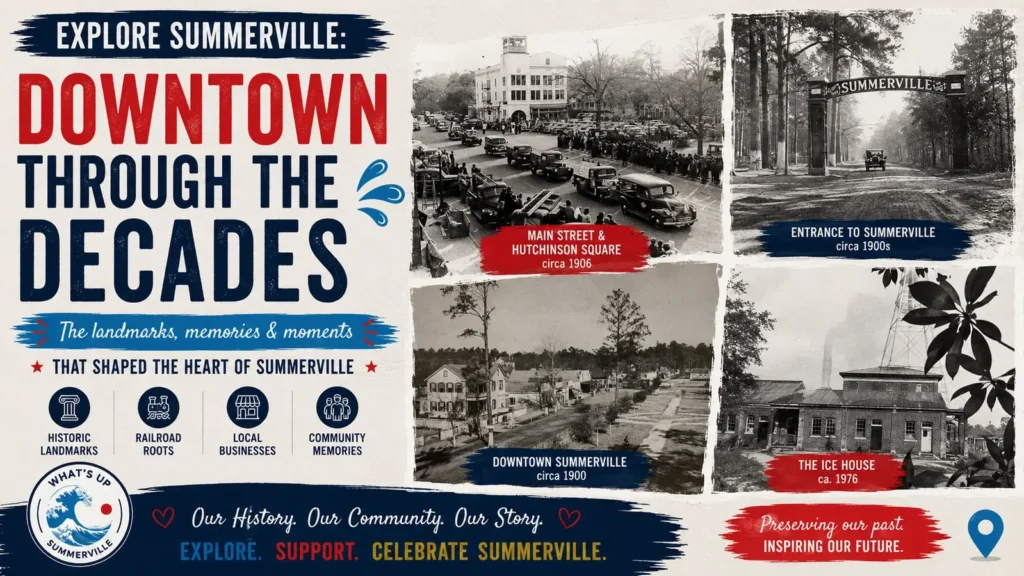
Main Street & Hutchinson Square (Early 1900s)


At the start of the 20th century, Main Street looked very different from the downtown we know today.
If you were to stand at the corner of Main and Doty Avenue in 1906, you wouldn’t find the paved asphalt we drive on today. Instead, you’d see unpaved, sandy roads lined with early storefronts and a growing town centered around Hutchinson Square.
Named for the Hutchinson family, Hutchinson Square became a place for commerce, conversation, and community life — a role it continues to play today. Back then, it was the social hub where residents gathered, businesses grew, and the latest news traveled through town. This era marked Summerville’s transition from a quiet pineland retreat into a growing Lowcountry town with a thriving downtown district.
Although the buildings, roads, and businesses have changed, Hutchinson Square remains one of Summerville’s most recognizable gathering places. It’s a testament to the town’s early commitment to preservation. In fact, many of the historic commercial buildings that frame the square today were recognized in the 1976 National Register nomination, ensuring that the visual story of our town remains intact for future generations.
To dive deeper into the origins of this iconic spot, check out The Story Behind Hutchinson Square.
The Pine Forest Inn and Summerville’s Resort Era (Early 1900s)
During the late 1800s and early 1900s, Summerville became known far beyond the Lowcountry as a destination for rest and relaxation. This reputation even gained international attention. In 1888, the International Congress of Physicians in Paris recognized Summerville for its pine-filled environment and its connection to respiratory health.
The Pine Forest Inn represented this chapter of Summerville’s history, welcoming visitors who came for the area’s mild climate and natural beauty. This “Resort Era” helped shape Summerville’s identity as a peaceful retreat and contributed to the town’s lasting connection with nature. It’s the reason why, to this day, our town motto is “Sacra Pinus Esto” (Let the Pine be Sacred).


Wealthy northerners would travel by rail to spend their winters here, staying in grand hotels that offered everything from golf to hunting.
This influx of visitors didn’t just bring economic growth; it brought a sophisticated architectural influence that still defines the character of historic Summerville.
Downtown Celebrates 100 Years (1947)

In March 1947, Summerville celebrated its Centennial, marking 100 years since the town’s incorporation in 1847. The celebration was a massive community effort that brought everyone downtown for a parade through the streets surrounding Hutchinson Square.
The historic Summerville Town Hall, built in 1892, can be seen in photographs from that day overlooking the celebration. This landmark served the community for decades, witnessing everything from the aftermath of the 1886 earthquake to the rise of the automobile. It eventually made way for the current Town Hall building in 1969, but the memories of that 100-year milestone remain a significant part of our local lore.
The Centennial Parade captured a moment in time: classic cars lining the streets, crowds gathered downtown, and a community celebrating the story it had built together.
The Railroad and a Growing Community

Few things shaped early Summerville as much as the arrival of the railroad. When the tracks arrived in the mid-19th century, they helped transform the area from a seasonal retreat into a thriving town.
The historic train station connected Summerville to Charleston and destinations beyond, supporting commerce and the arrival of visitors seeking the area’s famous pine-filled environment during the resort era. It’s why our downtown is laid out the way it is: businesses and homes were built to be within walking distance of the depot.
For more on how the tracks laid the foundation for our town, read The Railroad That Built Summerville. Even today, the design of the 2019 revitalization of Hutchinson Square: specifically the pavilion: was inspired by the original railroad depot that once stood nearby.
Hutchinson Square Through the Years

As Summerville grew, Hutchinson Square changed along with it. The square has stood through some of the town’s biggest changes. It saw the rebuilding efforts after the devastating 1886 earthquake and the ensuing fires that reshaped the downtown landscape.
Through every decade, it has evolved. Generations have experienced downtown in different ways — from shopping trips and local businesses to festivals, parades, and community events. In the 21st century, it underwent a major revitalization that added a fountain, new landscaping, and a raised pavilion to better host our modern community events.
Whether it’s the Flowertown Festival, the Sweet Tea Festival, or a quiet Third Thursday evening, the square remains the centerpiece of downtown life — the place where Summerville’s past and present cross paths every day.
Everyday Places That Became Local Memories


Not every piece of history comes from major landmarks or municipal buildings.
Some of the most cherished memories live in the everyday places where residents gathered.
The Ice House and the James F. Dean Theatre represent another side of Summerville’s history — the everyday places where memories were made. From businesses that served a growing town to theaters where generations gathered for entertainment, these locations show that history isn’t only found in major landmarks.
When we walk past these sites, we aren’t just seeing brick and mortar; we’re seeing the places where generations of Summerville residents created memories.
Visit This Historic Spot: Flowertown Players (James F. Dean Theatre)
Located in the historic heart of downtown, this theatre is the modern steward of a beloved Summerville landmark.
- Website: flowertownplayers.org
- Phone: 843-875-9251
- Instagram: @flowertown_players
Still Serving Summerville: Guerin’s Pharmacy
While we’re talking about historical spots that are still alive and well, you can’t miss Guerin’s. It’s the oldest corner drugstore in South Carolina and a downtown staple since the 1800s.
- Website: guerinspharmacy.com
- Phone: 843-873-2531
A Downtown That Continues to Evolve
The Summerville we know today is built on generations of change. Businesses have opened and closed. Buildings have come and gone. Roads, parks, and gathering spaces have transformed to meet the needs of a growing population.
But despite the progress, the heart of downtown remains the same: a place where the community comes together. From historic postcards showing sandy tracks to today’s high-definition photos of festivals on Hutchinson Square, each decade adds another chapter to Summerville’s story.
We are a town that moves forward without forgetting where we came from. As you walk through downtown this week, take a moment to look up at the architecture and imagine the unpaved roads and steam engines of the past. You’re walking through a century of history that is still being written.