
Explore Summerville History is our ongoing series uncovering the stories, people, and places that shaped the community we call home today.
Long before the railroad brought visitors seeking fresh pine air…
Long before Hutchinson Square became the heart of downtown…
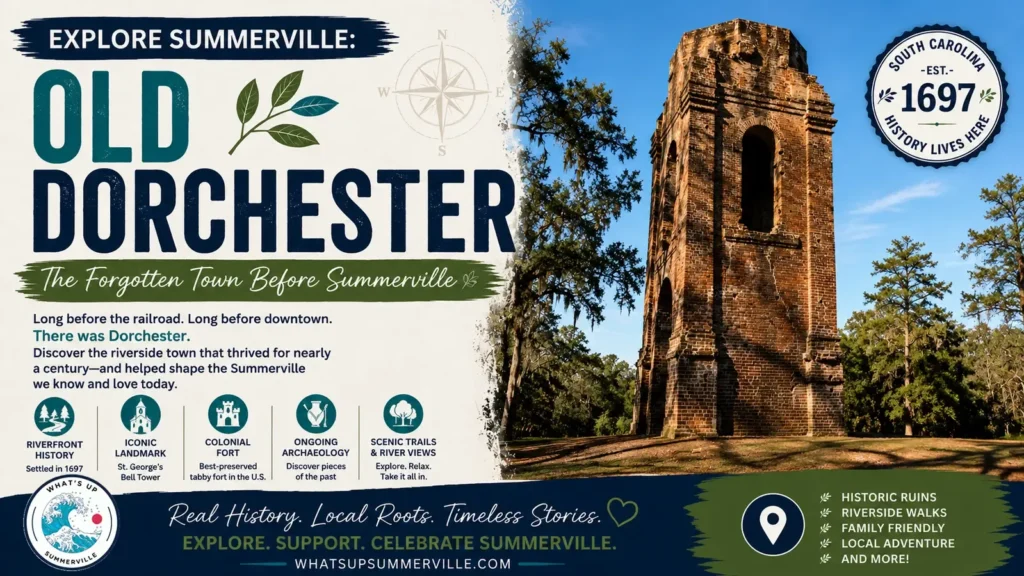
There was Dorchester.
For nearly a century, Old Dorchester stood as one of colonial South Carolina's most important inland trading towns. Settled in 1697 along the Ashley River, it connected plantations, merchants, and travelers with Charleston and the wider Atlantic world. Today, only ruins remain—but those ruins tell the story of where this part of the Lowcountry truly began.
Although the town itself disappeared, its story never completely vanished. Today, thousands of cars pass the entrance to Colonial Dorchester State Historic Site every week without realizing the remarkable history hidden just beyond the trees. Stone ruins, centuries-old graves, and the remains of one of South Carolina's earliest inland settlements sit quietly along the banks of the Ashley River.
While Summerville grew into the "Flowertown in the Pines" we know and love today, Old Dorchester slowly faded away. But its ruins remain, offering one of the Lowcountry's most fascinating windows into colonial life.
What You'll Find Below
✔️ The story of the town that came before Summerville
✔️ Why settlers chose the Ashley River
✔️ How Old Dorchester became an important trading community
✔️ What caused the town's decline
✔️ What you can still see today
✔️ Tips for making the most of your visit
Quick Facts at a Glance
📍 Location: 300 State Park Rd, Summerville, SC 29485
🏛 Founded: 1697
🏛 Managed By: South Carolina State Parks
🌊 Setting: Located along the scenic Ashley River
🧱 Main Feature: Best-preserved oyster-shell tabby fortification in the U.S.
⛪ Iconic Landmark: Historic St. George's Anglican Church bell tower
🚶 Activities: Walking trails, archaeological viewing, and fishing
📖 Significance: One of South Carolina's best-preserved colonial sites
A Town Built Along the River
To understand why Old Dorchester existed, you first have to understand the Ashley River. Long before paved roads connected the Lowcountry, rivers served as the primary highways. The Ashley River carried people, crops, supplies, and ideas between inland settlements and the busy port of Charleston.
When a group of Congregationalist settlers from Dorchester, Massachusetts, arrived in 1697, they weren't simply building a village; they were establishing a strategic trading community. They chose this specific spot because it was the highest point of navigation on the river: meaning it was as far inland as large trading boats could comfortably go.
The settlers who founded Dorchester arrived under the leadership of Reverend Joseph Lord. They established the community not only as a commercial settlement, but also as a place where they could continue practicing their Congregationalist faith. As South Carolina's Anglican Church became the established church, the community evolved as well, eventually becoming home to St. George's Anglican Church, whose surviving brick bell tower still dominates the site today.

Merchants arrived by boat, farmers brought crops like rice and indigo to market, and families built homes overlooking the water. Churches, taverns, and warehouses soon transformed this quiet stretch of shoreline into a thriving colonial town. For generations, nearly every aspect of life revolved around the rhythm of the Ashley River.
Life in Colonial Dorchester
Imagine standing in Old Dorchester during the early 1700s. The air would be filled with the sounds of a growing community: children running through dirt streets, blacksmiths shaping iron in busy workshops, and the heavy thud of barrels being unloaded at the wharf.
This wasn't an isolated frontier outpost. It was a sophisticated settlement connected to the wider world through commerce and faith. By the mid-1700s, Dorchester had grown to include about 40 houses and a population that supported a library, multiple shops, and two major places of worship.
The heart of the town’s spiritual life was St. George’s Anglican Church. While the original wooden structure was built around 1719, it was the addition of the massive brick bell tower in 1751 that truly defined the town’s skyline. Today, that tower still stands as a silent sentinel over the grounds, though the church itself was lost to the fires of the Revolutionary War.
But Dorchester wasn't simply a quiet colonial village. Every week, farmers, craftsmen, and merchants gathered in town to buy, sell, and trade goods. Twice each year, four-day fairs attracted visitors from throughout the colony. Those fairs transformed Dorchester into a regional gathering place where business, politics, and social life intersected, bringing together people from plantations and settlements across the Lowcountry. Rice, indigo, timber, livestock, imported goods, and handcrafted products all passed through the settlement, making Dorchester one of colonial South Carolina's most important inland trading communities despite its relatively modest population.

When History Changed Course
Communities rise, change, and sometimes, they disappear altogether. Old Dorchester experienced each of those chapters.
During the French and Indian War, Dorchester's strategic importance led to the construction of the tabby fort and powder magazine that still stand today. Two decades later, during the Revolutionary War, the town once again became an important military outpost. Among those connected to Dorchester's military history was Francis Marion—the legendary "Swamp Fox"—who briefly commanded the American garrison before becoming one of South Carolina's most celebrated Revolutionary War leaders. The British eventually occupied Dorchester, burning much of the town—including St. George's Church—before withdrawing in 1781.
After the war, the town struggled to recover. Several factors led to its eventual decline:
Health Concerns
The swampy lowlands near the river were prone to malaria and other "fevers."
Economic Shifts
New transportation routes and the rise of other trading hubs reduced Dorchester's importance.
The Rise of Summerville
Families began looking for healthier, higher ground. They found it just a few miles away in the pine forests. The higher, drier ground and cleaner air offered relief from malaria and seasonal fevers that plagued the marshes along the Ashley River. Those families gradually relocated inland, laying the foundation for the community that would eventually become Summerville.
By the late 1780s, the bustling town that once overlooked the Ashley River had been largely abandoned. Nature began to reclaim the streets, and Old Dorchester quietly faded into history.
Walking Through Three Centuries
One of the most remarkable things about visiting Colonial Dorchester State Historic Site today is that it doesn't feel like a museum hidden behind glass. You are walking where people actually lived, worked, and died.
The St. George’s Bell Tower is the most photographed feature, but don't miss the Tabby Fort. Built between 1757 and 1760 during the French and Indian War, this fort was designed to protect the town's powder magazine. It is constructed of "tabby"—a colonial concrete made from lime, sand, water, and crushed oyster shells. Because suitable building stone was scarce in the Lowcountry, colonists created tabby using locally available materials. Burned oyster shells produced lime, which was mixed with sand, water, and additional crushed shells to create an incredibly durable early concrete. More than 250 years later, Fort Dorchester remains one of the finest surviving examples of colonial tabby construction in the United States.

Archaeological excavations continue at the site, often in plain view of visitors. Archaeologists have uncovered everything from ceramic plates and clay pipes to the foundations of colonial homes, helping us piece together the daily lives of the people who called Dorchester home. New discoveries continue to reshape historians' understanding of everyday life in colonial Dorchester.
Why We Love It
History feels different when you're standing where it actually happened. Colonial Dorchester invites visitors to slow down, wander the grounds, and imagine life more than three centuries ago. It’s a place that is simultaneously peaceful and reflective.
Despite being hundreds of years old, the site still feels remarkably alive. Whether you're watching the tide go out on the Ashley River or standing beneath the towering brick ruins, you can feel the weight of the stories buried beneath your feet.
It's easy to think of Colonial Dorchester as simply another historic site, but it's much more than that. Without Dorchester, there may never have been a Summerville. The people who once lived, traded, worshipped, and raised families along the Ashley River helped shape the community that later took root beneath the pines.
Every visit to Old Dorchester is a reminder that Summerville's story didn't begin in the nineteenth century—it began nearly a hundred years earlier, along the banks of a quiet blackwater river that carried the first chapter of our community's history.
Did You Know?
At low tide, visitors can sometimes see the remains of Dorchester's original eighteenth-century log wharf extending into the Ashley River. More than two centuries after ships once unloaded cargo there, portions of the structure are still visible under the right conditions.
Experience It Like a Local
To get the most out of your visit, we recommend arriving early in the morning. The light filtering through the moss-draped oak trees creates a serene atmosphere that’s perfect for photography and quiet reflection.
- Arrive Early: Morning light and cooler temperatures make for the most peaceful experience.
- Wear Comfortable Shoes: The paths are mostly easy, but you'll be walking over uneven historic ground.
- Bring a Camera: The bell tower and the river views are stunning in the morning light.
- Check the Tides: At low tide, you can sometimes see the remains of the 18th-century log wharf in the river mud.
- Take the Trails: The walking paths are easy and offer various vantage points of the fort and the old cemetery.
- Pack a Picnic: There are plenty of shaded spots to sit and enjoy the breeze off the river.
Get in Touch: Colonial Dorchester State Historic Site
If you're ready to step back in time, here is everything you need to plan your visit to this incredible piece of Summerville’s past.
- Website: South Carolina State Parks – Colonial Dorchester
- Phone: 843-873-1740
- Address: 300 State Park Rd, Summerville, SC 29485
- Instagram: @scstateparks
- Facebook: SC State Parks Official
Connect & Grow with What's Up Summerville
Love discovering places like Old Dorchester? That's exactly what Explore Summerville is all about. From historic landmarks and scenic parks to local restaurants and hidden gems, we’re here to help you experience every side of the Flowertown.
Whether you're a lifelong resident or visiting for the first time, there's always another story waiting just around the corner. Every park, restaurant, and historic site tells a piece of our story, and What's Up Summerville exists to help you discover them: one adventure at a time.
Explore More
Old Dorchester tells the story of the community that came before Summerville. To continue the journey through local history, visit Hutchinson Square, where a new chapter of our town’s story began, or continue following the Ashley River by exploring Ashley River Park, where the same waterway that once carried colonial trading vessels now serves as the backdrop for one of Summerville's most popular parks.
Sometimes, understanding where we're going begins with discovering exactly where we started.
Part of the Explore Summerville History Series
Discover the people, places, and stories that shaped Summerville—from colonial settlements and railroad towns to parks, neighborhoods, and local landmarks that continue to define our community today.
Sources & Further Reading
This guide was researched using historical records, archaeological findings, and official state park resources. For readers who'd like to explore further:
- Archaeological Institute of America — Off the Grid: Colonial Dorchester: https://archaeology.org/issues/march-april-2014/off-the-grid/south-carolina-colonial-dorchester/
- Discover South Carolina — Walk the Historical Grounds: https://discoversouthcarolina.com/articles/walk-the-historical-grounds-of-colonial-dorchester
- Dorchester County — Do More History: https://www.dorchestercountysc.gov/our-county/do
- National Register of Historic Places — Old Dorchester State Park Nomination: https://www.nationalregister.sc.gov/dorchester/S10817718007/OldDorchesterSPsm.pdf
- South Carolina 250 — Colonial Dorchester: https://southcarolina250.com/historical-site/colonial-dorchester-state-historic-site/
- South Carolina State Parks — Colonial Dorchester State Historic Site: https://southcarolinaparks.com/colonial-dorchester
- South Carolina State Parks — History & Interpretation: https://southcarolinaparks.com/colonial-dorchester/history-and-interpretation
{“@type”:”BlogPosting”,”image”:”https://cdn.marblism.com/Su_2k60_j5I.webp”,”author”:{“name”:”What’s Up Summerville”,”@type”:”Organization”},”@context”:”https://schema.org”,”headline”:”Explore Summerville History: Old Dorchester — The Forgotten Town Before Summerville”,”keywords”:[“Old Dorchester”,”Summerville History”,”Colonial Dorchester State Historic Site”,”St. George’s Church Bell Tower”,”Tabby Fort SC”],”publisher”:{“logo”:{“url”:”https://www.whatsupsummerville.com/logo.png”,”@type”:”ImageObject”},”name”:”What’s Up Summerville”,”@type”:”Organization”},”description”:”Discover the hidden history of Old Dorchester, the colonial trading town that preceded Summerville, SC. Learn about the St. George’s bell tower, the tabby fort, and why the town was abandoned.”,”datePublished”:”2026-06-22″,”articleSection”:”Community Guides”}