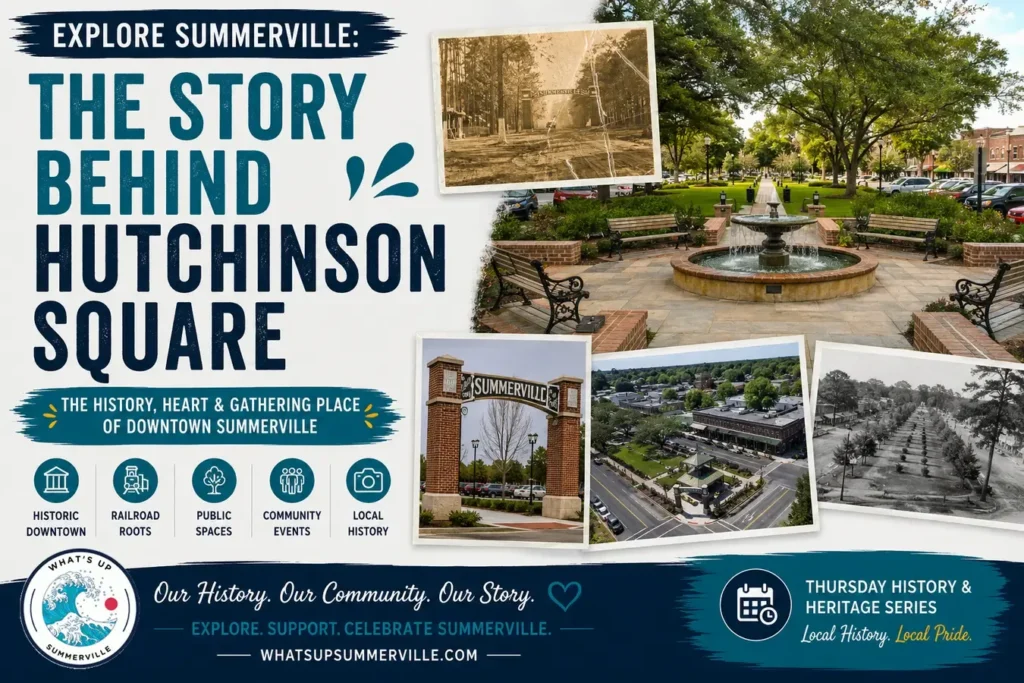
A living guide to the history, people, and places that shaped the heart of Downtown Summerville.
About This Guide
This guide is part of What’s Up Summerville’s ongoing mission to document, preserve, and share the stories that have shaped our community. Information has been compiled from official Town records, preservation documents, historical archives, and other trusted resources. As additional historical records become available, this guide will continue to be updated and expanded.
First published: June 2026 • Last updated: June 2026
Why This Place Matters
More than 50,000 people drive through Downtown Summerville every week. Thousands attend festivals, concerts, parades, farmers markets, and community events centered around Hutchinson Square each year.
Yet surprisingly few know why this place exists—or how it became the symbolic heart of Summerville.
The story of Hutchinson Square isn’t simply about landscaping or historic buildings. It’s the story of how a small railroad town became one of South Carolina’s most recognizable communities while preserving the character that continues to attract residents and visitors today. Whether you’re visiting for the first time or have called Summerville home for decades, understanding Hutchinson Square means understanding Summerville itself.
Featured Quote
“A town is remembered not only by its buildings, but by the places where its people come together.”
At a Glance
📍 Location
Historic Downtown Summerville
🌳 Historic District
Listed on the National Register of Historic Places (1976)
🚶 Best For
History • Festivals • Photography • Shopping • Dining • Public Art
🎉 Annual Events
Third Thursday • Christmas Tree Lighting • Flowertown Festival Activities • Community Celebrations
🕒 Recommended Visit
- Morning for quiet walks
- Evening for restaurants and events
- Spring during azalea season
Quick Facts
Address: Hutchinson Square, Main Street, Summerville, SC
Named For: Phillip Henry Hutchinson (based on current official Town tourism information; additional historical research ongoing)
Historic District: National Register of Historic Places (1976)
Original Railroad Era: 1830s
Current Square Completed: 2019
Managed By: Town of Summerville
Known For: Third Thursday, community events, festivals, public gatherings, holiday celebrations
Before There Was a Square, There Was a Railroad
To understand Hutchinson Square, you first have to understand why Summerville exists at all.
Imagine stepping off a train in Summerville around 1900. The scent of longleaf pine filled the air—a fragrance so well known that visitors traveled from Charleston and beyond seeking cleaner air, cooler summers, and a healthier climate beneath the trees that would eventually earn Summerville its reputation as the “Flowertown in the Pines.” Merchants greeted customers along Main Street. Horse-drawn wagons rolled past storefronts while visitors checked into nearby inns for a season of fresh air and rest. Within just a few blocks, nearly everything a resident needed could be reached on foot.
Everything changed with the arrival of the South Carolina Canal and Rail Road during the 1830s.
A Town Transformed. The railroad transformed Summerville from a quiet summer retreat into a thriving town. The arrival of the railroad didn’t simply make travel easier—it changed Summerville’s future. Businesses clustered near the depot because every arriving passenger represented a potential customer. Hotels welcomed seasonal visitors, merchants expanded their storefronts, and neighborhoods slowly radiated outward from the tracks. More than 180 years later, the walkable layout established during those early railroad days still shapes Downtown Summerville.
Although the sights and sounds have changed over the past century, the layout of Downtown Summerville still reflects those early railroad days.
🏛 Historical Note
The current pavilion was intentionally designed to echo the architecture of Summerville’s historic railroad depot.
Reference: Town of Summerville – Hutchinson Square Revitalization Project
Timeline of the Square
1830s
Railroad reaches Summerville.
↓
1847
Town incorporated.
↓
1886
The Great Charleston Earthquake impacts Summerville and much of the Lowcountry, influencing rebuilding efforts throughout the region.
↓
1906
Historic photograph documents Downtown centered around today’s Hutchinson Square.
↓
1933
Virginia Bailey coins “Flowertown in the Pines.”
↓
1941
Original Flowertown Arch erected.
↓
1976
Historic District added to National Register.
↓
2015
Revitalization approved.
↓
2016
Engineering Excellence Award.
↓
2019
Revitalized Hutchinson Square opens.
While these milestones tell the story of Hutchinson Square’s physical evolution, the real story has always been about the people who gathered here. Each generation has added another layer to the square’s history, transforming it from a crossroads into the heart of the community.
“Commercialism and Socializing”
One of the most fascinating descriptions of early Downtown Summerville comes from a historic 1906 photograph preserved by the South Carolina Picture Project. The organization describes the square as a place for both “commercialism and socializing.”
That simple phrase perfectly captures what Hutchinson Square has always represented. Business and community. Commerce and conversation. A place where errands became opportunities to catch up with neighbors.

A 1906 view of Downtown Summerville. The South Carolina Picture Project describes this area as a place for both “commercialism and socializing.”
Credit: Library of Congress
Source: South Carolina Picture Project

Then & Now Comparison. Split image. 1906 on left. Current photo on right.
Credit: Library of Congress
📸 Then & Now
1906: A historic photograph shows horse-drawn wagons, storefronts, and townspeople gathering in what would become Hutchinson Square.
Today: The wagons have been replaced by festivals, live music, and community celebrations, but the square continues serving exactly the same purpose: bringing people together.
Why Is It Called Hutchinson Square?
Official information published by Visit Summerville identifies the square as being named for Phillip Henry Hutchinson, Summerville’s first Intendent (Mayor), Civil War veteran, and member of one of the area’s influential early families.
However, because multiple versions circulate online, What’s Up Summerville is continuing to research primary records to better document the square’s origins. Historical accuracy matters, and as additional archival information becomes available, this guide will continue to evolve.
📖 From the Archives
The original Flowertown Arch welcomed visitors beginning in 1941 with the words:
“Summerville — The Flowertown in the Pines.”
The reverse side reminded departing visitors: “Let the Pines Be Sacred.”
Reference: Visit Summerville – The Summerville Arch
The Flowertown Connection

The original Flowertown Arch welcomed visitors entering Summerville beginning in 1941, inspiring today’s replica at Hutchinson Square.
Credit: Visit Summerville

Today’s arch serves as a tribute to the original entrance sign while celebrating Summerville’s enduring identity as the “Flowertown in the Pines.”
A New Chapter: The Revitalization
In 2015, the Town of Summerville approved an ambitious revitalization project. Town Engineer Russ Cornette noted the significance of the project’s community-driven approach:
“One of the most successful elements of the Hutchinson Square Master Plan was the public involvement throughout the planning process… We held several public meetings to gather input from stakeholders and residents… This plan is intended to improve pedestrian circulation and accessibility, increase safety, provide open green space for events, integrate public art, and protect the grand live oaks.”
The project earned the Engineering Excellence Award in 2016, a reflection of a design that sought to tell history rather than replace it.
Looking Around the Square
One of Hutchinson Square’s greatest strengths is its location. Within a two-minute walk, you’ll find locally owned restaurants, coffee shops, theaters, public art, government buildings, and historic storefronts. Nearly every path through Downtown Summerville eventually leads back to the Square, reinforcing its role as the community’s central gathering place.
- ☕ Local coffee shops
- 🍴 Restaurants and patios
- 🎭 Flowertown Players
- 🎨 Public Works Art Center
- 🏛 Town Hall
- 💊 Historic Guerin’s Pharmacy
- 🛍 Boutique shopping
- 🎨 Public art
Hutchinson Square isn’t an isolated park—it’s the crossroads that connects nearly every part of Historic Downtown.

Credit: Stantec – Hutchinson Square Master Plan
Town Hall
↓
Public Works
↓
Restaurants
↓
Visitors Center
↓
Flowertown Players
💡 Did You Know?
The 1976 National Register nomination recognized Downtown Summerville’s remarkable collection of historic commercial buildings, many of which still frame Hutchinson Square today.
Reference: National Register of Historic Places – Summerville Historic District Nomination
Five Details You May Have Never Noticed
- 🏛 The Pavilion: The pavilion wasn’t designed to look modern. Its architecture intentionally echoes Summerville’s historic railroad depot, serving as a visual reminder that the railroad helped transform a small summer retreat into the thriving downtown visitors enjoy today.
- 🌉 The Arch: The current arch is more than a decorative landmark. It pays tribute to the famous 1941 entrance arch that once welcomed visitors to town and reinforced the identity Summerville had carefully built around its flowers, pines, and small-town charm.
- 🌳 The Live Oaks: Many of the mature live oaks were intentionally preserved and protected throughout the revitalization process. Their shade does more than make the square comfortable—it gives the space a sense of age, permanence, and continuity that newer public spaces often struggle to create.
- 🚶 The Walkability: Downtown still follows the railroad-era street pattern established more than a century ago. That means the way people naturally move through the area today—on foot between shops, restaurants, and gathering spaces—is still shaped by decisions made during Summerville’s earliest period of growth.
- 🎉 The Gathering Space: Unlike many parks, Hutchinson Square was specifically redesigned to function as both a quiet civic park and a high-capacity event venue. On one day it can feel peaceful and reflective, and on the next it can comfortably hold concerts, markets, and celebrations without losing its welcoming character.
Why Hutchinson Square Still Works
Great public spaces rarely happen by accident.
Hutchinson Square succeeds because it combines several qualities that have always drawn people together:
- It sits at the crossroads of Downtown.
- Restaurants, shops, galleries, and civic buildings surround it.
- Mature live oaks provide shade throughout the year.
- Wide brick walkways encourage people to slow down rather than simply pass through.
- Open lawns naturally become gathering places for concerts, festivals, and community celebrations.
Urban planners often talk about “placemaking”—creating spaces where people genuinely want to spend time. Long before that term became popular, Hutchinson Square had already become exactly that.
More Than a Park: The Soul of Summerville
A successful public square isn’t measured only by its landscaping. It’s measured by the memories people make there—the moments where the physical space transforms into the soul of the community.
On an ordinary Tuesday morning, the Square is a place of quiet rhythm. You’ll hear the steady splash of the fountain and the distant sound of someone playing a guitar in the pavilion. You’ll see retirees sharing a bench, dogs lounging in the cool grass, and parents pushing strollers along the wide brick paths. It’s the “living room” of the town, where the pace slows down just enough to notice the sunlight filtering through the Spanish moss.
But when the sun goes down on a Third Thursday, the Square transforms. The air fills with the irresistible scent of kettle corn and local food trucks. Children dance with abandon in front of the pavilion while a local band plays, their laughter competing with the music. It’s a sensory explosion—the chatter of neighbors catching up, the clinking of glasses from nearby restaurant patios, and the vibrant energy of artists showcasing their work under the oaks.
Come November, the Square holds a different kind of magic. On the first Saturday after Thanksgiving, the town gathers for the tree lighting. There is a specific, hushed anticipation as thousands of twinkling lights finally flicker to life, reflecting in the eyes of wide-eyed kids. Throughout the holidays, the Square becomes a stage for the Summerville Christmas Parade and countless family photos, wrapped in the warmth of community tradition.
Whether it’s the colorful chaos of the Summerville Flowertown Festival, the somber respect of a Veterans Day ceremony, or a simple first date over coffee, Hutchinson Square is where Summerville happens. It is the place where we come together to celebrate, to remember, and to simply be neighbors.
Why It Matters Today
History isn’t preserved simply so we can remember the past. It’s preserved because it helps us understand the present. Every concert held beneath the pavilion, every family photo taken beneath the arch, every Third Thursday celebration, and every conversation shared on a shaded bench adds another chapter to Hutchinson Square’s story. The square has witnessed generations of Summerville residents growing up, returning home, opening businesses, celebrating milestones, and welcoming visitors to their community. As Summerville continues to grow, spaces like Hutchinson Square become even more valuable. They remind us that progress and preservation don’t have to compete. A community can welcome new neighbors, embrace new ideas, and continue evolving while still protecting the places that define its identity. More than a destination, Hutchinson Square serves as a shared front porch for the community—a place where history isn’t locked away in a museum, but experienced every day by the people who call Summerville home.
Planning Your Visit
The Square is beautiful year-round, but each season offers something different.
- 🌸 Spring: Azaleas and Flowertown Festival
- ☀ Summer: Third Thursday
- 🍂 Fall: Farmers Market
- ❄ Winter: Tree Lighting and Christmas Parade
Hutchinson Square has witnessed generations of change.
The arrival of the railroad. The growth of Downtown. Festivals that became traditions. Children who grew into parents and grandparents. Businesses that came and went.
Through it all, the square has remained a constant. It reminds us that a community is more than its buildings—it’s the people who gather there. Whether you’re visiting Summerville for the very first time or have walked these brick paths for decades, Hutchinson Square offers something increasingly rare: a place to slow down, connect with neighbors, and experience the heart of a town that has always valued community above all else.
Perhaps that’s why, after more than a century, Hutchinson Square still feels exactly like what every great downtown hopes to become. Not just a destination. A gathering place.
One Last Look
The next time you find yourself walking through Hutchinson Square, don’t rush to your destination. Pause beneath the live oaks. Listen to the fountain. Look toward the pavilion. Watch families, friends, and visitors moving through the same streets that have welcomed generations before them. You’re not simply standing in a park. You’re standing in the place where Summerville continues to tell its story. And tomorrow, someone else will add another chapter.
Leave Your Mark
Leave Your Mark
Every generation experiences Hutchinson Square differently. Some remember riding the train into town. Others remember their first Flowertown Festival. Some remember watching children dance during Third Thursday, while others think first of Christmas lights, concerts beneath the pavilion, or quiet mornings under the oaks.
What does Hutchinson Square mean to you?
If you have a memory, photograph, postcard, or family story connected to the Square, we’d love to hear it. Together, we can continue preserving the history of one of Summerville’s most meaningful places.
Continue Exploring Downtown
If you enjoyed learning about Hutchinson Square, continue exploring some of Summerville’s other stories.
🏛 Historic Downtown Walking Guide
🌺 Secret Gardens of Summerville
🎨 Downtown Public Art Guide
🌸 Why Summerville Is Called the Flowertown
Sources & Research Methodology
Research Methodology
This guide was researched using official Town documents, preservation records, National Register documentation, historical publications, engineering reports, and publicly available archival resources. As additional primary source material becomes available, this guide will be updated to reflect the most accurate historical record possible.
Visit Summerville – The Summerville Arch
https://www.visitsummerville.com/the-summerville-arch/
Town of Summerville – Hutchinson Square Revitalization Project
https://www.summervillesc.gov/260/Hutchinson-Square-Revitalization-Project
Stantec – Hutchinson Square Master Plan
https://www.stantec.com/en/projects/united-states-projects/h/hutchinson-square-master-plan
National Register of Historic Places – Summerville Historic District Nomination (1976)
https://npgallery.nps.gov/GetAsset/2d6b0d9c-5bde-476f-b72a-91e84210fe0d
Research Status
Last Updated: June 2026
This guide is part of an ongoing historical research project by What’s Up Summerville. As additional archival records, photographs, and primary sources become available, this article will be updated to preserve the most accurate history possible.
Have historical photographs, newspaper clippings, or family stories about Hutchinson Square? We’d love to hear from you. Contact the What’s Up Summerville team to help preserve our community’s history.
About the What’s Up Summerville History Series
Every community has stories worth preserving. The What’s Up Summerville History Series explores the places, people, landmarks, and events that have shaped our town—combining historical research with modern storytelling to help preserve Summerville’s past for future generations. Each guide is treated as a living document and updated as new photographs, archival records, and historical information become available.