
THE BIG PICTURE
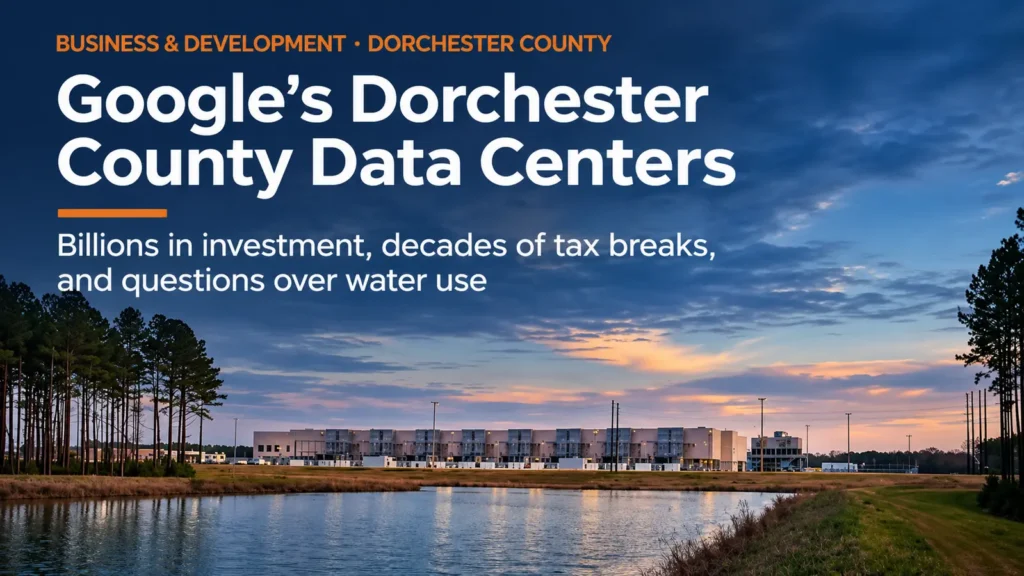
Two major Google data center projects are taking shape in Dorchester County, bringing billions in announced investment and the promise of new jobs. But long-term tax incentives, substantial water demands, and a legal fight over transparency have raised questions about what the county—and its residents—will receive in return.
Google lists Summerville among its South Carolina data center locations.
That's a detail that might surprise residents who associate the technology giant's Lowcountry operations primarily with its established campus near Moncks Corner.
But Google's presence in the region is expanding, and two major projects in Dorchester County are at the center of that growth.
The investment is substantial. So are the questions surrounding it.
County leaders have promoted the projects as an economic-development success, while critics have questioned the scale of the incentives and the secrecy surrounding projected water consumption.
One resident even took Dorchester County to court to obtain information about the water that a Google facility could use.
That lawsuit ended in a settlement in 2025—but the broader discussion over transparency, resources, and the long-term benefits of the projects is far from over.
Where Are Google's New Data Centers?
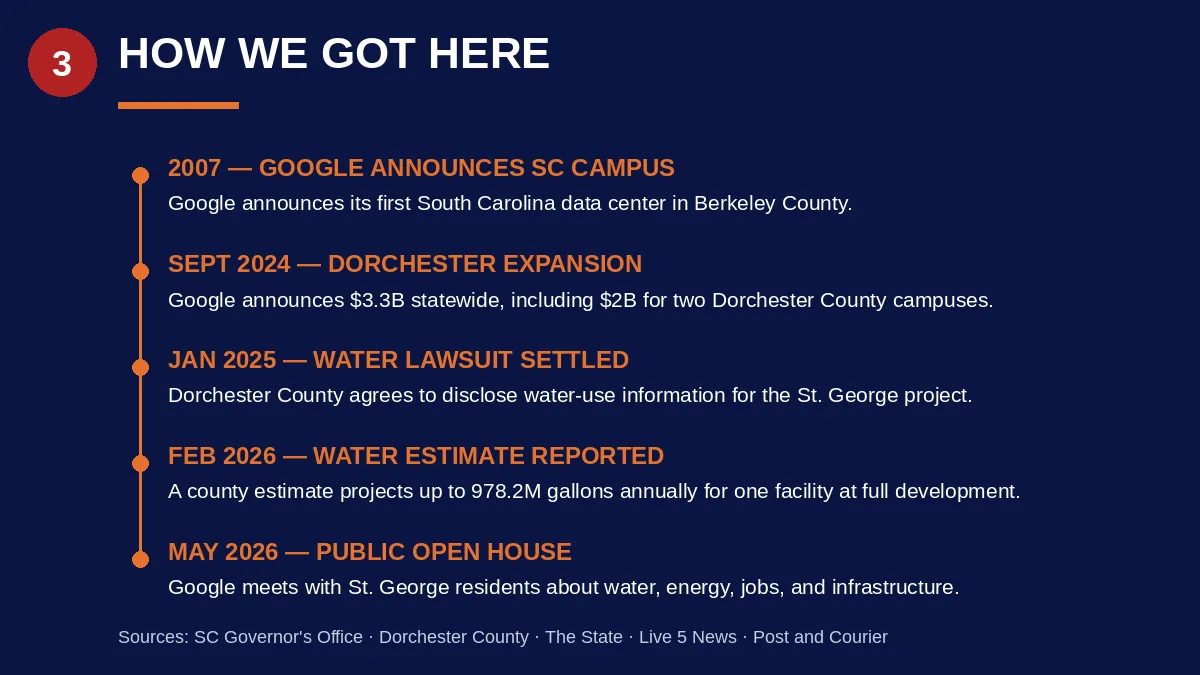
Google announced two new Dorchester County data center campuses on September 26, 2024.
The sites are located at:
- Pine Hill Business Campus in Ridgeville, west of Summerville.
- Winding Woods Commerce Park in St. George, farther northwest in Dorchester County.
Both facilities are intended to support growing demand for Google's digital services, cloud computing, and artificial intelligence infrastructure.
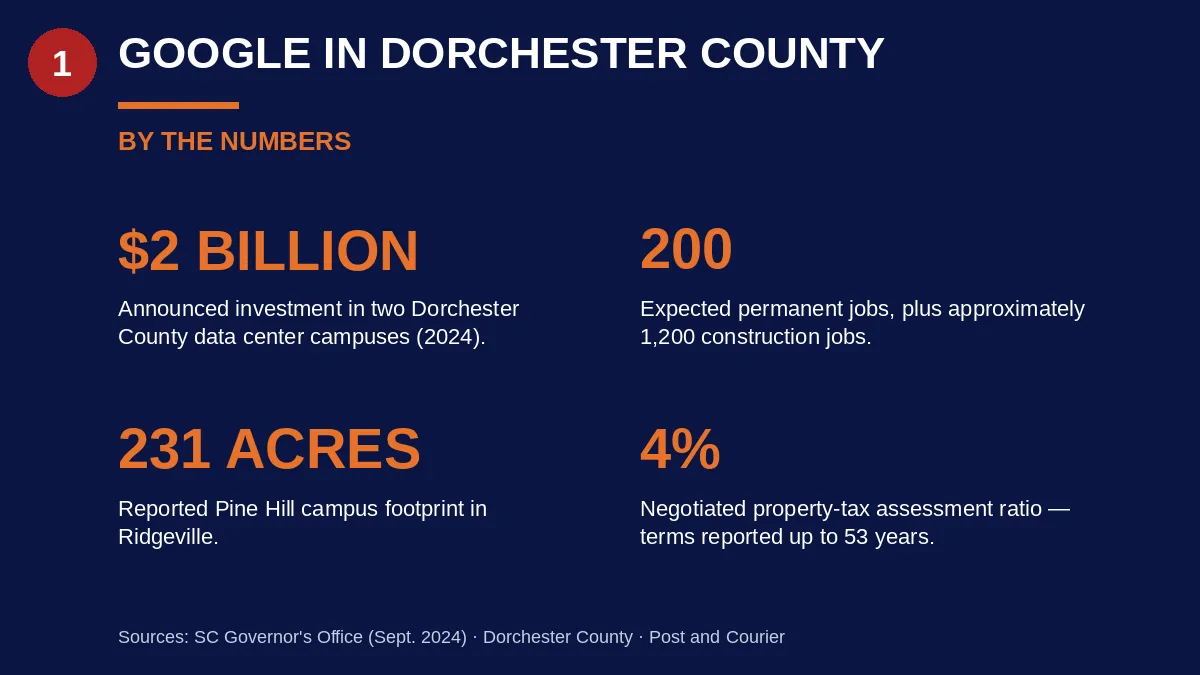
The original announcement included $3.3 billion in South Carolina investment, with $2 billion directed toward the two Dorchester County campuses and $1.3 billion toward expansion of Google's existing Berkeley County operations.
In October 2025, Google announced another $9 billion in statewide investment planned across 2026 and 2027. That larger amount covers South Carolina investments generally and should not be interpreted as money committed exclusively to Dorchester County.
Construction activity has been underway at the Dorchester County projects. During a May 2026 community meeting, Google representatives discussed their progress and plans for the campuses.
Although Google uses Summerville in its regional location descriptions, these developments are Dorchester County projects, not projects approved or incentivized by the Town of Summerville.
What Does Dorchester County Get in Return?
According to the state's original announcement, the two campuses are expected to generate 200 permanent operational jobs.
Dorchester County has also cited approximately 1,200 construction jobs associated with the projects.
Those are meaningful employment opportunities, particularly during construction, when large facilities require workers from numerous trades.
County officials also point to additional tax revenue, contracts for local businesses, and infrastructure improvements as potential benefits.
Data centers may generate significant taxable property value, although negotiated incentives affect how much tax revenue ultimately reaches local governments.
But the employment figures raise an understandable question:
How should a community measure the value of a multibillion-dollar investment when the number of permanent jobs is relatively small?
The answer depends on more than employment alone. Tax revenue, infrastructure costs, utility demand, and the terms of the agreements also matter.
And those agreements deserve a closer look.
What Incentives Did Google Receive?
Like many large economic-development projects, Google's expansion came with negotiated financial incentives.
Reporting on Dorchester County's agreements, particularly the Pine Hill project, identified several significant provisions.
Property-tax treatment lasting decades
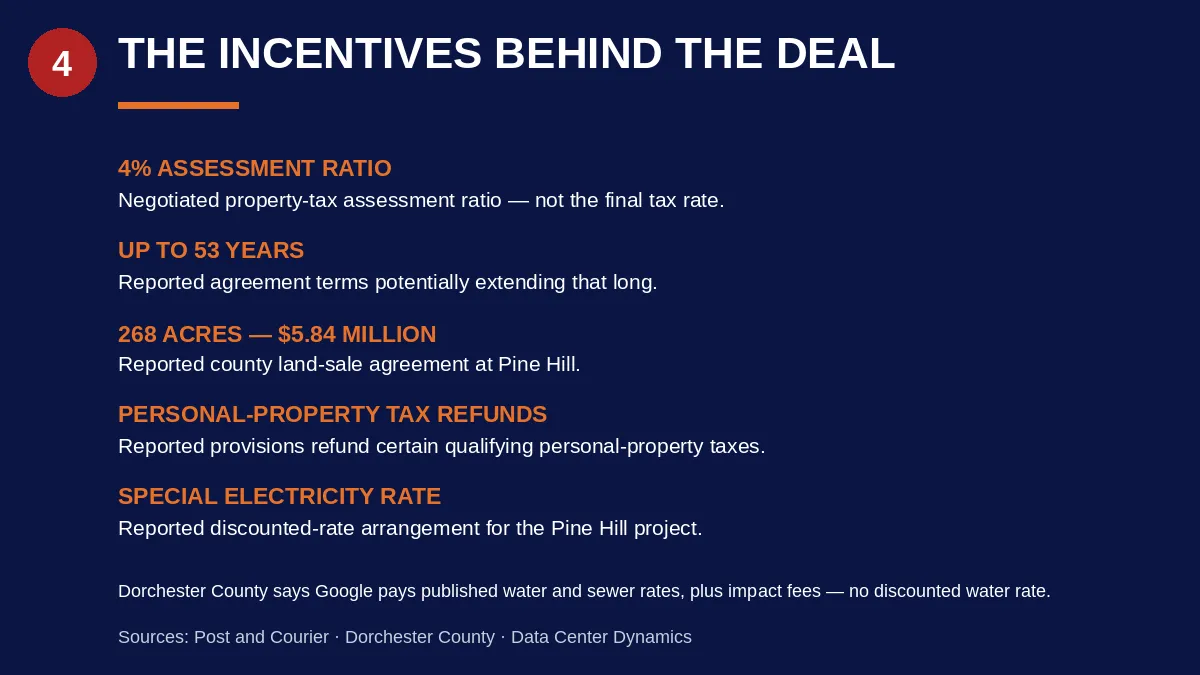
The agreements include a reduced 4% property-tax assessment ratio for qualifying property associated with the projects.
In South Carolina, an assessment ratio is used to determine the taxable assessed value of property before the applicable tax rate is applied. It does not mean the company pays a flat 4% property tax.
The arrangement was reported to last at least 40 years, with provisions allowing it to extend up to 53 years.
That's a commitment potentially spanning more than half a century.
Discounted county-owned property
Reporting also documented the county's agreement to sell approximately 268 acres at Pine Hill Business Campus for about $5.84 million.
The reported purchase price was roughly half the property's advertised asking price. The approximately 268 acres covered by the land agreement should not be confused with the separately reported 231-acre campus footprint.
Personal-property tax refunds
Reporting identified provisions for refunding certain qualifying personal-property taxes covered by the agreement.
These provisions can significantly change what a company ultimately pays compared with ordinary tax treatment.
Discounted electricity
Reporting identified a special electric-service rate arrangement with Dominion Energy South Carolina for the Pine Hill project, described as less than half the residential rate at the time. That comparison does not, by itself, establish who bears any difference in cost.
That electricity agreement is separate from the county's water and sewer charges.
To supporters, these incentives are tools for attracting major investment in a competitive national market.
To critics, they raise questions about how much public value is being exchanged for the investment—and whether the long-term benefits justify the concessions.
Then Came the Fight Over Water
Data centers house enormous quantities of computing equipment, and keeping that equipment at appropriate operating temperatures can require substantial amounts of electricity and water.
The amount depends on the facility's cooling systems, climate, operating conditions, and other design choices. Water withdrawn from a supply is not necessarily the same amount as water consumed after accounting for discharges.
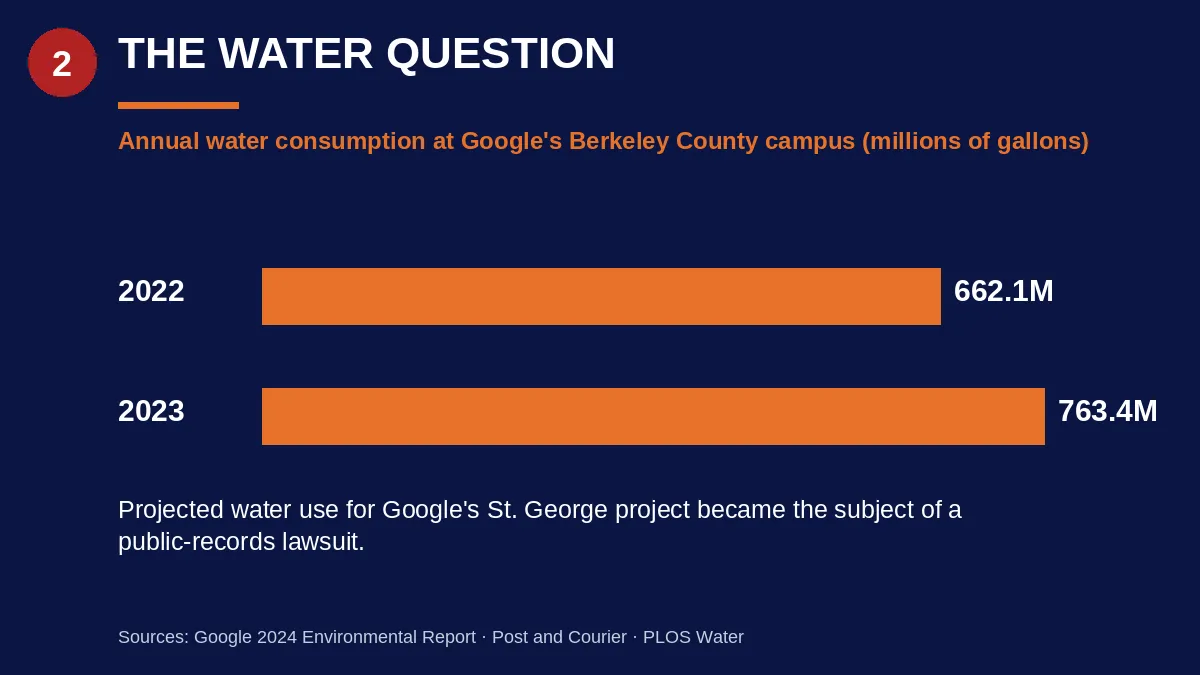
Google's established Moncks Corner campus has already demonstrated the potential scale of that demand. Google’s environmental reporting recorded 662.1 million gallons consumed in 2022 at its Berkeley County campus. Consumption rose to 763.4 million gallons in 2023. The company separately reported 847.2 million gallons withdrawn in 2023; withdrawal and consumption are different measurements.
Naturally, the arrival of two additional campuses prompted questions about their future water requirements.
But obtaining those figures became a legal dispute.
The agreement associated with Google's St. George project treated information about actual or projected water consumption as confidential.
A Mount Pleasant resident, Frank Heindel, sought the information through South Carolina's Freedom of Information Act.
When Dorchester County refused to release the requested records, Heindel filed a lawsuit in 2024 challenging the secrecy.
The dispute centered on whether projected water consumption could be withheld as confidential business information or a trade secret.
The case was settled in January 2025.
As part of the settlement, Dorchester County agreed to disclose Google's water-use information. Reporting on the agreement also described provisions for publishing St. George water figures and covering part of Heindel's legal expenses.
The settlement concerned the water-disclosure dispute associated with the St. George project. It did not automatically resolve every disclosure question involving Google's separate Pine Hill campus.
And an important distinction remains: an agreement to disclose information is not, by itself, proof that every required disclosure has subsequently been made.
How Much Water Could the New Facilities Use?
The question has become more concrete as additional estimates have surfaced.
In February 2026, The State reported that county estimates obtained the previous October indicated one of Google's two planned Dorchester County data centers could eventually use approximately 978.2 million gallons of water annually in its final development phase.
That's nearly a billion gallons in a year.
However, the figure is a projected future demand at full development, not a measurement of current consumption.
It also represents one facility, not a verified combined total for both new campuses.
That distinction matters when discussing the potential effects on the region's water systems.
There is also a difference between making projected demand available through records requests and routinely publishing ongoing consumption figures for public inspection.
Dorchester County's public fact sheet says Google will include annual site-level water usage in its environmental reporting once the facilities become operational.
The county's general fact sheet does not, however, establish whether every daily or monthly disclosure required under the 2025 settlement has been published.
What Does Dorchester County Say About Water Supply?
The county's explanation is an important part of the discussion.
According to Dorchester County's Data Center Fact Sheet, the projects will draw on regional water infrastructure, including systems connected to Lake Marion.
The county says the facilities will be built in phases, meaning water demand is also expected to increase in phases rather than all at once.
It also states that:
- Google pays the same published water and sewer rates as other customers, rather than receiving a special water-service discount.
- Google is responsible for applicable impact fees associated with infrastructure needed to serve the facilities.
- Water and sewer infrastructure improvements can also support other customers in surrounding communities.
- The county does not plan to drill new wells specifically dedicated to serving the data centers.
In the greater St. George area, the county says it increased its regional surface-water capacity allocation from 1.2 million to 3 million gallons per day and activated a 500,000-gallon storage tank.
County officials present those improvements as investments that can serve future residential and economic development beyond Google.
These details help explain why county leaders support the projects.
They also introduce a question worth following as the facilities develop: How will actual water consumption compare with projections, and how will those figures be communicated to residents?
Google Has Faced the Questions Directly
Concerns about the projects haven't been limited to lawsuits or government meetings.
In May 2026, Google hosted a public open house in St. George where residents could ask questions about water, energy, employment, infrastructure, and the company's plans.
Google representatives emphasized a commitment to transparency and community engagement.
The meeting offered residents an opportunity to hear directly from the company and discuss the developments.
But public meetings and ongoing disclosure are different things.
A presentation can explain a company's plans. Consistent public reporting allows residents to compare those plans with what ultimately happens.
Both have a role in maintaining public trust.
The Bigger Question: What's a Fair Deal for Dorchester County?
There are legitimate arguments on both sides of this debate.
Google's investment represents billions of dollars, hundreds of construction opportunities, permanent jobs, potential local contracts, and infrastructure that county leaders say will benefit the wider community.
Major technology infrastructure also supports services millions of people use every day.
At the same time, the projects involve long-term financial incentives, substantial electricity and water demand, and decisions that could shape the county for decades.
The water-disclosure lawsuit demonstrated why some residents believe access to information must be part of the conversation from the beginning—not something obtained only after a legal challenge.
And because these projects can operate for decades, evaluating their impact should not stop when construction is finished.
Residents should be able to understand how much revenue is generated, what public resources are committed, how utility demand develops, and whether the expected community benefits materialize.
Your Turn: What Do You Think?
Two billion dollars in announced Dorchester County investment. Two hundred expected permanent jobs. Major infrastructure commitments. Financial incentives that could extend for more than 50 years.
And a lawsuit that ended with an agreement to disclose information about the water one of the facilities could use.
Is this a fair long-term deal for Dorchester County?
Are the investment, employment opportunities, and infrastructure benefits worth the incentives offered?
Or should residents have had greater access to the financial and environmental details before those agreements were approved?
We'd like to hear your perspective.
Sources and Further Reading
- South Carolina Governor's Office — Google announces new Dorchester County operations (September 26, 2024)
- Dorchester County — Official Data Center Fact Sheet
- Dorchester County Economic Development — Google's expanded statewide investment (October 13, 2025)
- The Post and Courier — Reporting on data center financial incentives
- PLOS Water — Research discussing water disclosure and the Dorchester County lawsuit (January 2026)
- The State — South Carolina data center water-demand reporting (February 2026)
- Live 5 News — Google holds St. George public open house (May 2026)
- Google — South Carolina Data Centers
- Google — 2023 Environmental Report (2022 water figures)
- Google — 2024 Environmental Report (2023 water figures)