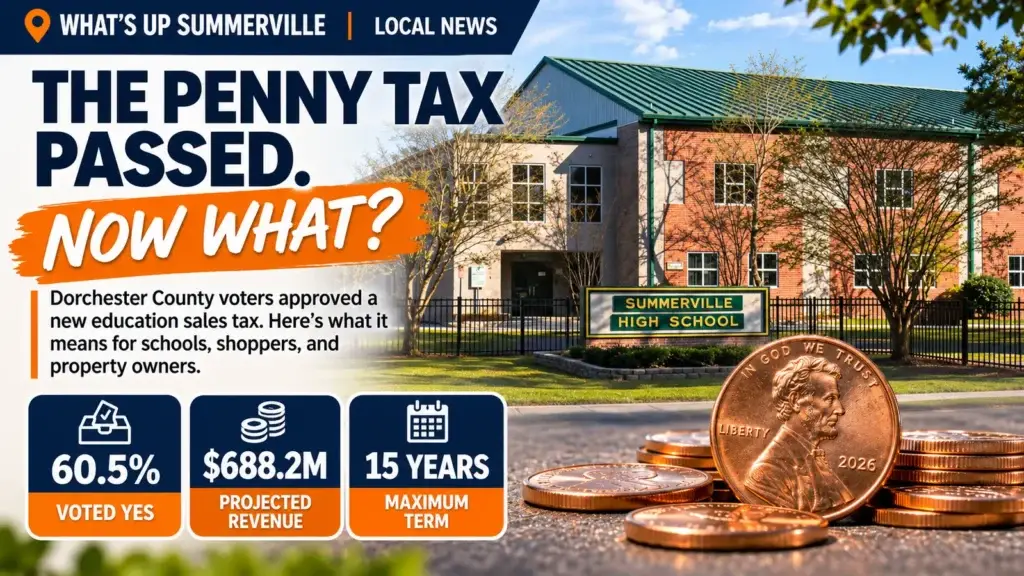
The November 3 referendum authorizes an additional penny in sales tax on eligible purchases to fund new schools, renovations, and debt-service property tax relief across Dorchester County.
Dorchester County voters have approved a new 1-cent sales tax to help pay for school construction and improvements across the county.
In the November 3 general election, voters supported the Education Capital Improvements Sales and Use Tax by a margin of 35,676 to 23,297, according to the county’s November 5 unofficial results report.
That represents 60.50% voting yes and 39.50% voting no — a decisive majority, though nearly four in ten voters opposed the measure.
Vote counts are unofficial. Revenue is a projection, not guaranteed collections.
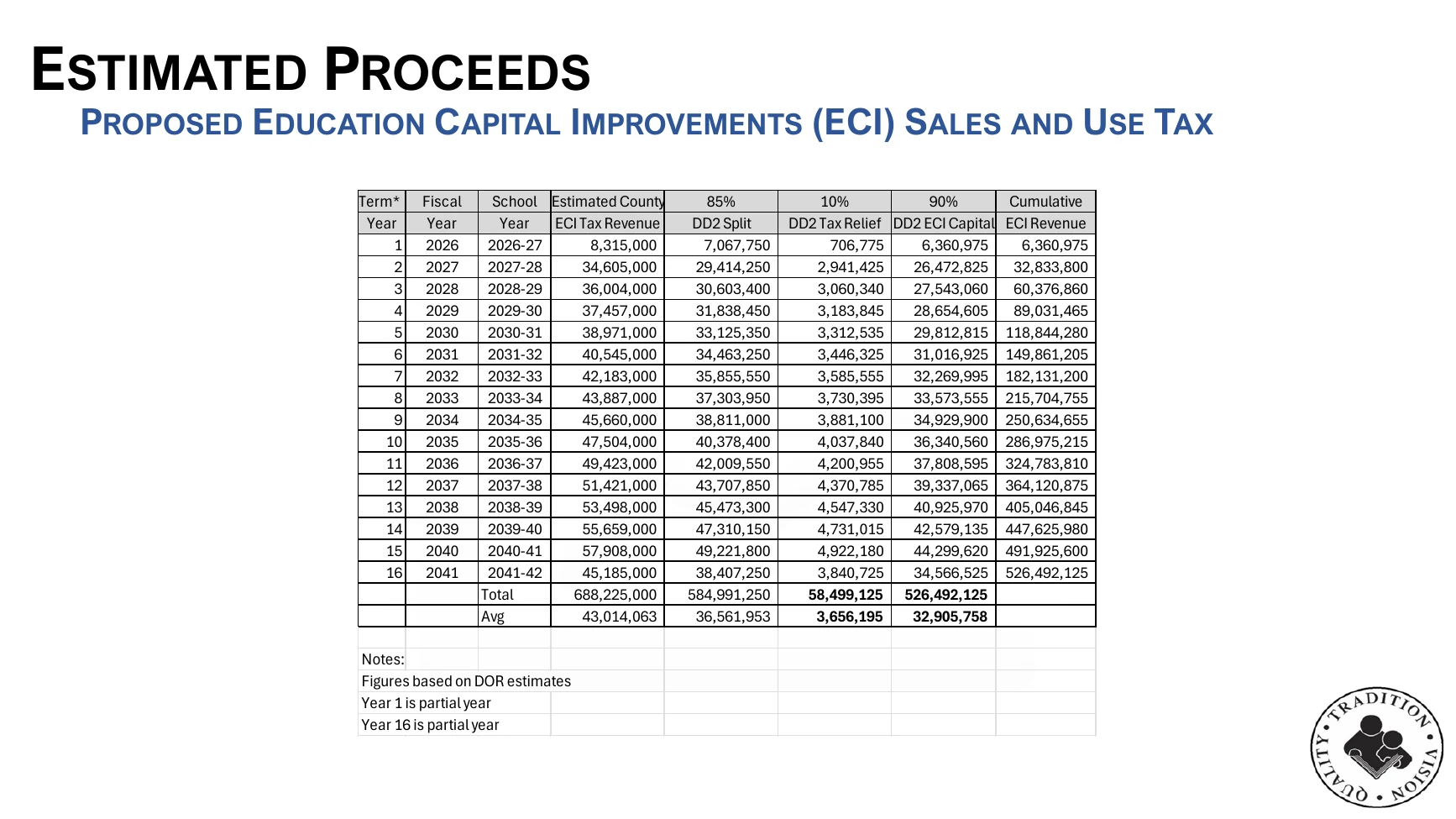
The tax is scheduled to take effect April 1, 2027, and may remain in place for up to 15 years. The South Carolina Revenue and Fiscal Affairs Office projects approximately $688.2 million in revenue over that period for Dorchester School Districts Two and Four.
For residents, the decision raises several practical questions: How much more will shopping cost? Which schools will benefit? How does the promised property tax relief work? And when will construction begin?
Here’s what we know.
What Exactly Did Voters Approve?
The referendum authorizes an additional 1% sales and use tax on eligible purchases made in Dorchester County. In simple terms, that means an additional penny for every dollar spent on a taxable purchase.
A $100 purchase subject to the new tax would cost an additional $1.
The county’s general combined sales tax rate, currently 7%, is expected to increase to 8% when the education tax begins. Actual rates may vary by municipality and other applicable local taxes.
The revenue is designated for education capital improvements — construction, renovations, equipment, and other approved long-term infrastructure needs. It cannot be used for ordinary school operating expenses such as teacher salaries or routine instructional supplies.
The measure has a maximum duration of 15 years rather than establishing a permanent tax. Berkeley and Charleston counties already use education sales taxes to fund school capital projects.
How Much Will It Cost the Average Household?
Dorchester School District Two estimates the new tax will cost a typical county family approximately $143 per year. The estimate is based on IRS sales tax tables and a household earning the county’s cited median annual income of $78,000.
That $143 figure is an estimate, not a fixed charge. What a household actually pays depends on how much it spends on purchases subject to the tax.
What Won’t Be Taxed?
The added education tax does not apply to every purchase. Unprepared groceries are exempt, and that exemption is not limited to people receiving food assistance. Other purchases may be exempt or subject to separate tax treatment under South Carolina law, including certain medical purchases.
The distinction matters: one household’s additional sales tax expense may look different from another’s because their taxable spending differs.
Visitors Will Help Pay, Too
One argument made in favor of the measure was that revenue would also come from people who shop in Dorchester County but live elsewhere. Anyone making an eligible taxable purchase contributes to the revenue regardless of their home county.
Supporters described that broader collection base as an advantage over relying entirely on local property owners to fund school construction.
Where Will the $688 Million Go?
The referendum establishes a specific split of revenue between Dorchester County’s two public school districts.
| School District | Share | Projected 15-Year Revenue |
|---|---|---|
| Dorchester District Two | 85% | Approximately $585 million |
| Dorchester District Four | 15% | Approximately $103 million |
The ballot further directs how each district must use its share: 90% for the approved capital improvement projects and 10% for property tax relief through reduced debt-service millage.
The 10% portion is intended to reduce the property tax levy needed to repay certain school district bonds. It is not a direct rebate or a guarantee that every homeowner saves the same dollar amount. The actual effect depends on district debt obligations, millage, and individual property circumstances.
Dorchester District Two: New Schools and Major Renovations
Dorchester School District Two serves much of the growing Summerville area, where ongoing residential development has increased pressure on school facilities. The district’s share would support both new construction and improvements to existing campuses.
New Schools in Growing Areas
One of the largest components is construction of a new school or schools in the district’s southern and northwestern areas, generally around Highway 61 and Delemar Highway (SC-165).
These areas include growing communities such as Summers Corner, Watson Hill, and Homecoming. District officials have cited the potential for thousands of additional homes in the broader corridor, increasing the need to plan for future classroom capacity.
Improvements at All Three High Schools
The approved list includes improvements at Summerville High School, Fort Dorchester High School, and Ashley Ridge High School. The authorized work spans academic buildings, fine arts, outdoor athletic facilities, and career and technical education programs.
The scope goes beyond cosmetic updates: the ballot provides for construction, renovation, expansion, and equipment work responsive to campus needs.
Middle Schools and Districtwide Maintenance
Alston, Dubose, and Gregg middle schools are also included in the approved project list.
Other districtwide needs include roofs, HVAC systems, flooring, lighting, playgrounds, technology, furniture, equipment, and school bus replacements — including general education, special education, and activity transportation.
- New school or schools in growth areas around Highway 61 and SC-165
- Renovations and improvements at all three high schools
- Work at Alston, Dubose, and Gregg middle schools
- Districtwide facility systems, equipment, technology, and buses
What District Two Was Considering Before the Vote
An October 26, 2026, Dorchester School District Two Finance Committee presentation offers an early look at how the district was considering implementing its share. Importantly, these were potential allocations and financial scenarios presented before voters approved the tax — not an adopted post-election construction budget.
The committee presentation sketched out about $350 million for deferred operations-and-maintenance capital needs, $75 million for other maintenance and capital needs, and $100 million for new school construction in the Delmar Highway area. The figures were planning estimates, not individual school construction awards.
The district’s presentation emphasized establishing a comprehensive registry of facility needs — including roofing, HVAC, drainage, inspections, and anticipated future maintenance — and moving toward a 15-year capital program. Its stated aim was to shift from reacting to problems as they arise toward more proactive maintenance of existing school assets.
That adds important context to the ballot’s long list of eligible projects. The list authorizes potential uses of revenue; it does not mean each school already has a final allocation, schedule, or guaranteed completion date.
The capital-priority figures total approximately $525 million, close to the district’s projected $526.5 million for capital work after allocating 10% of District Two’s share to tax relief. They should not be interpreted as a final line-item budget.
Property Tax Relief: Two Very Different Models
The presentation also compared two ways the district might implement the required property-tax relief. Under one model, District Two would preserve more debt-service revenue and future borrowing flexibility. Under the other, it would maximize yearly debt-service millage reductions and rely more heavily on paying for maintenance capital needs as revenue arrives.
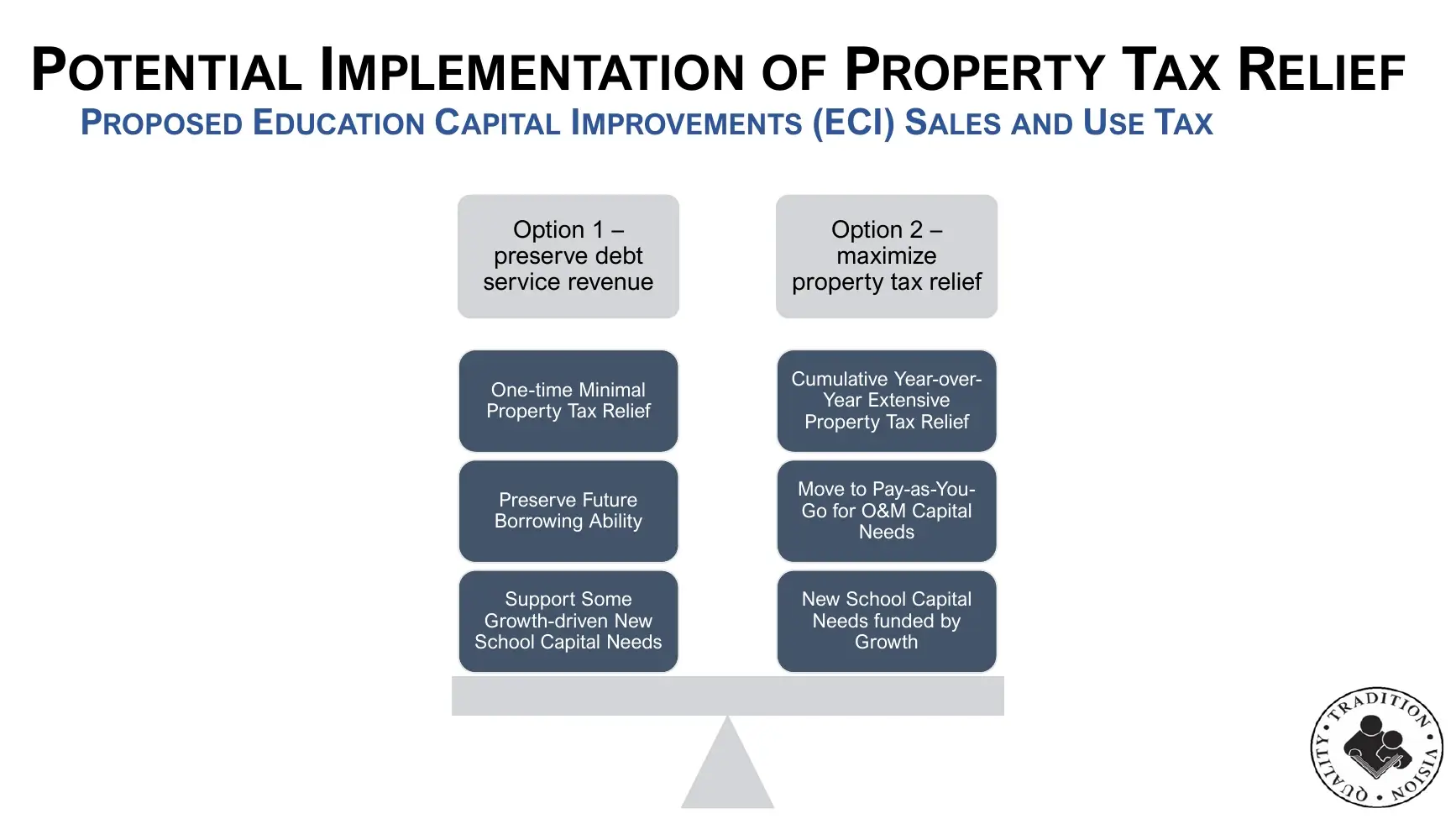
The models started from a 65-mill debt-service rate. The preserve-revenue scenario illustrated a rate near 61.36 mills later in the period; the maximize-relief scenario illustrated a decline to about 10.46 mills by fiscal year 2041–42. Those are modeled illustrations, not announced rates or guaranteed savings.
This matters because two strategies can both satisfy the voter-approved 10% tax-relief requirement while producing very different year-by-year patterns in property-tax millage and school debt financing. The district will need to explain its eventual approach publicly.
One detail worth noting: the presentation’s primary proceeds schedule projects $688.225 million countywide, while the two hypothetical millage-model spreadsheets use $691.678 million. They also differ in some annual inputs. This article uses the primary $688.2 million projection rather than conflating the separate models.
The schedule also lists 16 fiscal years because the tax period is shown across partial fiscal years at the beginning and end; this is not a proposal to collect the tax for 16 full years.
Source: Dorchester School District Two Finance Committee presentation, October 26, 2026 (pages 4–8).
Dorchester District Four: Replacing Schools and Expanding Programs
District Four serves communities including St. George, Ridgeville, and Harleyville. Although it receives the smaller share of the countywide proceeds, its approved list includes major construction needs.
A Replacement School in Ridgeville
The district proposes a new combined elementary and middle school in Ridgeville to replace the existing school, addressing aging facilities while preparing for residential growth.
A New Elementary School in St. George
The approved list also includes a replacement elementary school in the St. George area. Together, the Ridgeville and St. George projects represent major investments in District Four’s existing educational infrastructure.
Woodland High School and Other Facilities
Woodland High School is slated for instructional additions and facility upgrades, along with a new athletic fieldhouse. Pre-election reporting identified potential career and technical education uses, including nursing, media technology, and JROTC.
The ballot also includes classroom modifications and temporary portable facilities at Clay Hill Elementary, improvements at Harleyville Elementary, and changes to district office space for career and technical programming.
Will District Four Receive Enough?
That remains an important question. Before the election, District Four’s superintendent acknowledged that the district’s estimated share would not fully cover all of its major construction needs.
District Four is projected to receive roughly $103 million over the tax’s life. After the required 10% property tax relief allocation, approximately $93 million would remain for capital projects.
Voter approval adds a funding source, but it does not guarantee that every approved project can be completed within the estimated budget. Project priorities, construction costs, and any additional funding will matter.
- New combined elementary/middle school in Ridgeville
- New elementary school in St. George
- Instructional additions and fieldhouse at Woodland High School
- Clay Hill, Harleyville, and district office improvements
Why Some Voters Opposed the Tax
Although the measure passed with a clear majority, more than 23,000 voters rejected it. Their concerns are part of the story, too.
Supporters emphasized the need for school facilities in growth areas, improvements to aging campuses, and a way to collect construction revenue from visitors as well as residents.
Skeptical residents raised questions about adding costs for households already facing higher expenses, particularly people on fixed incomes. Others argued that developers building new housing should bear more of the cost of additional schools, or questioned how existing education funding is allocated.
Those viewpoints came from public discussion and should not be treated as a single organized opposition position. The vote determined whether the county could levy the tax; it did not end disagreements about how best to fund school infrastructure.
What Happens Now?
With the measure approved, the next stage shifts from campaigning to implementation. The vote counts cited here are from unofficial results and remain subject to certification.
Under the authorizing timetable, collection is scheduled to begin April 1, 2027, following certification in accordance with state law.
The districts must then translate the approved lists into budgets, project priorities, design and procurement work, and eventually construction schedules.
Which School Will Be Built First?
That is one of the biggest remaining questions. The referendum identifies eligible projects but does not provide a confirmed groundbreaking sequence or comprehensive construction timetable.
District Two will have to balance growth-driven expansion with needs at existing schools. District Four will have to prioritize major replacement and expansion projects within a smaller allocation.
Construction costs, enrollment patterns, and actual tax receipts will all affect the pace and scope of the work.
What Residents Should Watch
As school leaders move into implementation, a few public accountability questions deserve continued attention. In District Two, these now include the choices laid out in the October 26 Finance Committee presentation:
- Project priorities: Which schools and renovations get funding first?
- Construction schedules: When will planning, bidding, groundbreaking, and completion take place?
- Budget accountability: How do actual costs compare with initial projections?
- Revenue collections: Does the tax generate the amounts projected over time?
- Property tax relief: Which modeled approach, if either, does District Two adopt, and how will it affect millage and borrowing?
- Unfunded needs: How will districts handle costs or projects beyond the available revenue?
These answers should become clearer as the districts publish implementation plans and report on revenue and expenditures.
The Bottom Line
Dorchester County voters have authorized a significant new funding source for school construction and improvements. Starting April 1, 2027, the 1-cent education sales tax is projected to generate about $688 million over as many as 15 years.
The money is divided between Districts Two and Four, with most proceeds dedicated to capital projects and a portion required for debt-service property tax relief. For shoppers, it will be another consideration in taxable spending. For the districts, it creates an opportunity to address population growth and aging buildings.
The vote answered whether Dorchester County would raise the money. The next question is how quickly — and how effectively — that money becomes new and improved schools.
That is the story we’ll be watching — especially which District Two capital priorities move from early financial modeling to actual board-approved projects and timelines.
What’s Up Summerville will continue following the referendum’s implementation, construction priorities, and school district updates as more information becomes available.
Election figures are from Dorchester County’s November 5, 2026, unofficial results report. Revenue and household cost projections are estimates, not guaranteed collections. Referendum uses are set out in the ballot; District Two planning concepts are from the October 26 Finance Committee presentation and are not final adopted spending decisions.
Support Local • Love Summerville