
🔴 🔴 🔴 DID YOU KNOW? · SOUTH CAROLINA HISTORY
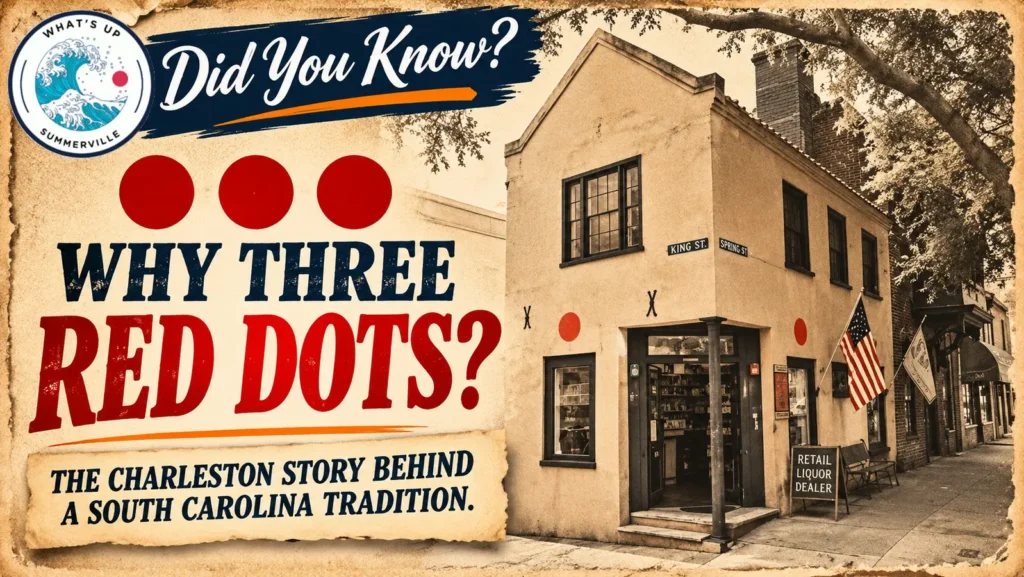
Why do so many liquor stores around Summerville display three bright red dots? The answer goes back to a clever Charleston sign painter, South Carolina’s strict post-Prohibition advertising rules, and a symbol lawmakers once tried to ban.
You’ve probably seen them on storefronts and roadside signs around Summerville: three unmistakable red circles. For longtime South Carolinians, they’re almost invisible in their familiarity. For newcomers, they can be downright puzzling.
They aren’t a code for a particular brand, a rating system, or a sign that a store offers three different kinds of alcohol. They’re the legacy of an advertising workaround that became one of South Carolina’s most recognizable visual traditions.
The short answer
It started with ONE red dot
In 1945, a Charleston sign painter reportedly drew a bright red circle around the tiny lettering that state rules allowed on a liquor-store sign. The original single circle eventually evolved into the familiar three-dot look seen at many stores today.
A liquor store that could barely advertise
South Carolina permitted private retail liquor sales to resume in 1935, but legalization did not end the fight over alcohol. Supporters of tighter restrictions wanted liquor shops to keep a low profile, while retailers still needed customers to find them.
In 1938, state officials restricted storefront identification to a discreet sign. By 1945, the advertising rules had become even tighter. Retailers were limited to small lettering identifying them as a “Retail Liquor Dealer,” along with prescribed dealer information. Neon advertising, price promotions, and bottles displayed in front windows were restricted.
A business could legally sell liquor, but conspicuous promotion was another matter. This created a practical problem: how could passing motorists recognize the store if its permitted sign was so difficult to see?
A Charleston sign painter has an idea
The best-documented origin story leads to the corner of King and Spring streets in Charleston in July 1945. Liquor dealer Jesse J. Fabian hired longtime sign painter C. A. “Doc” Wansley to letter one of his storefronts within the rules.
According to a story reported in the Charleston News & Courier in 1951 and later traced by food-and-drink historian Robert F. Moss, Wansley found the tiny prescribed lettering hard to notice. He reportedly took inspiration from the bold red circle on a Lucky Strike cigarette package and painted a prominent red circle behind the lettering.
It was simple, bright, memorable—and more visible than the required words alone.
A local history connection
King & Spring streets, Charleston
The red-dot origin is associated with a Charleston storefront, not an unidentified nationwide liquor-store chain. That makes this familiar symbol part of Lowcountry history, even though it later spread across South Carolina.
How one red dot became three
The circle caught on. Other retailers adopted red dots on signs and buildings, and the practice spread across the state. By 1949, examples had appeared even in northwestern South Carolina. An Associated Press story in 1951 described the symbol as already widespread.
The first documented dot was a single circle. Over the years, one, two, and—most famously—three red dots in a row became common ways of identifying liquor stores. Historical accounts do not establish a special official meaning for the number three.
So while people tend to call them “the three red dots,” the origin story is about an eye-catching visual shorthand, not a three-part message.
The state tried to ban the symbol
By 1968, South Carolina’s Alcoholic Beverage Control authorities had decided that the dots themselves amounted to prohibited advertising. The agency moved to outlaw the very symbol that generations of residents had come to recognize.
But legislators responded by protecting the red dot. Later rules spelled out how the circles could be displayed. A version of the state liquor law archived in the 2001 South Carolina Code explicitly allowed red dots up to 36 inches in diameter on the front, rear, and sides of a store.
The important distinction: those historical dimensions describe rules in effect at the time, not necessarily today’s complete sign requirements. Advertising regulations have changed over the decades, while the custom has remained.
The red-dot timeline
- 1935: Private retail liquor sales resume in South Carolina after the Prohibition era.
- 1938–1945: Strict limits on signs and storefront advertising make liquor retailers difficult to identify.
- July 1945: A red circle is reportedly painted at Jesse J. Fabian’s Charleston shop by sign painter Doc Wansley.
- By 1951: Red dots have spread widely enough to attract newspaper attention.
- 1968: Alcohol regulators attempt to prohibit red dots; lawmakers move to preserve them.
- 1976: Rules more clearly describe permitted dot placement and size.
- Today: Red dots remain an unmistakable piece of the state’s streetscape.
Why do they still appear everywhere?
Even after the original advertising restrictions were relaxed, there was little reason for liquor-store owners to abandon a symbol customers already understood. The red dots had effectively become a recognizable South Carolina convention.
Their endurance is an example of a workaround becoming a tradition. What began as an attempt to make a tiny sign visible turned into an unofficial symbol for an entire category of storefronts.
It also explains why travelers from other states may be confused: three large red circles on a storefront are not a universal way of advertising liquor sales. They are a particularly South Carolina visual cue.
A small piece of Lowcountry history hiding in plain sight
The next time you drive past three red dots in Summerville, look at them a little differently. They point back to an era when liquor could be sold in South Carolina, but almost could not be advertised—and to a Charleston sign painter who found a memorable solution.
Nearly everyone recognizes the dots. Far fewer know that the whole thing reportedly began with one.
Let’s hear from Summerville
Did you know the story?
Were the red dots one of the first things you noticed when you moved to South Carolina? Or did you grow up seeing them without ever wondering why? Tell us in the comments.
Sources & further reading
Historical attribution: The Charleston origin story was traced in newspaper reporting from 1951 and has been documented by the South Carolina Encyclopedia and later historical research. The present-day configuration of three dots evolved from the original single-circle idea.