Every business has a story.
The problem is that a lot of those stories get polished so much that they stop sounding like stories at all.
What starts as:
“We started this business because…”
turns into:
“We’re committed to providing exceptional service, unmatched quality, and solutions tailored to our customers’ needs.”
And just like that, the interesting part disappears.
People usually connect more with why the business exists, who is behind it, and what happened along the way than they do with a polished list of reasons they should buy from you.
Tell People What Actually Happened
Your business story does not need to sound impressive.
It needs to sound real.
Maybe you noticed something was missing locally.
Maybe a hobby turned into a side business.
Maybe friends kept asking where they could buy something you made.
Maybe you spent years working in an industry before deciding to build something of your own.
Maybe you inherited a family business and are now putting your own stamp on it.
Those details are usually more memorable than the cleaned-up version businesses think they are supposed to tell.
Instead of trying to make your story sound bigger, make it more specific.
Your Story Is More Than Your Origin Story
You also do not have to keep telling the same “how we started” story over and over.
Your business story keeps happening.
It can be:
- why you added a new service
- how you developed a particular product
- why you chose your location
- what you learned from your first year
- a behind-the-scenes look at how something gets made
- a milestone that actually meant something to you
- a customer interaction that changed how you do business
Those are all pieces of the larger story people build in their minds about your business.
That gives you a lot more to talk about than repeatedly posting, “Here’s what we sell.”
Lead With the Person, Not the Product
A lot of business storytelling goes wrong because the product becomes the main character.
“We make custom signs.”
“We provide landscaping services.”
“We sell handmade candles.”
Those statements tell people what you do.
They do not give people much reason to remember you.
Now compare that with:
“I started making signs in my garage after friends kept asking where I bought the ones I had made for my own house.”
Same business.
But now there is a person, a reason, and a beginning.
The product still gets mentioned. It just is not carrying the entire story.
Give the Reader Something Specific
Details are what make a business story believable.
Your first customer.
The market where you started selling.
The old equipment you used before you could afford something better.
The family member who helped pack orders.
The tiny storefront before the bigger one.
The mistake that made you change the way you do something.
Businesses often remove those details because they do not feel polished enough.
Those may be the exact details people remember.
Compare:
“We started small and have grown thanks to the support of our community.”
with:
“Our first setup was one folding table, two signs, and enough inventory to fit in the back of the car.”
The second one gives people something they can actually picture.
Keep the Story Focused
A business story does not need to include everything.
Pick one point and build around it.
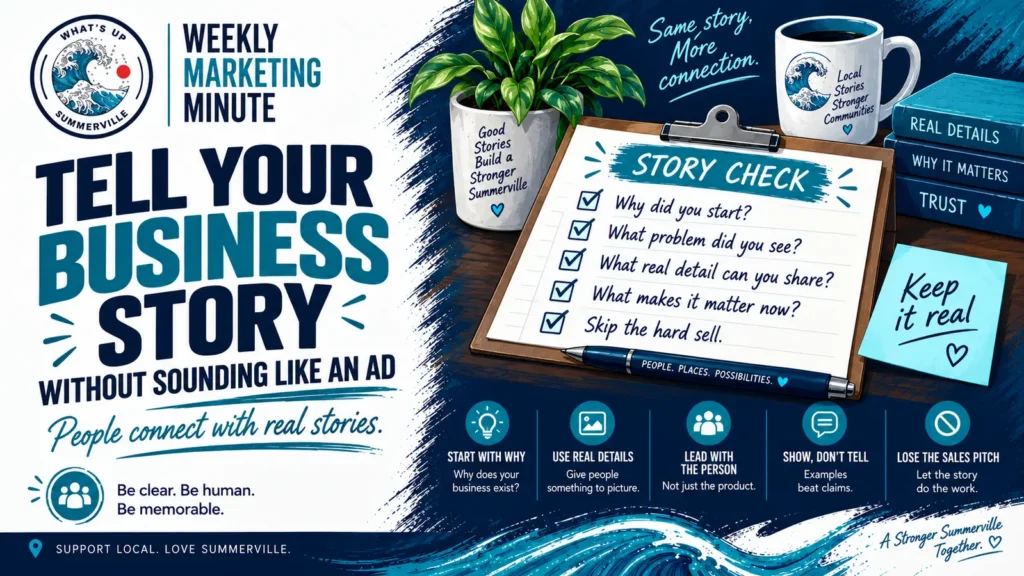
A simple structure is:
What was happening?
Give the reader enough context to understand the situation.
What changed?
What made you start, adjust, build, create, or try something different?
Why does it matter now?
Connect that story to the business people see today.
That is usually enough.
You are not writing the company autobiography.
Show, Don’t Announce
Businesses sometimes tell people how they want to be perceived instead of showing them why.
“We care about our customers.”
“We believe in supporting the community.”
“We take pride in quality.”
Those things may absolutely be true, but they become much stronger when there is an example behind them.
Instead of saying you care about customer service, tell the story of the unusual request you helped solve.
Instead of saying you support local, show the local organization you partnered with or the business you regularly source from.
Instead of saying quality matters, show part of the process that customers normally do not see.
Specific examples do more work than claims.
Don’t Turn the Ending Into a Commercial
You can tell a great story and lose people in the last two sentences.
Everything sounds natural until suddenly:
“Ready to experience the difference? Contact us today!”
You do not always need that.
A story can simply end.
You can thank the people who helped you get there.
You can talk about what you are excited about next.
You can invite people to stop by.
You can ask people if they remember an earlier version of the business.
Or you can leave the story alone and let it do its job.
Not every post has to close the sale.
Sometimes the goal is simply to help someone know your business a little better than they did before.
Remember Who You’re Talking To
You are not writing an “About Us” section for a corporate brochure.
You are talking to another person.
Your business story should sound closer to how you would tell it across a table than how you would present it in a boardroom.
Use normal language.
Skip the buzzwords.
Leave out the sentences you would never actually say out loud.
And tell the part of the story you genuinely enjoy telling.
That is usually where the strongest material is.
The Marketing Minute
Before you post a business story, ask yourself three questions:
Does this sound like something I would actually say to a customer?
Did I give them something specific enough to remember?
Would the story still be worth reading if I removed the sales pitch at the end?
If the answer is yes, you are probably on the right track.
There is nothing wrong with advertising.
Businesses need to sell.
But storytelling serves a different purpose.
It helps people understand who you are, why the business exists, and what makes it worth remembering.
And sometimes that connection does more for your marketing than another sales pitch ever could.
Support Local • Love Summerville.