
What’s Hiding in Plain Sight Around Summerville?
You can walk through downtown Summerville a hundred times and still miss some of the details hiding right in front of you.
We tend to notice the restaurants, storefronts, traffic, events, and whatever destination brought us downtown in the first place. But look a little closer and there are pieces of Summerville’s story tucked onto rooftops, built into sidewalks, hidden inside familiar buildings, and standing beside places most of us pass every week.
So for this week’s Explore Summerville, we’re not giving you another list of places to eat or things to do.
We’re asking you to look closer.
1. There Are Birds Watching You Downtown
No, not those birds.
Scattered throughout downtown Summerville is a collection of life-sized bird sculptures that are surprisingly easy to walk right past.
The B.I.R.D.S. — Birds In Residence: Downtown Summerville — collection includes bronze sculptures perched on balconies, windowsills, signs, rooftops, and other unexpected spots throughout the historic district.
Some are relatively easy to find. Others require you to stop looking straight ahead and start looking up.
That’s part of the fun.
Next time you’re downtown, see how many you can spot without pulling out a map first.
2. Hutchinson Square Is Quietly Referencing Summerville’s Past
The pavilion and entrance sign at Hutchinson Square may feel like they’ve simply become part of downtown, but their designs weren’t chosen randomly.
The Town of Summerville says the pavilion was inspired by the historic railroad depot that once stood near the square in the early 1900s.
The large entrance sign at Main Street and Doty Avenue also takes inspiration from an old archway that once stretched across Main Street.
So even though today’s square is the result of a modern revitalization project, pieces of older Summerville were deliberately worked into what replaced it.
You may have stood underneath them dozens of times without realizing it.
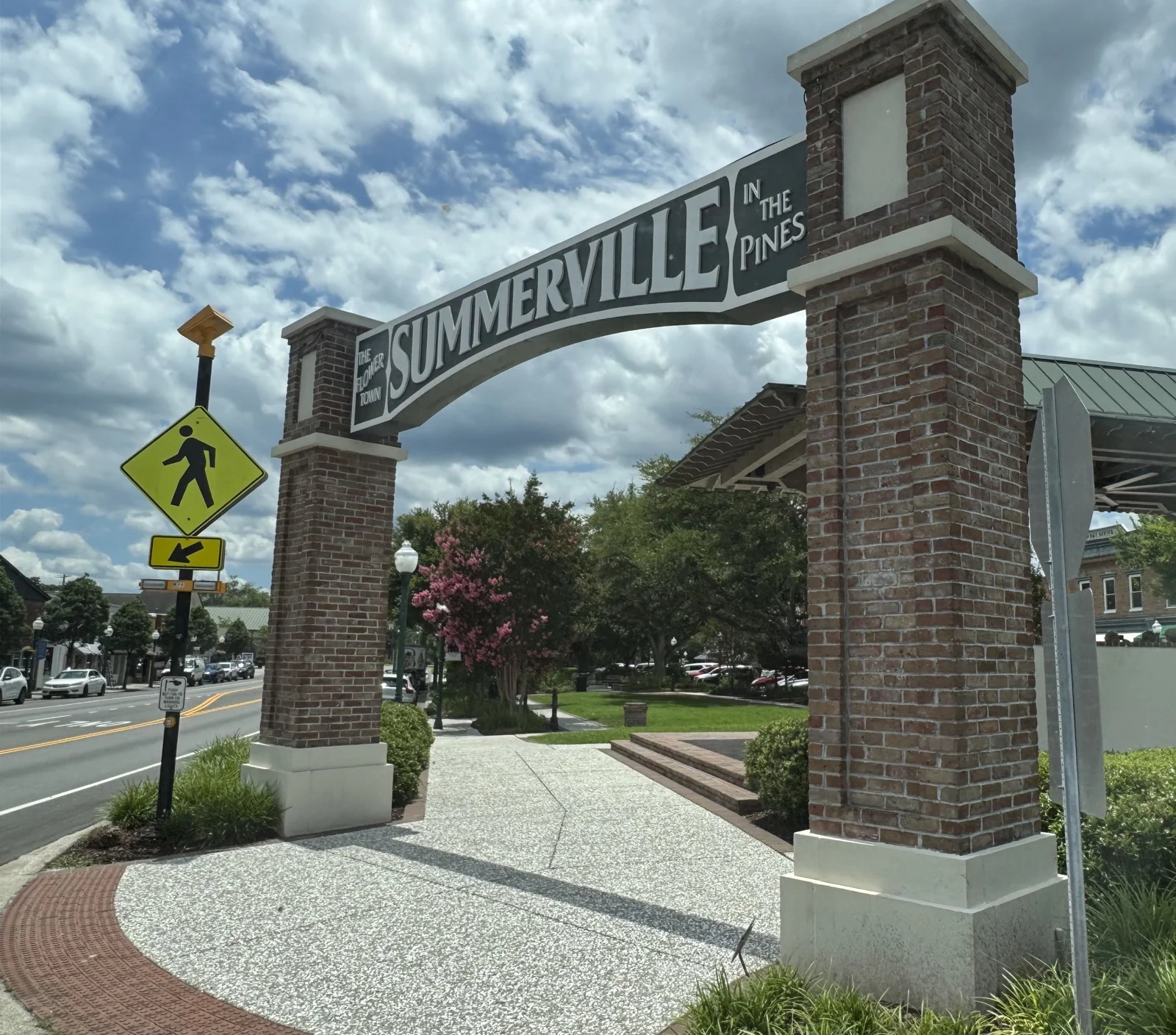
The gateway at Hutchinson Square echoes an earlier Summerville entrance arch. Photo: Thunder60447, Wikimedia Commons, CC BY 4.0. Resized and converted to WEBP.
3. The Summerville Museum Wasn’t Built to Be a Museum
The Summerville Museum and Research Center on East Doty Avenue has had several lives.
Between 1923 and 1928, the Town built a Water Department on the property. The site included a roughly 100-foot steel water tower and a 300,000-gallon water cistern.
The building was later expanded and became the Summerville Police Department in 1976 before eventually becoming the museum we know today.
And here’s the part to look for: the museum says the brick facade of the original one-story Water Department building can still be seen inside the museum lobby.
It’s literally an older building hiding inside the building you’re standing in.
4. You’re Walking on a Piece of Short Central’s Past
Short Central is one of the most recognizable little stretches of downtown Summerville today — outdoor tables, shops, events, and a pedestrian-friendly connection right off the heart of town.
But take a second to look down.
The brick paving itself has a story.
According to the South Carolina Picture Project, bricks dating to the 1920s were uncovered during a paving project in 2001. Their discovery helped lead to the decision to create the pedestrian area that exists there today.
In other words, part of what gives Short Central its character isn’t a modern attempt to make the street look historic.
The history was already underneath it.
5. That Theatre on Main Street Started as a Movie House
Plenty of people know the James F. Dean Theatre as the home of the Flowertown Players.
But the building’s theatrical history started with a different kind of screen.
It was built in 1935 by Carolina Films, Incorporated and operated as a movie theatre for decades, showing films until the mid-1970s as single-screen theatres began falling out of favor.
Flowertown Players was established in 1976, and after years of performances, moves, renovations, and restoration, live theatre eventually returned to the Main Street building.
So when you walk past the theatre today, you’re looking at a building that has been entertaining Summerville in one form or another for generations.
6. Timrod Library Isn’t Quite Like a Normal Library
You could easily pass the Timrod Library on Central Avenue and assume it’s simply another historic building downtown.
It’s much more unusual than that.
The Timrod is a membership library and describes itself as one of only two membership libraries still operating in South Carolina.
Its mission combines providing books and other materials with preserving the historic building that houses the collection.
It’s one of those distinctly Summerville places that can fade into the background if you’ve driven past it enough times.
But there’s not much ordinary about it.
7. There’s a Story Beside the Church of the Epiphany That Deserves a Closer Look
At the Church of the Epiphany on Central Avenue, a monument honors Catherine “Kitty” Springs.
Springs was a successful businesswoman and property owner in the 1800s who operated a hat and dress shop in Summerville.
She also donated money and land that helped establish important institutions in the community, including the Church of the Epiphany and schools serving Black children in Summerville.
The Episcopal Diocese of South Carolina notes that Epiphany was built in 1887 on land donated by Springs.
It’s the kind of monument that’s easy to pass when you’re headed somewhere else.
But stop for a moment, and there’s a much bigger Summerville story standing there with it.
Sometimes Exploring Means Slowing Down
It’s easy to think exploring your own town means finding somewhere you’ve never been.
Sometimes it just means paying closer attention to somewhere you’ve been a hundred times.
Look up at the buildings.
Look down at the sidewalk.
Read the marker you’ve walked past.
Wonder why something was built the way it was.
There’s a lot of Summerville hiding in plain sight.
How many of these had you already noticed?
And more importantly: what did we miss?
If there’s a strange detail, marker, architectural feature, piece of public art, or bit of Summerville that people walk past every day without noticing, let us know.
We have a feeling this one may need a Part Two.
Support Local • Love Summerville.