What You’ll Find Below
- Why protecting pine trees helped lead to Summerville’s incorporation
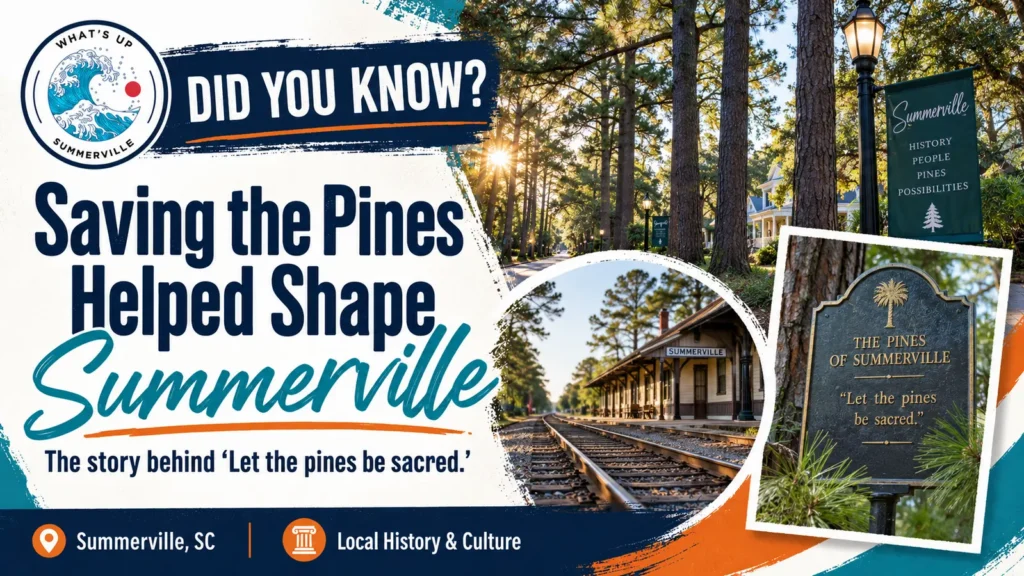
- The story behind “Let the pines be sacred”
- How “Flowertown in the Pines” became part of the town’s identity
- A little history to remember the next time you look around town
Long before Summerville became known for azaleas, sweet tea, or the phrase “Flowertown in the Pines,” the pine trees themselves were already part of the town’s identity.
In fact, protecting them was one of the reasons Summerville became an incorporated town in the first place.
The Railroad Was Cutting Through the Pines
By the 1830s, the railroad was already running through the area that would become modern Summerville.
Those tracks helped connect the community to Charleston and brought new growth, but they also created a problem: pine trees were being cut down along the railroad corridor.
At the time, many residents believed the surrounding pine forests had health benefits. The scent, shade, elevation, and cleaner air were all part of what had already made the area attractive to Charlestonians escaping the heat, mosquitoes, and disease of the city during the summer months.
Residents wanted more authority to protect those trees.
So when Summerville was incorporated in 1847, one of the reasons was to give citizens the legal power to push back against the railroad company cutting down the pines.
“Let the Pines Be Sacred”
That effort helped inspire one of Summerville’s earliest and most memorable mottos:
“Let the pines be sacred.”
It sounds poetic now, but at the time it reflected something very practical.
The pine forest was part of what people believed made Summerville healthier, cooler, and more desirable than the surrounding Lowcountry.
That connection between the town and its trees became strong enough to survive generations.
From Sacred Pines to Flowertown in the Pines
Nearly a century later, Summerville was still building its identity around that same landscape.
In 1933, the phrase “Flowertown in the Pines” was adopted as the town began promoting its azaleas and gardens to visitors. According to Visit Summerville, the phrase came from a local schoolgirl, Virginia Bailey, who won a contest to create a memorable description of the town.
Then in 1941, a large wooden arch was built over North Main Street welcoming visitors to:
“Summerville — the Flowertown in the Pines.”
Drivers leaving town would see the old message on the other side:
“Let the pine be sacred.”
A Piece of Summerville That Is Still Here
Today, Summerville looks very different from the small railroad community of the 1800s.
But the trees are still part of the place.
You see them throughout older neighborhoods, along historic streets, and in the imagery and language the town still uses to describe itself.
Did You Know?
Protecting the pines was one of the reasons Summerville became an incorporated town in 1847.
So the next time you hear “Flowertown in the Pines,” remember:
The “pines” part isn’t just decoration.
Protecting those trees helped shape the town Summerville became.
Support Local • Love Summerville