
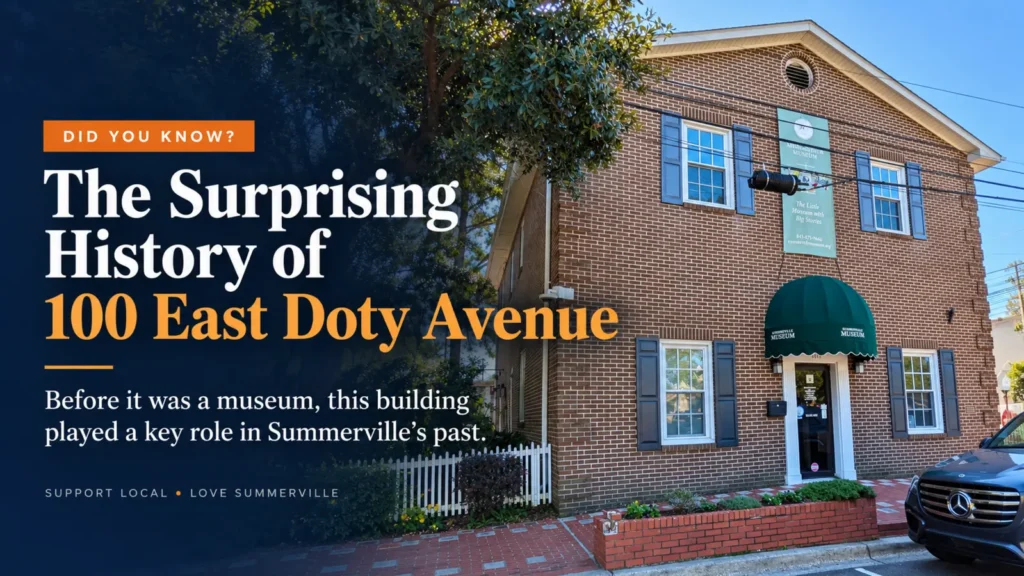
Before it preserved Summerville’s history, this building helped make it.
If you’ve ever visited the Summerville Museum and Research Center, you know it’s a place filled with stories from the town’s past.
But there’s one story you might not expect: the history of the building itself.
Before it housed photographs, artifacts, and exhibits, the building at 100 East Doty Avenue served as Summerville’s Water Department, police headquarters, courtroom, and jail.
And here’s another interesting detail: when the building was first constructed, its address wasn’t even on Doty Avenue.
The street was known as Railroad Avenue.
A Water Tower Along Railroad Avenue
The story begins in the 1920s, when Summerville was continuing to develop the public infrastructure needed to serve its growing community.
The property, previously owned by the Eagle Creek Lumber Company, became the site of a new municipal waterworks facility.
Between 1923 and 1928, the Town of Summerville constructed its Water Department on the property. The site included a brick building, a steel water tower approximately 100 feet tall, and a massive cistern capable of holding 300,000 gallons of water.
Imagine that water tower standing near the railroad in downtown Summerville. It would have been a considerably different sight from the museum visitors recognize today.
Eventually, the town moved its waterworks operation elsewhere, and the tower was removed.
But not every trace disappeared.
The original brick facade can still be seen inside the museum lobby. Outside, concrete supports and remnants of the former waterworks provide additional reminders of the property’s original purpose.
The Building Gets a Very Different Job
The next major chapter came in 1976.
By then, the building had been expanded and became home to the Summerville Police Department.
Its interior was adapted for police operations, and the space included more than offices.
The second floor housed a courtroom for the town judge, offices, and a holding cell. Downstairs were additional cells, a police officers’ day room, a radio room, and office space.
That means the same building where visitors now explore Summerville’s history once hosted court proceedings and held people in custody.
For anyone familiar only with the museum, it’s quite a contrast.
The Police Department remained at the location until June 1990, when it moved to a new municipal complex on West Second North Street.
The building was about to get another opportunity to serve Summerville.
A Museum Takes Shape
On May 2, 1991, a group of residents organized by Robert Pratt gathered to discuss an idea: creating a museum dedicated to preserving the history of Summerville and its surrounding communities.
The group continued meeting and building support for the project.
In April 1992, they signed a lease with the Town of Summerville for the former police station on East Doty Avenue.
Volunteers began renovating the building and preparing the space for exhibits.
By December of that year, the museum was welcoming visitors.
Its official grand opening followed in March 1993 under the name Summerville Dorchester Museum.
In 2022, the organization adopted the name Summerville Museum and Research Center, reflecting its continued work to preserve, research, and share local history.
After decades of municipal use, the building had found a purpose centered on remembering the community it once helped serve.
Why Is It Called Doty Avenue?
The building isn’t the only thing that changed over time.
According to the museum’s history, a 1913 map of Summerville identifies the street as Railroad Avenue.
It was a fitting name. The road ran parallel to the railroad connecting Charleston with Hamburg, now part of North Augusta. That rail connection helped bring passengers, freight, business, and visitors through Summerville.
The street kept its original name for decades.
Lawrence Hayden Doty served as mayor of Summerville from 1953 until 1965. Following his death on February 28, 1965, the town renamed Railroad Avenue in his honor.
What had once been Railroad Avenue became Doty Avenue, the name residents know today.
It’s one more example of how familiar places can carry stories that aren’t immediately obvious.
More Than a Museum Building
The history of 100 East Doty Avenue is unusual because so much of Summerville’s municipal past can be traced to one address.
The building helped support the town’s water system. It later became a place for law enforcement, court proceedings, and detention. Then residents and volunteers gave it a new purpose as a home for local history.
And some of those earlier chapters remain visible today.
The original brickwork and surviving waterworks features offer a connection to a time when a tall steel water tower stood nearby and the street outside was still called Railroad Avenue.
The next time you visit the Summerville Museum and Research Center, it’s worth remembering that the building isn’t simply a place where Summerville’s history is displayed.
It’s part of that history, too.
The Building Through the Years
A quick look at 100 East Doty Avenue’s changing roles
Visit the Summerville Museum and Research Center
Address: 100 East Doty Avenue, Summerville, SC 29483
Hours: Thursday–Sunday, 10 AM–4 PM
Website: summervillemuseum.org
The museum preserves and shares artifacts, exhibits, and stories exploring Summerville’s cultural and natural history.
Support Local • Love Summerville