Every business has slower days.
Maybe Monday afternoons are dead. Maybe Wednesday appointments never completely fill. Maybe the lunch rush disappears after 1:30. Maybe there’s one weekend every month that just never seems to perform like the others.
When that happens, the first instinct is often:
“Let’s run a sale.”
And sometimes a discount makes sense.
The problem comes when discounts become the automatic answer every time business slows down.
If customers regularly see Tuesday discounts, end-of-month specials, last-minute markdowns, or repeated “today only” offers, they can eventually learn something you never intended to teach them:
If I wait long enough, I’ll probably get a better price.
Now you’re not just filling a slow day. You may be training customers to avoid paying full price.
A better approach is to ask:
How can I make this slower time more appealing without making my regular price less valuable?
Here are a few ways to do it.
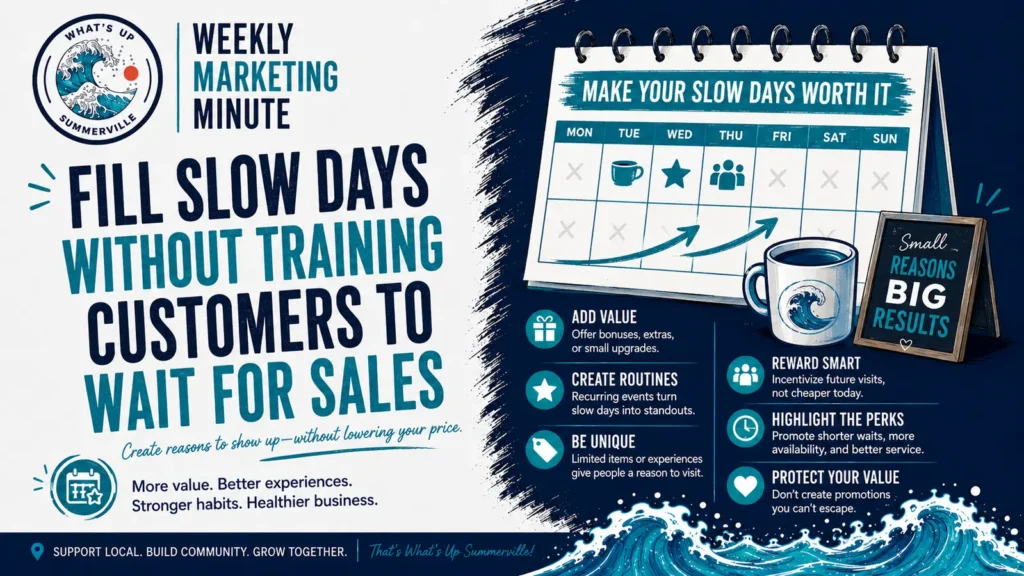
Add Value Instead of Cutting the Price
Instead of taking something away from the price, add something to the experience.

A bakery might include a small sample with Tuesday orders.
A salon could offer a complimentary add-on during traditionally slower appointment times.
A retailer might include a small gift or bonus item with purchases over a certain amount.
A restaurant could feature a special pairing or limited side.
The customer still pays the normal price, but there’s an extra reason to visit now.
That distinction matters.
You’re saying:
“Come today and get a little something extra.”
Not:
“What we normally charge is negotiable if you wait.”
Give the Slow Day Its Own Identity
Sometimes the easiest way to make a slow day more interesting is to stop treating it like an ordinary day.
Give people something they can associate with it.
Maybe it’s:
- Workshop Wednesday
- Tuesday Tastings
- Thursday Trivia
- First-Friday releases
- A weekly featured flavor
- A recurring kids’ activity
- A monthly vendor pop-up
- A specific service offered only on certain days
It doesn’t have to be huge.
The goal is to create a reason for someone to think:
“Oh, that happens on Wednesdays.”
Once people begin associating an activity, product, or experience with a particular day, you’re building a routine instead of constantly creating another promotion.
Create Something Limited Without Discounting It
Limited availability can be more powerful than a lower price.
A coffee shop could offer one specialty drink every Tuesday.
A baker could release a small batch of something that isn’t available the rest of the week.
A boutique could showcase new arrivals on its slowest day.
A service business might reserve certain appointment types for quieter periods.
People don’t necessarily need a cheaper reason to visit.
Sometimes they simply need a specific reason to visit now.
Reward the Next Visit
If you want to use an incentive, consider using one that encourages customers to return instead of reducing the value of the current purchase.
For example:
- Visit during a slower period and receive bonus loyalty points.
- Make a purchase today and receive a small perk to use next time.
- Bring a friend and receive a future-use reward.
- Preorder during a slower week and receive priority access to the next release.
Now your promotion is doing two jobs:
It helps fill today’s slower period and gives the customer a reason to come back.
Sell the Advantage of Coming When It’s Quieter
This one is easy to overlook.
Sometimes your slow period already has a benefit — you just haven’t marketed it.

For a restaurant, it might mean shorter waits.
For a salon, it could mean easier appointment availability.
For a photographer, it might mean more flexible scheduling.
For a retail shop, it could mean more one-on-one attention.
For an activity-based business, quieter hours may mean less waiting and more time actually enjoying the experience.
Instead of apologizing for a slow time, position it as an advantage.
“Want to skip the Saturday crowd? Come see us Wednesday afternoon.”
That can be a marketing message all by itself.
Don’t Create a Promotion You Can’t Escape
This is the bigger picture.
A promotion that works once can quickly become something customers expect.
If every Tuesday becomes 20% off Tuesday, removing that discount later may feel like a price increase — even though you’re simply returning to your normal pricing.
That doesn’t mean you should never run a sale.
Sales can be useful for clearing inventory, celebrating an event, introducing something new, creating urgency, or rewarding loyal customers.
Just make sure the discount has a purpose beyond:
“It’s slow today.”
Because your goal shouldn’t simply be to make one slow afternoon busier.
Your goal should be to create reasons for customers to choose your business throughout the week while protecting the value of what you sell.
This Week’s Marketing Minute
Identify your slowest day, time, or appointment window.
Then, before reaching for a discount, ask:
“What could I add, feature, or make special about this time?”
Maybe it’s a small bonus.
Maybe it’s something limited.
Maybe it’s an event.
Maybe it’s a loyalty incentive.
Maybe it’s simply reminding customers that this is the easiest time to visit.
You don’t always need a lower price to fill a slow day.
Sometimes you just need a better reason to show up.