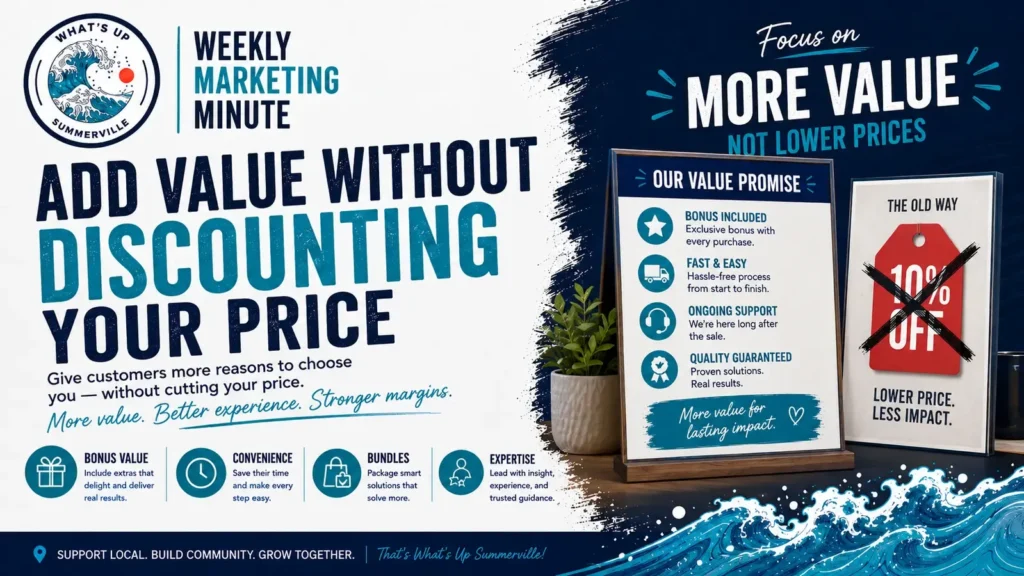
When business slows down, one of the easiest marketing buttons to push is the discount button.
10% off.
Buy one, get one half off.
$20 off this weekend only.
Sometimes a discount makes perfect sense. But if discounts become your go-to strategy every time you want to attract customers, you may accidentally train people to wait for the next sale instead of buying from you at your regular price.
There is another option:
Make the purchase more valuable without making it cheaper.
For a local business, that can often be a stronger long-term strategy. You protect your margins, reinforce the quality of what you offer, and give customers more reasons to choose you beyond price.
Your Price Isn’t Always the Problem
When someone decides not to buy, it is easy to assume the price was too high.
Sometimes it is.
But customers rarely evaluate price by itself. They compare the price to what they believe they are getting in return.
A $50 service can feel expensive when someone does not understand what is included. That same $50 can feel completely reasonable when the business clearly communicates the convenience, expertise, quality, support, and extras that come with it.
Instead of immediately asking:
“How much should I discount this?”
Try asking:
“How can I make this feel more valuable?”
That small shift can change the way you market your business.
It may also reveal that your current offer is already stronger than you think. Customers may simply need a clearer explanation of what they receive and why it matters.
Add Something Instead of Taking Something Away
A discount takes money away from the sale.
Adding value gives the customer something extra while allowing you to maintain your normal pricing. That extra value does not necessarily have to cost your business very much.
A photographer might include a few additional edited images.
A restaurant could include a small dessert with a family meal.
A landscaper might add a seasonal property check after completing a larger service.
A salon could include a complimentary treatment with certain appointments.
A retail shop might offer free gift wrapping.
A service business could include a follow-up consultation or priority scheduling.
The customer receives something additional, but the core product or service has not been devalued. Even better, the perceived value of the extra can sometimes be much higher than its actual cost to the business.
The key is to choose an addition that is genuinely useful. A random bonus may not make much difference. A thoughtful extra that solves a problem, saves time, or improves the customer’s experience can make the entire offer more appealing.
Convenience Has Value Too
Not every bonus has to be a physical product.
Making the customer’s life easier can be incredibly valuable, especially for busy families and professionals in the Summerville area.
Think about things like:
- Free local delivery
- Easier scheduling
- Online booking
- Curbside pickup
- Reminder texts
- Faster turnaround
- Simple bundled packages
- Complimentary setup
- Follow-up support
None of these require putting a giant SALE sign across your marketing. They simply make doing business with you easier.
For busy customers, convenience can be worth more than a small discount. Someone may choose your business because you respond quickly, offer evening appointments, provide clear instructions, or make the process simple from beginning to end.
If your business offers a convenience that customers appreciate, make sure it is visible in your marketing. Mention it on your website, in your business listing, in emails, and when you explain your services.
Your presence in local search matters, too. Keeping your information clear and current in places such as the Summerville business directory helps customers understand where you are, what you offer, and how to take the next step.
Bundle Services Instead of Cutting Prices
Bundling is another way to increase perceived value.
Instead of lowering the price of one product or service, combine several things that naturally belong together. The goal is to create a complete solution that feels easier to choose.
A cleaning company might create a move-in package.
A photographer could offer a family session package that includes prints.
A restaurant might create a dinner-for-four bundle.
A boutique could pair complementary products into a ready-to-gift package.
A home service company might combine several seasonal maintenance tasks into one appointment.
The customer sees a complete solution rather than several individual purchases. When the bundle is positioned correctly, the conversation becomes less about comparing individual prices and more about the convenience and value of the entire package.
A good bundle should answer a real customer need. Look at the products or services people frequently purchase together. Then give that combination a clear name and explain who it is for.
For example:
- “New Homeowner Starter Package”
- “Family Dinner Night”
- “Back-to-School Hair Refresh”
- “First-Time Visitor Package”
- “Seasonal Home Checkup”
A clear package is often easier to understand and remember than a long list of separate options.
Expertise Is Part of the Value
Local businesses often forget that customers are not only paying for the product.
They are paying for you.
Your experience.
Your knowledge.
Your recommendations.
Your ability to solve a problem faster than they could solve it themselves.
Show that expertise in your marketing.
Explain why you recommend one product over another. Show customers how you perform your service. Answer common questions. Share tips. Explain mistakes people should avoid.
When customers understand the knowledge behind what you do, the price begins to make more sense. That is especially important for service businesses where much of the value is invisible until the work is completed.
A plumber is not only fixing a pipe. A contractor is not only completing a project. A stylist is not only providing an appointment. Each professional is bringing judgment, training, experience, and problem-solving ability to the customer’s situation.
Use your content to make that invisible value visible.
A short “why we recommend this” explanation, a before-and-after example, or a quick answer to a frequently asked question can help customers feel more confident about booking at your regular price.
Experience Can Be the Difference
Two businesses can sell essentially the same thing and still provide completely different experiences.
A friendly greeting.
Remembering a customer’s name.
A handwritten thank-you card.
Following up after a service.
Beautiful packaging.
Helping someone carry a purchase to their car.
Taking five extra minutes to explain something.
Those things may seem small, but they are often exactly what customers remember. They are also difficult for a competitor to copy with a coupon.
For local businesses, personal experience is one of your biggest advantages over larger companies. A customer may be able to order a similar item online or find a lower advertised price elsewhere, but they cannot get your exact combination of attention, familiarity, care, and local knowledge from a national chain.
Use that advantage.
Think through the customer journey from the first phone call or website visit to the follow-up after the purchase. Where could you remove friction? Where could you make the interaction feel more personal? What would make the customer want to tell a friend about the experience?
Those improvements can become part of your value proposition.
Make Sure Customers Know What’s Included
Sometimes you have already added value: you just forgot to tell anyone.
Look at your current product or service and list everything the customer receives. You may discover that you are giving customers things you barely mention:
- Consultations
- Custom recommendations
- Setup
- Delivery
- Support
- Follow-ups
- Warranties
- Local expertise
- Personal service
- Years of experience
If those things matter, put them in your marketing. Don’t assume customers automatically know.
Instead of writing, “Lawn service available,” explain what the customer gets: dependable scheduling, a property check, service reminders, clean-up, and an easy way to contact your team.
Instead of writing, “Custom cakes,” explain the consultation process, flavor guidance, design planning, pickup instructions, and personal attention that go into the order.
Specific details help customers compare value, not just price.
Before You Discount, Try This
The next time you are tempted to run a sale, ask yourself:
What could I add that would make this offer more useful, convenient, complete, or memorable?
Then choose one improvement and communicate it clearly.
You might:
- Add a small bonus that customers will actually use.
- Make one step in the buying process easier.
- Create a bundle around a common customer need.
- Share the expertise behind your work.
- Improve one memorable part of the customer experience.
- List everything already included in your regular price.
Sometimes a discount is the right tool. But it should be a tool, not the entire marketing strategy.
Competing only on price is difficult because someone can almost always come along and charge less. Competing on value is different.
When customers understand everything they receive — the product, the service, the expertise, the convenience, and the experience — you give them a reason to choose your business even when you are not the cheapest option.
That is a much stronger position for any local business to build from.
Support Local • Love Summerville.