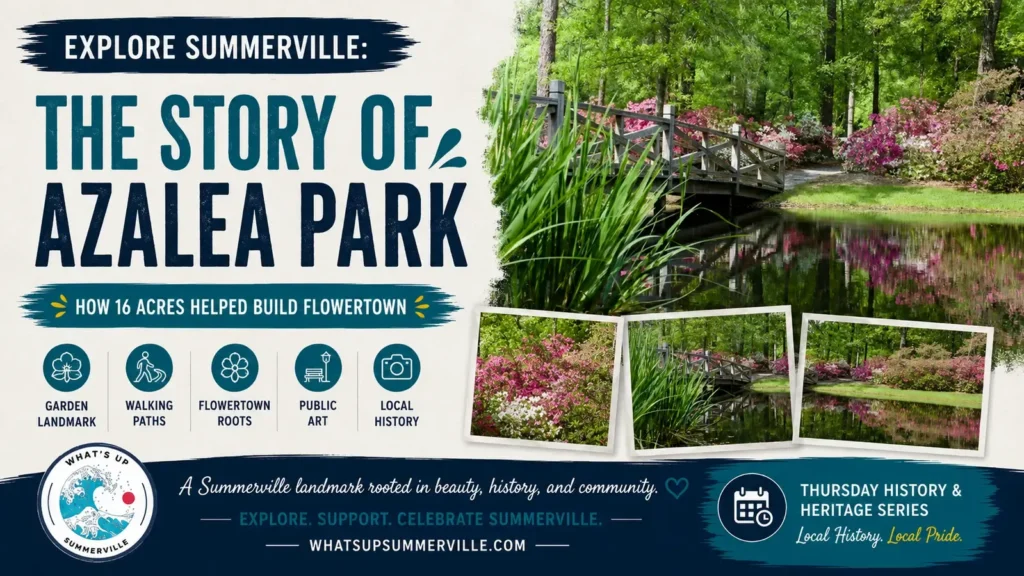
Azalea Park feels as though it has always belonged in Summerville.
Its winding paths, reflection ponds, towering trees, flowering gardens, bronze sculptures, and quiet benches have become part of the town’s identity. Generations have walked through the park during spring blooms, posed for photographs beside its gazebos, watched turtles gather near the water, and returned each year as the Flowertown Festival fills the grounds.
But Azalea Park did not simply grow into existence.
The park was created through a combination of civic ambition, local generosity, public investment, and a belief that flowers could help shape Summerville’s future.
Before There Was an Azalea Park
By the early 20th century, Summerville was already known for its natural landscape.
The town’s towering pine trees had attracted visitors for generations, and residents had long taken pride in protecting the trees and gardens that gave the community its character. In 1925, the local Chamber of Commerce adopted the slogan “Flower Town in the Pines,” strengthening the connection between Summerville’s identity and its landscape. By the 1930s, the familiar “Flowertown in the Pines” identity had become part of the town’s public promotion.
During the 1920s, a civic organization commonly identified in local histories as the Civic League raised money to purchase approximately 16 acres in the heart of Summerville. The organization later became associated with what is now the Flowertown Garden Club, and the land it purchased and donated to the town became the foundation of Azalea Park.
At the time, however, the property did not resemble the landscaped park residents know today. Summerville was also beginning to transition from a quiet retreat into a more structured community, a shift explored more fully in our guide to the character of historic Summerville.
The land needed paths, clearing, planting, and a larger vision. That vision arrived during one of the most difficult economic periods in American history.

A Park Created During the Great Depression
When the Great Depression began in 1929, Summerville Mayor Grange Cuthbert saw more than an undeveloped tract of land. He envisioned an azalea-filled public park that could beautify the town, attract visitors, and provide an economic boost at a time when communities across the country were struggling.
According to local historical accounts, the town later secured assistance through the Works Progress Administration. WPA workers helped clear and shape the rugged property, establishing paths and landscaped spaces that would eventually define the park. One local history reports that workers—including Cuthbert’s own son—were paid 10 cents an hour.
The project was more than beautification. It was an early form of local economic development: create a place worth visiting, encourage travelers to come to Summerville, and give them a reason to spend time in town.
But a park intended to celebrate flowers still needed flowers.
George Segelken and Thousands of Azaleas
Mayor Cuthbert turned to local nurseryman George Segelken, who had become known for cultivating azaleas, including varieties called the “Pride of Summerville” and “Pride of Mobile.”
Local accounts credit Segelken with supplying the new park’s azaleas. Some histories place the contribution at approximately 33,000 plants and say he personally planted many of them. The arrangement reportedly allowed him to remove and sell individual plants when visitors wished to purchase them.
That arrangement made the park both a public garden and a living showcase for Summerville’s nursery trade. Visitors could admire the flowers, associate their beauty with the town, and potentially take a piece of that landscape home with them.
By the spring of 1930, busloads of visitors were reportedly traveling from Charleston to see acres of blooming azaleas, some reaching six to eight feet tall, in the park and throughout Summerville’s private gardens. The town’s Flowertown identity was no longer only a slogan. It had become a destination.
More Than a Garden
Although the azaleas gave the park its name and reputation, Azalea Park developed into much more than a seasonal flower display.
The park stretches along both sides of South Main Street between West Third South and West Fifth South streets. Its paths wind through ornamental gardens, ponds, trees, and open spaces, creating a landscape that feels separate from the traffic passing through its center.
Over time, the park gained gazebos, tennis courts, community gathering areas, a playground, a children’s discovery garden, and the Cuthbert Community Center, named for the mayor whose vision helped shape the grounds. Today, visitors know it for its walking trails, ornamental gardens, ponds, sculptures, playgrounds, restrooms, and tennis courts.
Those additions helped turn Azalea Park into an everyday community space. Like Hutchinson Square, it evolved into one of Summerville’s central gathering places.
People come for weddings and photographs, quiet walks, playtime, tennis, picnics, and moments beside the ponds, not only during the few weeks when the azaleas are at their brightest.
Weathering the Storms
A living landscape is never finished. Throughout its history, Azalea Park has faced hurricanes, ice storms, fallen trees, and the continuous work required to maintain a large public garden.
Local accounts recall Boy Scouts planting donated pine seedlings after one damaging storm. Hurricane Hugo brought another major cleanup, later commemorated with a visual display near the Cuthbert Community Center.
Each recovery became another chapter in the park’s story. The landscape residents see today is not exactly the one planted during the 1920s and 1930s. Trees have matured and fallen. Gardens have been replanted. Paths, facilities, and gathering spaces have changed.
Yet the original purpose has remained remarkably consistent: preserve a beautiful public space that welcomes people into the heart of Summerville.
The Park That Helped Inspire the Flowertown Festival
Azalea Park’s spring blooms eventually helped inspire one of Summerville’s largest traditions.
In 1973, under the leadership of Jean Gantt, the Young Women’s Christian Organization—then known as the YWCO—launched a community celebration timed around the spring blooms. The organization became the Summerville Family YMCA in 1976, and the celebration grew into the Flowertown Festival.
Every spring, the festival spreads along Main Street and throughout Azalea Park, bringing arts, crafts, food, and thousands of visitors into the same landscape Mayor Cuthbert once hoped would strengthen Summerville’s economy. In that sense, the modern festival fulfills the original vision behind the park.
When Public Art Joined the Landscape
Near the end of the 20th century, Azalea Park entered another stage of its evolution. Sculpture in the South was created in 1999 after a community vision-planning survey conducted through Summerville DREAM found strong interest in adding outdoor art to public spaces.
Azalea Park became one of the collection’s most recognizable settings. One of the collection’s earliest additions was Hop to It, a bronze Southern leopard frog by Kim Shaklee, unveiled in September 1999. It became the first work purchased for Summerville by Sculpture in the South and found a natural home near Azalea Park’s ponds and wetlands.

Other sculptures followed. Toby, a bronze Labrador beside a park bench, was donated in memory of John Brooks and inspired by the story of a dog that comforted him during an illness. Follow the Leader, installed in 2002, depicts five children and a dog balancing along a low wall. It was specifically designed to invite interaction rather than remain separated from visitors on a distant pedestal.
Foxes, children, animals, and other figures now appear throughout the park, blending into the gardens and encouraging visitors to discover them gradually. The sculptures added another layer to Azalea Park without replacing its natural character. The park became both a public garden and an open-air setting for public art.
The Park Beyond the Blooms
Azalea Park is most famous in spring, but its importance is not limited to azalea season.
In summer, the tree canopy provides patches of relief from the Lowcountry heat. In fall, the paths become quieter and the landscape changes color. In winter, the structure of the gardens, ponds, bridges, sculptures, and trees becomes easier to see.
Children explore the playground and discovery garden. Couples take engagement and wedding photographs near the gazebos. Families walk the paths. Visitors begin self-guided tours of Summerville’s historic homes and gardens from the park. It remains a place for large public celebrations and ordinary private moments. That balance may be the park’s greatest success.
A Civic Project That Became Part of Summerville’s Identity
Azalea Park exists because generations of residents believed that creating and maintaining a beautiful shared space mattered.
A civic group raised money to purchase the land. A mayor imagined that a garden could help a town during the Great Depression. Workers cleared and shaped the property. A local nurseryman supplied thousands of plants. Garden clubs, civic organizations, scouts, town employees, artists, volunteers, and residents continued caring for and adding to it over the decades.
The result is more than a park named for a flower. Azalea Park helped turn Summerville’s Flowertown identity from a slogan into something people could see, walk through, and remember.
Nearly a century after its earliest plantings, the park still serves the purpose its creators imagined: it draws people together, welcomes visitors, supports the surrounding community, and reminds Summerville that its history is rooted not only in buildings and streets, but also in the landscapes people choose to preserve.
Sources & Further Reading
- Town of Summerville — Azalea Park
- Visit Summerville — The Making of Azalea Park
- Visit Summerville — Spring Flowertown Festival
- Summerville Family YMCA — Mission & History
- Sculpture in the South — public sculpture and organizational history
Historical note: Some details about Mayor Grange Cuthbert, George Segelken, storm recovery, and the park’s early development are preserved through local historical accounts and community histories.
Support Local • Love Summerville