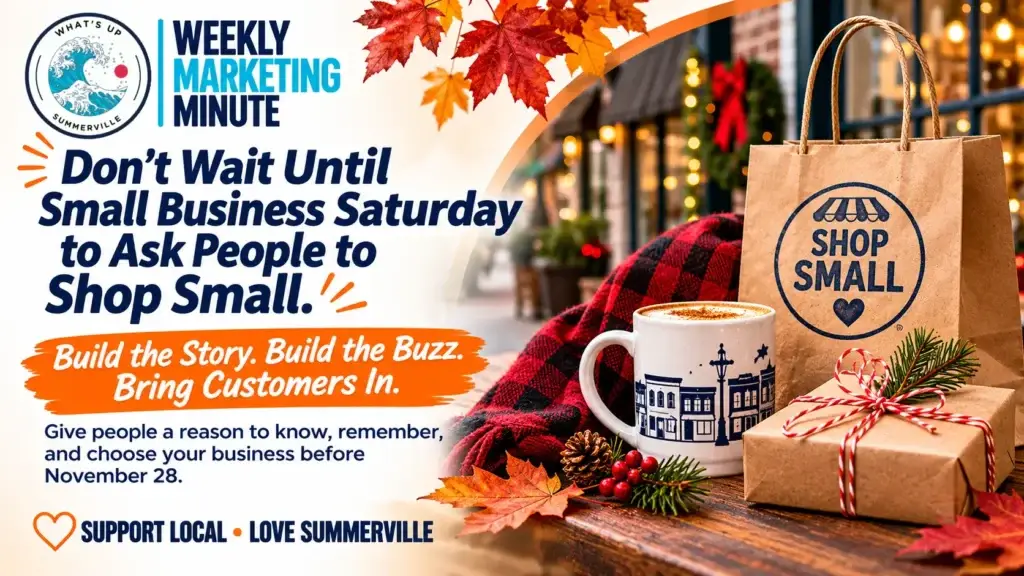
Every November, a familiar message starts appearing in storefront windows, email inboxes, and social media feeds: Shop Small. Shop Local. Support Your Community.
It is a message worth sharing. Independent shops, restaurants, makers, and service providers are part of what gives communities like Summerville their character. But as Small Business Saturday approaches, there is a question every local business owner should consider.
If the first time you ask someone to shop with you is November 28, you may already be late to the conversation.
Holiday purchases rarely begin when someone walks through a store’s front door. They begin with ideas, recommendations, wish lists, conversations, and decisions about where to spend money. Many of those decisions are taking shape right now.
A last-minute “Shop Local” graphic can remind people that Small Business Saturday exists. It does not necessarily give them a reason to choose your business. That reason has to be built beforehand.
A Shopping Day Is Not a Marketing Strategy
Small Business Saturday offers independent businesses a shared moment in the spotlight. Participation, however, is not a marketing plan by itself.
Imagine two Summerville shops preparing for November 28. One operates as usual, posts a festive “Shop Small” graphic that morning, announces a discount, and hopes customers show up. The other begins weeks earlier: introducing its owner, showing holiday arrivals, explaining why customers love certain products, and sharing what visitors can expect on the big day.
By Saturday, the second shop is not trying to start a relationship with a stranger. It is continuing a conversation customers have already seen.
The purpose of early marketing is not necessarily to make an immediate sale. It is to make your business familiar, memorable, and relevant before customers are ready to buy.
That progression matters. People first have to become aware of a business. Then they need a reason to consider it. Only after that might they be ready to act. One promotional post cannot be expected to do every job equally well.
Give Customers More Than a Generic “Shop Local” Message
There is nothing wrong with asking the community to support independent businesses. But the message becomes more useful when you connect it to a specific product, service, person, or experience.
A baker could show the early-morning work behind a batch of sourdough and announce when holiday preorders open. A boutique might introduce gifts from regional makers and explain who they would be perfect for. A salon could highlight gift certificates as experiences rather than simply listing their prices. A local artist might demonstrate how a handmade piece comes together.
Every example encourages local spending, but none relies entirely on the idea of local spending. Instead, it helps customers imagine an actual visit, order, gift, or experience.
Generic: “Shop small with us on November 28!”
Specific: “We’re preparing a small collection of locally made holiday gifts. Over the next two weeks, we’ll introduce the makers, share gift ideas, and show you what’s arriving before Small Business Saturday.”
The second message starts building curiosity. It gives customers something to follow and makes the business itself part of the story.
Start With the Story, Not the Sales Pitch
Independent businesses have a marketing advantage that large chains cannot always replicate: customers can get to know the people doing the work.
Think about a regular vendor at the Summerville Farmers Market. A simple post announcing fresh bread for Saturday is useful. A post showing how that bread is prepared, who makes it, and what goes into it gives customers a more meaningful reason to remember it.
The same principle works for a florist preparing arrangements, a restaurant getting ready for the dinner rush, a contractor explaining a detail customers often overlook, or a boutique owner selecting merchandise for the season.
You do not need to invent an elaborate origin story. The everyday things you take for granted may be exactly what customers find interesting: why you chose a product, how you solve a problem, what preparation looks like, or what you enjoy about serving the community.
Let your marketing show the people and purpose behind the product. Then, when you invite people to shop, the invitation feels connected to something they already know.
Build Anticipation in Three Stages
Starting early does not mean posting the same reminder every day. If every message says “Don’t forget November 28,” your audience may stop noticing long before the date arrives. Give each part of your campaign a different purpose.
November 9–15: Introduce and Reconnect
Use this first week to help people know who you are. Share the reason you started, introduce someone on your team, show your process, or explain what makes a customer favorite special.
Even if you have operated for years, do not assume everyone knows your story. New neighbors arrive in Summerville, existing residents discover new places, and social media introduces your business to people who may never have seen it before.
- Story post: Why did you start your business, and what do you want customers to experience?
- Behind-the-scenes post: Show how something is made, prepared, selected, or delivered.
- Customer favorite: Feature one popular offering and explain what makes it stand out.
November 16–22: Give People Practical Ideas
Once people recognize your business, show them how it fits into their holiday plans. That may mean gift guides, seasonal products, convenient services, or experiences that make life easier.
A shop could organize gifts by budget. A bakery might highlight treats for out-of-town guests. A photographer could explain holiday session options. A home service provider might talk about getting a house ready before visitors arrive. A food truck could show where it will be and how customers can preorder for an upcoming stop.
The marketing is no longer just “Here is what we sell.” It is “Here is how this could help you, someone you care about, or your holiday plans.”
November 23–28: Make the Next Step Obvious
As Small Business Saturday approaches, move from inspiration toward details. Tell people what will be available, when to visit, whether quantities are limited, and how to order or reserve.
Do not make someone search through several posts for your hours, address, booking information, or preorder deadline. You have already done the work of building interest. The next step should be easy.
Week 1 — Connection: Meet the people, see the process, learn the story.
Week 2 — Consideration: Discover gift ideas, holiday solutions, and customer favorites.
Week 3 — Action: Confirm hours, specials, availability, ordering deadlines, and where to visit.
You Do Not Have to Win a Discount War
Small Business Saturday falls in a weekend dominated by major retail promotions. That does not mean every independent business has to compete on the largest markdown.
Small businesses often have different margins, staffing, and purchasing power than national chains. A promotion that brings in customers but erases the profit is not necessarily a successful promotion.
The reason someone chooses your business might be craftsmanship, specialized knowledge, a unique product, personal service, convenience, local pickup, or a memorable experience. Make those advantages visible.
Instead of discounting everything, consider whether you can offer a curated bundle, a special experience, thoughtful gift wrapping, advance ordering, or limited seasonal availability. The right approach will depend on your business and what customers value.
Before announcing a sale, ask yourself:
Are we giving people a reason to choose our business, or simply lowering the price until they do?
A well-planned discount can still be useful. It just should not be your entire strategy.
Do Not Forget the Customers Who Already Know You
Your holiday marketing does not have to focus only on finding new customers. People who have already purchased from you may be among the most interested in what is coming next.
If you have an email list, tell subscribers about new products, seasonal services, important deadlines, or early ordering opportunities. If you have a loyal social audience, invite them to share their favorites or recommend your business to someone shopping for a gift.
Keep those messages useful. Existing customers deserve more than constant sales pitches. Give them information and reasons to stay connected, not just another request to spend.
Make Sure Your Online Information Can Keep Up
Imagine your promotion gets someone interested, but your online information is outdated. Your website still shows last month’s hours. Your profile links to the wrong ordering page. Pickup details are nowhere to be found.
At that point, good marketing has created an opportunity that confusing information might waste.
Before November 28, review your website, Google Business Profile, social pages, and local directory listings. Make sure your hours, address, contact details, and purchase options agree with each other.
If a preorder deadline applies, say so plainly. If your business will be at a farmers market, festival, or pop-up, make the exact location easy to find. And when you link to a promotion, send customers directly to the relevant product, booking page, or details rather than making them search your entire website.
Good marketing builds interest. Clear information helps customers act on that interest.
Measure More Than Likes
Likes, views, and shares can tell you whether people noticed a post. They do not always tell you whether the campaign helped the business.
Look for signs of real customer interest: ordering-link clicks, inquiries about hours or availability, appointment requests, preorders, and visitors who mention something they saw online. If you can, keep a simple record of what people ask about and which promotions prompt action.
After Small Business Saturday, compare what happened with what you expected. Did you attract new customers? Did existing shoppers return? Which products or experiences performed well? Did your promotion produce worthwhile sales after costs?
Remember that not every result will happen on the same day. Someone who discovers your business in November may return in December or months later. That is another reason the relationship matters as much as the promotion.
The Opportunity Does Not End on November 28
Small Business Saturday is one day. The relationship can last much longer.
Thank customers who visited, purchased, recommended you, or shared a post. Show a few genuine moments from the day. Explain what is coming next. Make it easy for happy customers to leave honest reviews and keep up with your business.
If someone discovers you for the first time that weekend, think about what will give them a reason to come back. That is where a one-day shopping opportunity can become a long-term local connection.
This Week’s Marketing Minute
Before posting another generic “Shop Small” reminder, take a few minutes to answer three questions:
- What should people remember? Think about the people, values, products, or experience that make your business distinctive.
- What can you show them this week? Choose one authentic story, a behind-the-scenes moment, or a customer favorite.
- What should someone do next? Follow your page, browse holiday offerings, place a preorder, or plan to visit on November 28.
You do not have to make an aggressive sales pitch. You do have to give people a reason to pay attention—and an easy way to take the next step when they are ready.
The Bottom Line
By the time November 28 arrives, customers should already have reasons to recognize, remember, and consider your business. They should know a little about who you are, what you offer, and why it may belong in their holiday plans.
A generic “Shop Local” message may remind someone to support independent businesses. But the stories, helpful ideas, and connections you share in the weeks beforehand can give them a reason to support yours.
Don’t make Small Business Saturday the beginning of your marketing campaign. Make it the moment your preparation pays off.
Weekly Marketing Minute is a What’s Up Summerville series sharing practical marketing ideas for local businesses.
Support Local • Love Summerville