

Summerville is taking another look at how it regulates short-term rentals, including Airbnbs, traditional bed-and-breakfasts, and other properties offering overnight accommodations.
At a special Town Council planning workshop on October 15, 2026, officials considered changes to the town’s Unified Development Ordinance (UDO), the regulations governing how properties can be used throughout town limits.
The proposed revisions would reorganize short-term rentals into two classifications, establish additional occupancy standards, clarify permit requirements, and address how the rules apply to properties in certain mixed-use areas.
But an important distinction has been lost in some discussions of the proposal.
Many of Summerville’s short-term rental requirements aren’t new. The town is reconsidering how those rules are organized and applied, and some proposed changes could provide more flexibility in commercially oriented areas.
The discussion also comes against the backdrop of a contentious rezoning dispute involving the former Magnolia Inn property on South Magnolia Street, where property owners and nearby residents have expressed competing views about the future of downtown lodging.
Here’s what the proposed changes could mean for Summerville.
Why Is Summerville Revisiting Its Short-Term Rental Regulations?
The town has regulated short-term rentals for years, but its existing ordinance contains overlapping definitions and requirements for different lodging uses.
During its October 15 workshop, Council reviewed a proposed rewrite intended to clarify the distinctions between bed-and-breakfast establishments and short-term rentals.
The town’s own summary describes the revisions as changes and clarifications to existing lodging regulations.
Rather than maintaining separate, potentially confusing classifications, the proposal would organize short-term rentals primarily according to the number of guest rooms. The proposed changes also address occupancy, permits, advertising, and recorded neighborhood restrictions.
The proposal is part of a broader review of the town’s development regulations. It did not appear suddenly in October; officials had already been discussing revisions during earlier meetings.
The central question isn’t simply whether Summerville should regulate short-term rentals. It already does.
The question is whether the existing rules provide the right balance between residential neighborhoods, property owners, and businesses that accommodate visitors.
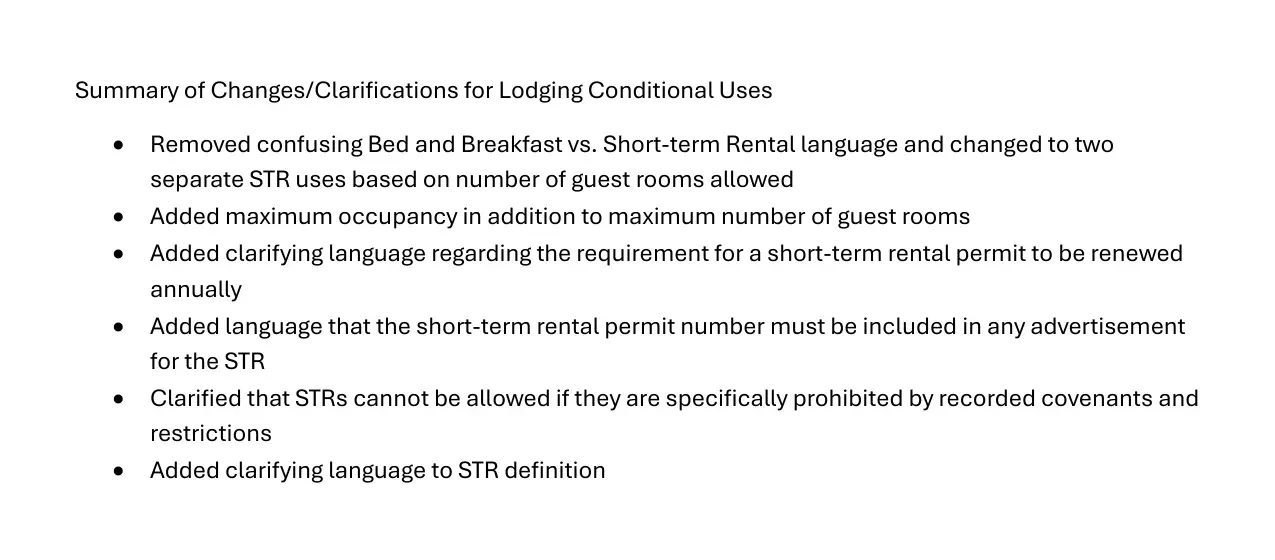
Town of Summerville’s summary of proposed changes and clarifications to lodging conditional uses, included in the October 15, 2026, Town Council workshop packet. Source: Town of Summerville.
Two Short-Term Rental Categories Instead of Overlapping Definitions
One of the most visible changes would establish two short-term rental classifications.
- Short-Term Rental 1 (STR-1): Properties with up to five guest rooms.
- Short-Term Rental 2 (STR-2): Properties with six to ten guest rooms.
These categories would replace overlapping terminology involving bed-and-breakfasts and short-term rentals.
However, the number of guest rooms isn’t the only consideration.
The proposed ordinance also identifies which zoning districts could accommodate each type of rental and whether the use would be permitted, conditional, or subject to additional approval.
That distinction matters.
A property suitable for a small, owner-operated lodging business might not qualify for the same treatment as a larger establishment with ten guest rooms.
The proposal attempts to make those differences more explicit, giving property owners and residents a clearer understanding of what types of lodging may be allowed in different parts of town.
Does the Owner Have to Live on the Property?
This is one of the most important parts of the discussion, and it requires some context.
Summerville already has owner-residency requirements for certain short-term rental properties.
The existing regulatory framework includes a requirement that qualifying owners reside at the property for at least 183 days each year.
Residency is tied to documentation such as the owner’s legal voting address, South Carolina driver’s license or identification card address, and qualifying four-percent homeowner property-tax assessment.
The regulations also address the owner’s presence when guests are registered.
Those requirements were not first introduced at the October 15 workshop.
What’s especially interesting about the proposed rewrite is how owner-occupancy could apply in the Neighborhood Mixed-Use (N-MX) zoning district.
The workshop draft includes language that would distinguish primarily residential properties from primarily commercial properties based partly on the use of neighboring properties.
Under that language, an N-MX property primarily used for commercial purposes, with at least half of adjacent properties also primarily commercial, could qualify for an owner-occupancy exemption.
That represents a potentially significant distinction for certain downtown properties.
Rather than uniformly tightening residency restrictions, the town is examining circumstances in which a commercial lodging operation might be treated differently from a short-term rental in a residential neighborhood.
An independent account of the October 15 meeting also reports that Council discussed and approved an amendment addressing owner-occupancy exemptions in business districts.
However, official minutes confirming the exact action and final wording were not available through the town’s online Agenda Center as of November 1, 2026.
That reported amendment therefore remains subject to confirmation against the official meeting record.
Occupancy Limits, Permits, and Advertisements
Other changes focus on how short-term rental operations are managed and documented.
The workshop proposal includes a maximum overnight occupancy standard of two people per bedroom, excluding minor children, plus two additional people per dwelling unit.
It also clarifies the requirement to renew a town-issued short-term rental permit annually.
And it would require advertisements for short-term rentals, whether posted online or in print, to display the property’s current town-issued permit number.
That last provision could make it easier for the town, potential guests, and neighbors to determine whether an advertised rental has a permit.
But there’s another important distinction.
Summerville already treats certain online advertisements as evidence that a property is being offered as a short-term rental.
That enforcement concept appears in the town’s earlier regulations. The proposed advertising change centers on requiring the permit number to be displayed.
The draft also addresses new permits when properties change ownership and clarifies that short-term rentals cannot operate where recorded covenants and restrictions specifically prohibit them.
Several other requirements, including business licensing, liability insurance, safety inspections, parking, and recordkeeping, are already part of Summerville’s regulatory framework.
Not every requirement appearing in the revised document represents a new restriction.
Already part of Summerville’s regulatory framework:
- Owner-residency requirements for qualifying properties
- Business licensing and short-term rental permitting
- Liability insurance and safety inspections
- Required compliance records
- Use of certain online advertisements as evidence of a rental offering
Proposed changes or clarifications:
- Two classifications based on guest-room capacity
- Additional maximum occupancy language
- Clearer annual permit-renewal provisions
- Permit numbers displayed in advertisements
- Clarifications involving recorded neighborhood restrictions
- Potential owner-occupancy exceptions in certain mixed-use areas
The Magnolia Inn Dispute Shows What’s at Stake
The broader debate over short-term rentals has a real-world example on South Magnolia Street.
The property at 115 South Magnolia Street, formerly operated as Magnolia Inn, has been the subject of repeated rezoning discussions.
The property owner, Magnolia Bed & Breakfast LLC, sought to change the property’s zoning from General Residential (GR-2) to Neighborhood Mixed-Use (N-MX).
In a July 20 letter submitted to the Planning Commission, owner Megan Dungan argued that the existing regulatory environment had made it increasingly difficult for traditional inns to continue operating in Summerville.
Dungan claimed that Summerville had at least five operating inns two years earlier, but that none remained at the time of her letter because of the town’s regulations.
That is the owner’s account. What’s Up Summerville has not independently verified the number of operating inns during those periods.
Dungan also described an earlier attempt to secure Downtown Mixed-Use zoning for the property.
After that request was denied, she said she met with town officials to discuss available options. According to her letter, the alternatives identified under the existing zoning included operating a state-licensed group home or converting the property into a long-term residential rental.
She subsequently pursued Neighborhood Mixed-Use zoning.
Her argument centered partly on consistency.
Dungan pointed to nearby properties already zoned for mixed uses, including offices and other commercial operations, and argued that her property should receive comparable consideration.
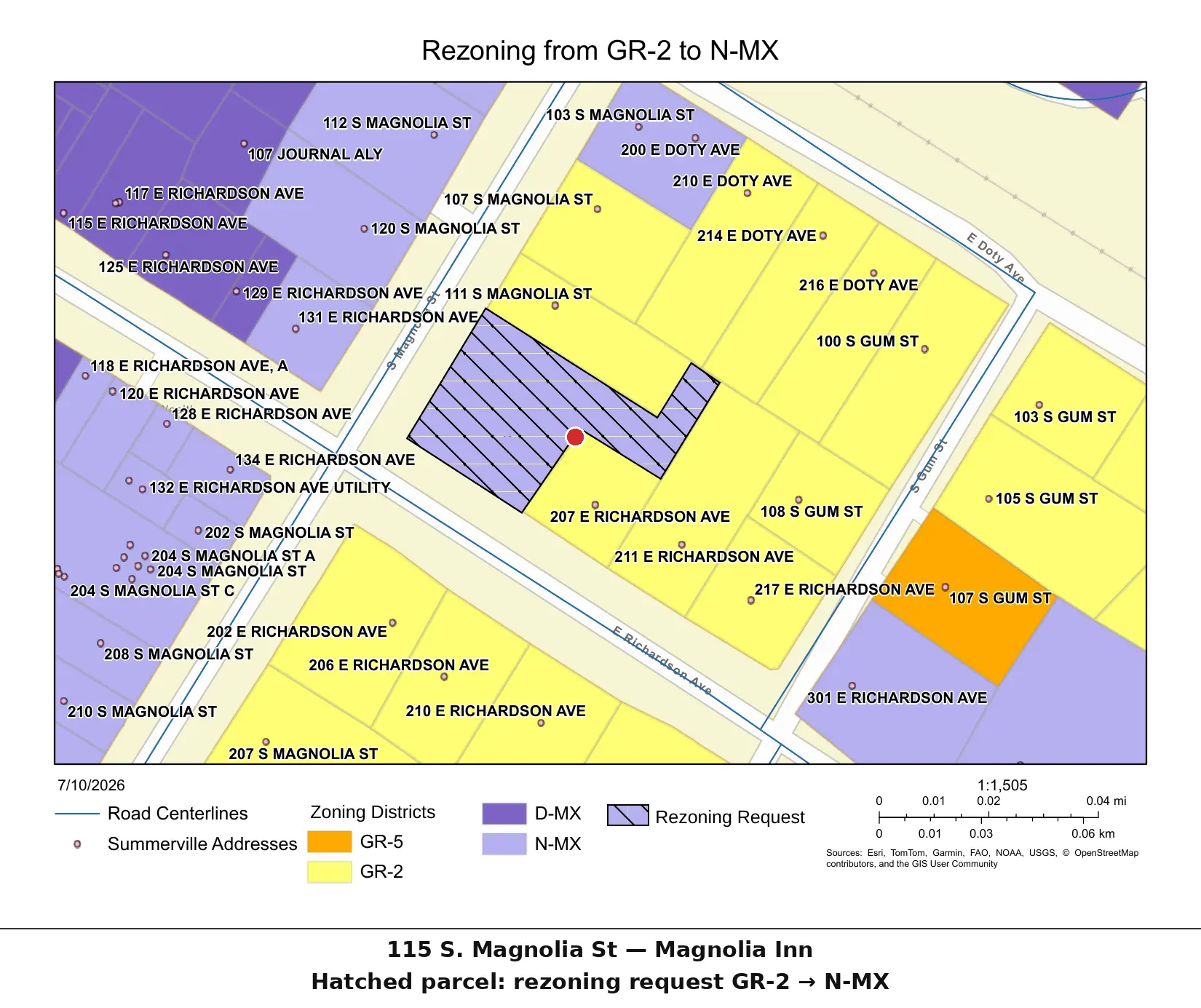
Official zoning map dated July 10, 2026, showing the 115 South Magnolia Street property (hatched) proposed for rezoning from GR-2 to N-MX, alongside surrounding residential and mixed-use zoning districts. The map was included in the August 10 committee packet for the Magnolia Inn rezoning request, a separate matter from the October 15 short-term rental ordinance review. Source: Town of Summerville.
But neighboring residents saw the situation differently.
The Planning Commission recommended denial of the N-MX rezoning request in July.
And the objections highlight a broader concern: what happens when commercial uses gradually expand into streets that have historically been residential?
Neighbors Raise Concerns About the Character of South Magnolia Street
Residents opposing the Magnolia Inn rezoning have argued that the proposed change could affect more than one property.
In correspondence submitted to the Planning Commission, Laura Crosby questioned whether the requested zoning was consistent with Summerville’s Comprehensive Plan and future land-use designations.
She also opposed previous attempts to rezone the property.
Birdie Crosby raised concerns that approving the request could encourage additional neighboring properties to seek commercial or mixed-use zoning.
That distinction is important because a zoning change can authorize uses beyond the specific business involved in the original application.
A decision made to accommodate one lodging property could have longer-term implications for how nearby land is developed or occupied.
Other residents have raised concerns about the increasing commercial character of the area and the cumulative effects of short-term rentals on established neighborhoods.
Their perspective reflects a familiar concern in growing communities: how to accommodate economic activity without gradually changing the residential character that attracted people to those neighborhoods.
Property Owners and Hospitality Supporters See Another Side
Property owners and supporters of short-term accommodations have raised a different set of concerns.
They argue that downtown Summerville needs a range of places for visitors to stay, particularly as the town continues to attract tourists, event attendees, and people visiting local businesses.
The availability of accommodations can affect the broader downtown economy.
Visitors staying overnight may also spend money at nearby restaurants, shops, and other businesses.
For some property owners, the debate also raises questions about whether regulations allow reasonable use of properties in areas where residential and commercial activities already exist side by side.
During earlier Council discussions, short-term rental supporters, including Wesley Donehue and Tim Pye, were identified in meeting accounts as defending the importance of local hospitality and downtown accommodations.
Those accounts reflect a contrasting perspective to the neighborhood objections, although the exact wording of their remarks should be checked against the official minutes before being published as direct quotations.
The two positions are not necessarily mutually exclusive.
Residents can reasonably expect protections against disruptive commercial activity, while property owners can reasonably ask for clear rules governing permitted uses.
The challenge for Summerville is determining where different types of accommodations belong and how they should operate.
Enforcement Is Another Part of the Discussion
Regulations only have practical meaning when the town can identify properties operating outside its rules.
Summerville’s existing regulations include provisions addressing permits, business licenses, recordkeeping, inspections, and advertisements.
An online listing can already be relevant when determining whether a property is being offered for short-term rental use.
The proposed requirement to display permit numbers in advertisements could make that oversight more straightforward.
Separate meeting accounts have also described expanded code-enforcement efforts and the use of rental-listing monitoring software.
However, claims about the number of potentially noncompliant listings have not yet been independently confirmed through an official town report.
That distinction matters. A listing flagged for review is not necessarily a confirmed violation, and multiple advertisements can sometimes represent the same property.
The broader issue remains whether the town’s rules are understandable, consistently administered, and enforceable.
Where Does the Proposal Stand?
The October 15 workshop was part of the town’s ongoing process of reviewing and potentially amending its Unified Development Ordinance.
The published meeting agenda authorized Council to discuss and take desired action on proposed short-term rental clarifications.
A third-party meeting account reports that Council voted to advance amended language to the Planning Commission, including changes related to owner-occupancy in certain commercial areas.
However, the town’s online Agenda Center did not have official minutes available for the October 15 workshop as of November 1, 2026.
What’s Up Summerville has not independently confirmed the precise vote, any amendments adopted during the meeting, or the exact version of the proposal forwarded for further review.
What is clear is that the workshop proposal should not be confused with a newly enacted ordinance.
Further review and formal adoption are required before proposed regulatory changes become effective.
Until then, property owners should refer to the town’s currently adopted ordinance and confirm applicable requirements with the town’s Planning and Zoning Department.
What Happens Next for Summerville?
The proposed rewrite could affect several groups differently.
For residents living near short-term rentals, clearer rules may help establish expectations regarding occupancy, parking, neighborhood impacts, and permitted uses.
For property owners, the classification and zoning provisions may determine whether a particular rental operation can be established or continued.
And for businesses serving visitors, decisions about lodging availability could influence the broader hospitality environment.
The town must also consider how its rules apply to different areas.
A residential street several miles from downtown may raise different concerns than a mixed-use block near the town’s commercial center.
Those distinctions are part of what makes the ordinance review significant.
The Magnolia Inn dispute illustrates how complicated the issue can become when an individual property sits near the boundary between established residential uses and expanding commercial activity.
Ultimately, this is about more than Airbnb.
It’s about how Summerville balances neighborhood character, tourism, property rights, and economic activity as the town continues to grow.
The final ordinance language matters, and the review process is worth following.
For residents and property owners on either side of the issue, now is a good time to understand what’s actually being considered and how future decisions could affect their neighborhoods.
Should Summerville provide greater flexibility for short-term rentals in commercially oriented areas while maintaining stronger protections in residential neighborhoods?
Or should the town take a different approach to balancing visitor accommodations and neighborhood concerns?
We’d like to hear from residents, property owners, and local businesses.
Sources and Further Reading
- October 15, 2026 — Town Council Planning Workshop and Proposed Short-Term Rental Revisions
- Town of Summerville — Unified Development Ordinance, Amended January 15, 2026
- August 10, 2026 — Committee Packet, Including Magnolia Inn Rezoning Materials and Correspondence
- September 17, 2026 — Town Council Agenda Packet
- October 8, 2026 — Town Council Minutes
- Town of Summerville — February 2020 Explanation of Short-Term Rental Regulations
- October 15 Council Meeting Account — MyTownView (Third-Party Summary)
Reporting note: This article distinguishes existing short-term rental requirements from revisions proposed during the October 15 workshop. The exact Council action reported by a third-party meeting account has not been independently confirmed against official minutes or a recording. The Magnolia Inn rezoning request is a separate proceeding from the townwide short-term rental ordinance review.
Support Local • Love Summerville