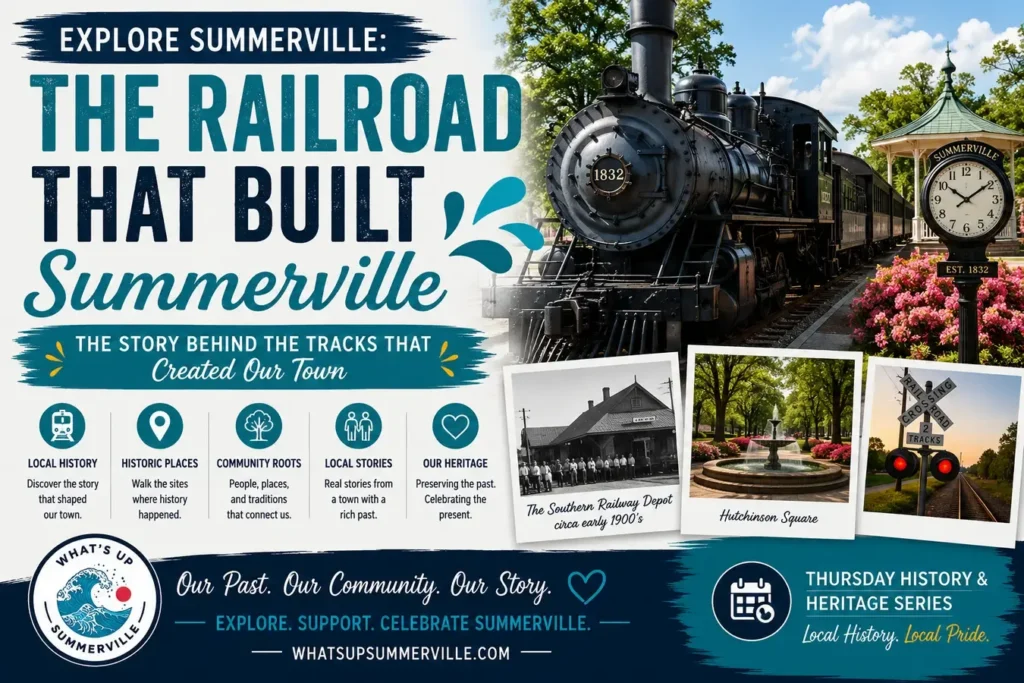
Imagine Summerville without the railroad. No downtown as we know it. No seasonal retreats among the pines. No depot. No commuters traveling between Charleston and the countryside. In many ways, the railroad didn't simply connect Summerville to the world—it created the town itself.
Most people don't think much about the railroad tracks that run through Summerville.
They're part of the scenery. You might wait at a crossing on your way to work, hear a train whistle in the distance, or watch freight cars roll through town without giving them a second thought. But those tracks tell one of the most important stories in Summerville's history.
In fact, without the railroad, Summerville as we know it likely wouldn't exist. The town wasn't just near the tracks; it was literally born from them.
Before Summerville: A Pine-Scented Escape
Long before Summerville became known as "Flowertown in the Pines," this area was largely a vast forest of towering longleaf pines and rural land tucked between Charleston and the inland portions of South Carolina.
In the early 1800s, the region offered something many Charlestonians desperately needed during the sweltering summer months: cooler temperatures, cleaner air, and a welcome escape from the heat and disease, including yellow fever and malaria, that often plagued the low-lying city.
The challenge was getting here. In those days, traveling even a relatively short distance could be difficult, slow, and incredibly uncomfortable. A journey that today takes 30 minutes in a car could take a full day by horse and carriage over rutted, sandy roads.
That changed forever with the arrival of the iron horse.
The First Tracks: The South Carolina Canal and Rail Road Company
While many people associate local rail history with the Charleston & Savannah Railroad, the true "founding father" of Summerville's tracks was the South Carolina Canal and Rail Road Company (SCC&RR).
Chartered in 1827, this ambitious company aimed to connect the port of Charleston to Hamburg, SC (near present-day Augusta, GA). It was a pioneering project that would eventually result in the longest continuous commercial railroad in the world at the time.
In late 1830, a locomotive named the "Best Friend of Charleston" made its debut. It was one of the first steam locomotives built in the United States, and it began running demonstration trips right out of Charleston. By July 1832, the tracks reached exactly 22 miles inland, stopping right here in Summerville.
The railroad didn't simply stop in Summerville. It helped create the very conditions that allowed Summerville to grow.
"New Summerville": A Town Designed by the Rails

In 1831, the SCC&RR did something visionary: they purchased land around the small seasonal village of Summerville and laid out a brand-new, planned community.
Often called "New Summerville," this town was designed on a specific grid known as the Detmold Plan. It featured a checkerboard pattern where building lots alternated with park blocks. These green spaces weren't just for looks; they were designed to ensure air flow and preserve the pines, which were believed to have medicinal qualities.
Unlike many communities that developed around rivers or ports, Summerville’s growth centered entirely around transportation. The railroad brought visitors, supplies, mail, and commerce. Houses and businesses naturally clustered near the station, and the town we know today began to take shape along that central steel spine.
The Birth of a Destination
As Summerville's reputation spread, the railroad made it possible for families to do more than just visit. They could live here.
By 1848, a dedicated commuter-style train began running between Charleston and Summerville. During the summer months, wealthy Charlestonians would ride the rails to their seasonal retreats among the pines. The railroad allowed them to work in the city and sleep in the cooler, healthier air of the "Flowertown."
The combination of natural beauty, easy accessibility via the train, and community spirit helped transform a seasonal retreat into a thriving, permanent town. Churches, schools, and civic organizations followed the families, and the depot became the heart of the community—a gathering place and a vital connection to the wider world.
The Golden Age and the Grand Depot

By the turn of the 20th century, Summerville had entered its "Golden Age" and become one of America's most respected health resorts. The town gained international recognition and was famously named one of the two best places in the world for the recovery of lung disorders by a world congress of specialists in Paris.
To accommodate the influx of wealthy tourists staying at grand establishments like the Pine Forest Inn, the railroad upgraded its presence. In 1902, the Southern Railway Depot opened at the north end of Hutchinson Square. Designed by the famous architect Frank Milburn, it was a grand, manor-like structure that stood as a symbol of the town's prosperity.
For decades, the depot was the center of Summerville life. It was where students left for college, where soldiers returned from war, and where the first azaleas were shipped out to spread the town’s beauty to other states.
The Railroad Today: A Living Connection

More than a century later, trains still move through the heart of Summerville.
While the grand Milburn depot was eventually demolished in the 1960s as passenger service declined, the tracks remain. Today, they are operated by Norfolk Southern, and they sit on the very same 1830s railbed cleared by the SCC&RR nearly 200 years ago.
"The tracks that sometimes delay our commute are the same tracks that established Summerville as a destination."
The role of the railroad has shifted from moving people to moving the freight that powers our economy, but its presence remains a visible and audible reminder of our origins. Those same rails helped establish Summerville as a destination, encouraged investment, and shaped the community we enjoy today.
The next time you find yourself waiting at a crossing, take a moment to consider what those rails represent. They aren't just carrying freight; they're carrying the story of how Summerville came to be.
Final Thoughts
Every town has an origin story. For Summerville, that story runs along a set of steel rails through the heart of town. The railroad connected people, created opportunity, and transformed a quiet stretch of pine forest into one of the Lowcountry's most beloved communities.
And more than a hundred years later, its impact can still be seen—and heard—every day.
Walk the Railroad's Legacy
If you want to experience the "Railroad Town" feel for yourself, take a stroll through the historic district. Many of our favorite local spots are just steps from the line:
Hutchinson Square
The historic heart of town where the grand Southern Railway Depot once stood. Today, visitors can enjoy community events, public art, restaurants, and one of the most walkable areas in Summerville.
Summerville Farmers Market
Held just steps from the historic rail line, the market offers a chance to experience a gathering place much like the community hubs that grew around the railroad more than a century ago.
- Location: Market Details
Get in Touch with Local History
Know another hidden gem, historic marker, or story we should feature? Let us know: we’re always looking for new ways to celebrate the history of the Flowertown!
{“@type”:”BlogPosting”,”image”:[“https://cdn.marblism.com/k9igotB8Nr2.webp”,”https://cdn.marblism.com/haSlwTi7-E6.webp”,”https://cdn.marblism.com/w7WRgrwkoEl.webp”,”https://cdn.marblism.com/HTo_8kLfl3h.webp”],”author”:{“url”:”https://www.whatsupsummerville.com”,”name”:”What’s Up Summerville”,”@type”:”Organization”},”@context”:”https://schema.org”,”headline”:”Explore Summerville: The Railroad That Built Summerville”,”publisher”:{“logo”:{“url”:”https://www.whatsupsummerville.com/logo.png”,”@type”:”ImageObject”},”name”:”What’s Up Summerville”,”@type”:”Organization”},”articleBody”:”Most people don’t think much about the railroad tracks that run through Summerville. They’re part of the scenery… [full text of article]”,”description”:”Discover the deep history of the railroad in Summerville, SC. From the pioneering ‘Best Friend of Charleston’ to the planned town grid, learn how the tracks shaped the Flowertown.”,”datePublished”:”2026-06-07T12:24:00-04:00″}