
Before someone calls, messages, books, orders, or walks through your door, there is a good chance they have already spent a few minutes checking out your business.
They may look at Google first. Then Facebook. Maybe Instagram. They might scroll through photos, check your hours, look for pricing, and see how easy it is to get in touch.
They are probably not thinking of it as an audit.
But that is essentially what they are doing.
They are trying to answer one simple question:
Does this business feel current, active, and trustworthy enough for me to take the next step?
That makes it worth occasionally looking at your business the same way a potential customer does.
Are You Clearly Active?
Start with the most basic signal.
When was the last time your business showed signs of life online?
That does not mean you need to post every day. But if your last Facebook post was six months ago, your newest Google photo is from 2024, and nothing on your website has changed in a year, a potential customer may wonder whether you are still open.
Recent activity gives people reassurance.
A new product. A photo from the shop. An upcoming event. A seasonal update. A customer favorite.
Even something simple tells people:
Yes, we are here.
What Do Your Photos Tell Them?
Customers use photos to answer questions you may never hear them ask.
What does the place look like?
What kind of products do you carry?
What does the food actually look like?
Is it casual or upscale?
Is there somewhere to sit?
What should I expect when I arrive?
Real, recent photos can build confidence quickly.
Take a look through the photos people see on Google, Facebook, Instagram, your website, and anywhere else your business appears.
Do they still represent your business today?
How Easy Is It to Find the Basics?
A customer should not have to become a detective.
Can they quickly find your:
- Hours
- Address
- Phone number
- Website
- Menu or services
- Booking or ordering link
- Contact options
This is where the Local Trust Audit is different from simply checking whether your information matches everywhere.
Consistency matters, but so does accessibility.
Your information can be perfectly accurate and still be frustrating if someone has to hunt for it.
Every extra step gives them another opportunity to leave.
Do They Have Any Idea What It Costs?
Not every business can put an exact price on everything.
That is fine.
But customers usually want some idea of what they are getting into before they reach out.
A restaurant can show a current menu.
A service business can list starting prices.
A photographer might show package ranges.
A contractor with custom pricing can explain how quotes work.
The goal is not necessarily to give away every number.
It is to remove enough uncertainty that someone feels comfortable taking the next step.
Can They Contact You the Way They Prefer?
Some customers want to call.
Others absolutely do not.
They may prefer Facebook Messenger, email, a contact form, online booking, or ordering directly through your website.
Look at your business from their perspective.
If they discover you at 9 PM after you have closed for the day, can they still do something?
Can they request an appointment?
Send a question?
Place an order?
A strong online presence does not force everyone through one door. It gives customers a clear way forward.
Watch for the Small Signs of Neglect
Sometimes the things that create doubt are surprisingly small.
A broken link.
An expired promotion.
A menu that has not been updated.
A Facebook cover photo advertising an event that happened months ago.
A page that still says “Coming Soon” long after something launched.
One outdated detail probably will not cost you a customer.
But several of them together can start telling a story you never intended to tell.
And that story may be:
Nobody is paying attention here.
Run the Audit Yourself
Pretend you know nothing about your own business.
Better yet, open a private browser window and search for it the way a customer might.
Look at the search results.
Open your website.
Check your social pages.
Scroll through the photos.
Try the links.
Find the hours.
Look for pricing.
Figure out how you would contact the business.
Then ask yourself:
If I were finding this business for the first time, would what I see make me comfortable taking the next step?
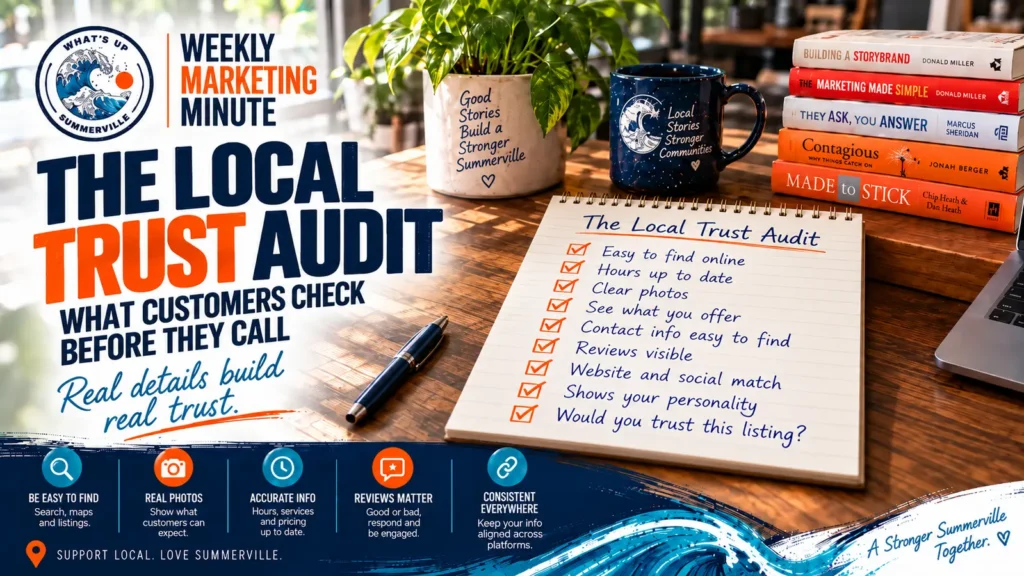
That is the Local Trust Audit.
You are not just checking whether everything is technically correct.
You are checking whether the entire experience gives a potential customer enough confidence to call, click, message, book, order, or walk through the door.
Your Marketing Minute
Customers begin forming an opinion about your business before you ever know they are looking.
Make sure what they find gives them a reason to keep going.
Support Local • Love Summerville