
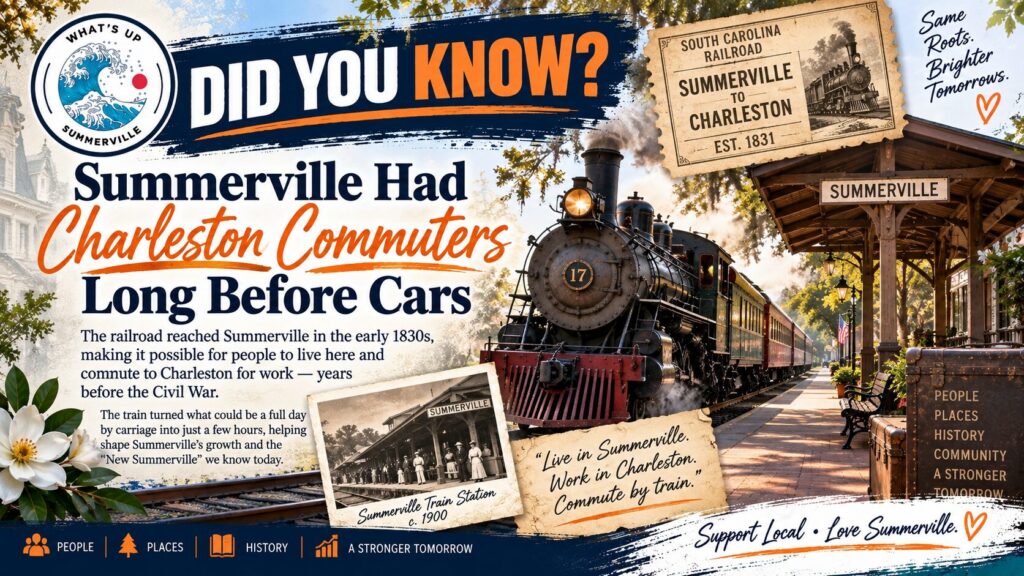
Long before I-26 traffic, brake lights, and morning backups into Charleston, people were already commuting between Summerville and the city for work.
They just did it by train.
For this week’s Did You Know?, we’re going back to the railroad era — when a new transportation connection helped transform Summerville from a seasonal retreat into something that looks surprisingly familiar today.
The Railroad Changed Summerville
Railroad construction between Charleston and the interior of South Carolina began in 1830, and by the early 1830s the line had reached Summerville.
That was a major change.
Before the railroad, traveling between Summerville and Charleston could take most of a day by carriage. The new rail connection cut that trip to a matter of hours and made regular travel between the two communities much more practical.
It didn’t just make Summerville easier to visit.
It made living here while working in Charleston possible.
Yes, Summerville Had Commuters Before the Civil War
According to the South Carolina Encyclopedia, some Summerville residents were commuting to jobs in Charleston before the Civil War.
One of them was noted South Carolina writer William Gilmore Simms.
Simms lived in Summerville for several years and used the train to travel into Charleston for his work as an editor.
More than a century before anyone complained about the morning drive on I-26, the basic idea was already here:
Live in Summerville. Work in Charleston. Commute between the two.
The Railroad Helped Create a “New Summerville”
The railroad did more than move people.
It helped reshape the town itself.
In 1832, the South Carolina Canal and Railroad Company laid out what became known as “New Summerville” near the railroad tracks.
Unlike the older settlement with its winding roads, the new section was laid out using a more regular street grid running alongside and across the railroad.
Land near the tracks became increasingly important for businesses, transportation, and daily life.
An open space was also set aside near the railroad — part of the area that eventually became the heart of downtown Summerville.
If you look at downtown today, the railroad still cuts directly through the middle of that layout.
Summerville’s Commuter Story Didn’t End There
Passenger service between Summerville and Charleston continued for generations.
By the early 20th century, the rail corridor had become a well-established transportation route between the two communities.
Historical records show multiple passenger trains running between Summerville and Charleston each day, serving commuters and travelers along the route.
Automobiles, buses, changing travel habits, and declining passenger rail use eventually reduced that service.
But the relationship it helped establish never really disappeared.
Summerville continued developing into a community where many people lived locally while traveling elsewhere in the Charleston area for work — something that remains very familiar today.
Before I-26, There Were Railroad Tracks
It’s easy to think of Summerville’s connection to Charleston as a modern result of suburban growth.
But that relationship goes back much further.
The railroad made Summerville more accessible, helped shape downtown, encouraged permanent settlement, and allowed people to begin doing something residents still do nearly two centuries later:
Wake up in Summerville and head toward Charleston for work.
The transportation has changed.
The commute definitely has.
But the connection between the two communities is nothing new.
Support Local • Love Summerville.