You can live in Summerville for years and still pick up a few assumptions about the town that aren’t quite right.
Some come from how quickly the area has grown. Others come from the fact that “Summerville” can mean the actual Town of Summerville, a mailing address, or the much larger area people casually think of as Summerville.
So for this week’s Explore Summerville, we’re clearing up a few of the most interesting ones.
1. Summerville Isn’t Just in Dorchester County
This is probably one of the easiest assumptions to make.
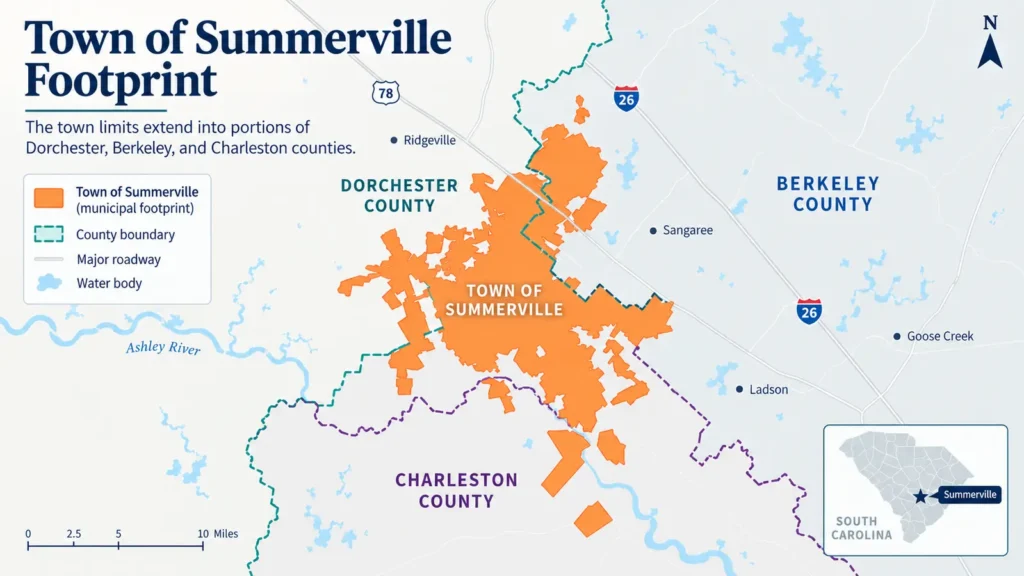
Dorchester County is the county most closely associated with Summerville, but the Town’s official boundaries actually extend into three counties: Dorchester, Berkeley, and Charleston.
That also helps explain why two people can both say they live in Summerville but deal with different county offices, schools, taxes, or services.
2. A Summerville Mailing Address Doesn’t Necessarily Mean You Live Inside the Town of Summerville
This one causes plenty of confusion.
Properties with Summerville addresses can be either inside the municipal limits or outside the incorporated Town of Summerville.
Town regulations and services only apply to properties actually located within town limits.
So “Summerville” on the envelope and “Town of Summerville” are not always the same thing.
That distinction becomes a lot easier to understand when you look at a map. The area using Summerville, SC mailing addresses stretches beyond the incorporated municipal boundary.
3. Summerville Didn’t Suddenly Begin in 1847
You’ll see 1847 everywhere because that’s the year Summerville was officially incorporated.
But the community itself is older.
Summerville’s beginnings stretch back to the late 1700s, when people from the Charleston area traveled inland to the pine-covered ridge during the summer months.
The railroad and later incorporation formalized a community that had already been developing for decades.
So 1847 marks the creation of the municipality — not the first appearance of Summerville.
4. “The Flower Town in the Pines” Isn’t Just a Cute Tourism Slogan
The flowers get most of the attention, especially every spring.
But the pine part of Summerville’s identity runs surprisingly deep.
After incorporation, the first Town Council passed a tree-protection ordinance in early 1848. The Town says that ordinance continues to be enforced today and is believed to be among the oldest tree-protection ordinances in the country.
The Town’s motto even includes:
“Sacra Pinus Esto” — “The Pine is Sacred.”
So the pines weren’t added to the branding later.
They were part of how early Summerville saw itself.
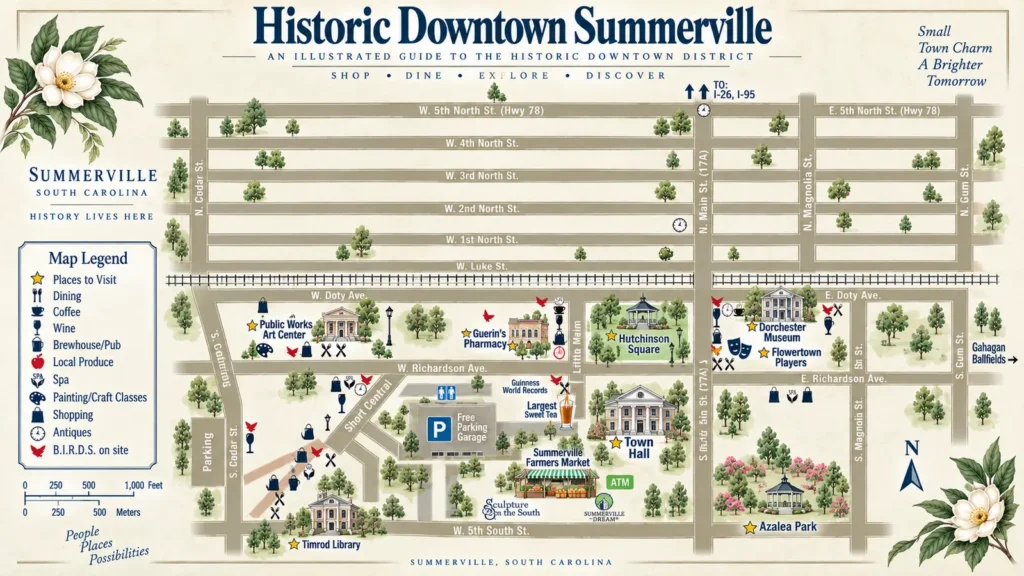
5. The Historic District Is a Lot Bigger Than Hutchinson Square
When people hear “historic downtown,” it’s easy to picture the Square, Main Street, and a handful of nearby storefronts.
But Summerville’s historic district reaches beyond the commercial core and includes hundreds of historically significant buildings, including homes, churches, and commercial properties.
Town planning documents have identified more than 700 historically significant buildings within the district.
That’s why historic-preservation rules can apply well beyond the blocks most people think of as “downtown.”
6. Summerville Is Probably Smaller — and Bigger — Than You Think
The official Town of Summerville had an estimated 53,177 residents in 2025, according to the U.S. Census Bureau.
That number can feel surprisingly low if you’re thinking about every neighborhood, subdivision, and business that uses “Summerville” in its address.
But that goes back to the town-limits issue.
The broader Summerville area people experience every day stretches well beyond the municipality itself.
So depending on what somebody means by “Summerville,” two very different population numbers can both sound believable.
7. Downtown Summerville Isn’t Frozen in Time
The historic look can make it feel like downtown has always existed more or less the way it does now.
It hasn’t.
Historic buildings have been renovated, restored, repurposed, and reoccupied over decades, while public projects and private redevelopment have continued reshaping downtown.
Historic preservation doesn’t mean nothing changes.
It means change happens while trying to preserve the character that made the area worth protecting in the first place.
Summerville Is a Little More Complicated Than the Name on the Map
Part of what makes Summerville interesting is that there are several versions of it layered together.
There’s the incorporated town.
There’s the larger area with Summerville mailing addresses.
There’s historic Summerville.
And there’s the fast-growing modern community surrounding all of it.
Once you start separating those pieces, a lot of things that seem confusing about the area start making a little more sense.
What’s something about Summerville that surprised you when you first learned it?
Support Local • Love Summerville.