
Walk through downtown Summerville on a quiet morning, and you’ll notice something remarkable.
Beyond the moss-draped oaks, colorful gardens, and welcoming front porches stand homes that have quietly witnessed generations of weddings, celebrations, hardships, and everyday life. Some have stood for more than a century, preserving stories that helped shape the Summerville we know today. Others were built before automobiles filled our streets, while still others welcomed families escaping Charleston’s summer heat when Summerville was known as a peaceful retreat beneath the pines. Each home has its own story, and together they help tell the story of Flowertown itself.
This week in our Explore Summerville series, we’re exploring some of Summerville’s most beautiful historic homes and exploring the architecture, craftsmanship, and history that continue to define one of South Carolina’s most charming downtowns.
A Town Built Beneath the Pines
Long before Summerville became one of the fastest-growing communities in South Carolina, it was known as a place of rest. The town’s identity is inextricably linked to the towering pine trees that once dominated the landscape. In fact, the town’s early nickname was the “Piney Woods,” and for good reason.
During the late 1800s, Charleston families traveled inland each summer seeking relief from the city’s intense heat and the threat of mosquito-borne illnesses like yellow fever and malaria. They found fresh air and cooler temperatures beneath Summerville’s towering pine forests, where physicians of the era believed the region’s clean inland air offered health benefits for people suffering from respiratory illnesses. In 1888, the International Congress of Physicians even named Summerville one of the top two places in the world for the treatment of lung and throat disorders.
As more families arrived, what began as a cluster of seasonal cabins transformed into a sophisticated resort destination. Elegant cottages, grand residences, churches, schools, and businesses began to appear. The arrival of the South Carolina Canal and Rail Road Company further accelerated this growth, turning a quiet retreat into the thriving community we know today. Many of those early homes still stand as reminders of that remarkable history, surviving hurricanes, fires, and the march of time.

More Than Beautiful Architecture
While every home tells its own story, together they create one of South Carolina’s most architecturally diverse historic neighborhoods.
One of the greatest joys of exploring Summerville is discovering that almost every historic home has its own personality. Unlike modern subdivisions where houses often share the same blueprint, the Historic District is a tapestry of individual expression and craftsmanship.
As you wander through the Historic District, you’ll find a variety of architectural styles that reflect the tastes and trends of the 19th and early 20th centuries, including:
- Victorian & Queen Anne: Characterized by asymmetrical shapes, decorative trim, and often vibrant paint colors.
- Colonial Revival: Known for its symmetry and classical details like pedimented front doors and fanlight windows.
- Classical Revival: Featuring grand, stately columns and a sense of monumental scale.
- Craftsman: Highlighting natural materials and exposed structural elements like rafters and beams.
- Early twentieth-century cottages: Smaller, more intimate homes that often feature steep gables and cozy front porches.
- Traditional Southern homes: Built for the climate, featuring expansive front porches (piazzas) and large windows.
Many of these structures feature tall windows designed to maximize natural light, wide porches for outdoor living, decorative columns that hint at the owner’s status, and intricate woodwork that showcases the skill of local artisans. High ceilings were a necessity, not just a luxury, as they allowed heat to rise and keep the living spaces cooler during the humid South Carolina summers: all designed long before air conditioning became common.
These homes weren’t simply built to impress. They were carefully designed to capture summer breezes, provide shade from the Lowcountry sun, and create inviting spaces where neighbors gathered for long afternoon chats on the porch long before television and smartphones existed.
💡 Did You Know?
Before air conditioning, many historic Summerville homes were intentionally designed with tall ceilings, expansive porches, transom windows, and large double-hung windows to capture natural breezes and help families stay cool during the Lowcountry’s long summers.
🏡 Historic Home Spotlight: White Gables

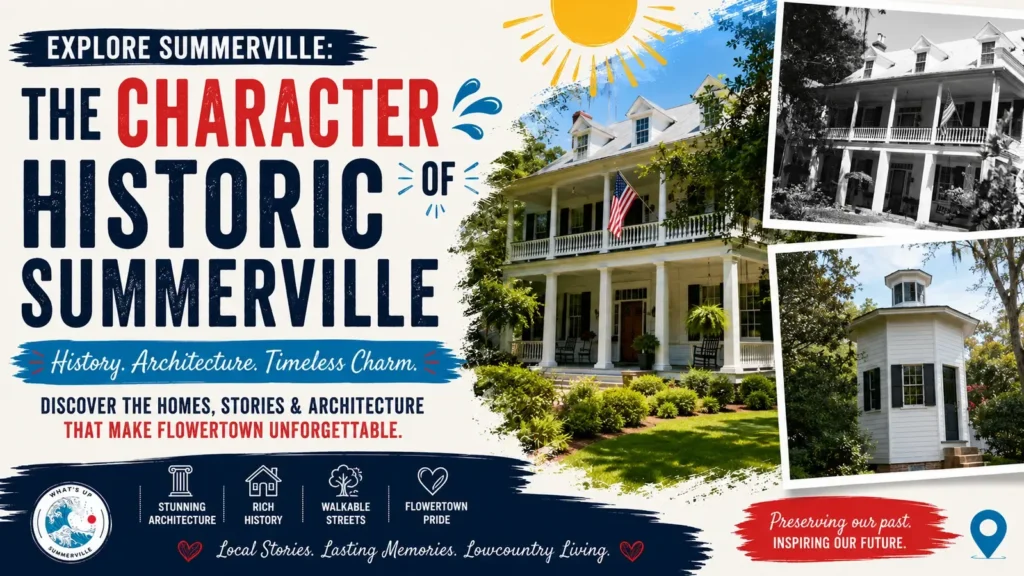
Perhaps no historic home in Summerville is more recognizable than White Gables. Located at 603 West Richardson Avenue, this stunning residence stands as a pinnacle of the town’s architectural heritage.
Originally constructed in the early 1830s by John Peake (sometimes referred to as Henry Peake), an officer and engineer with the South Carolina Canal and Railroad Company, White Gables became one of Summerville’s most recognizable homes. Over the decades, it served both as a private residence and, during two distinct periods, as a welcoming inn for visitors — briefly after the Civil War, and later from 1914 to 1939 under owner Sara Woodruff, who transformed White Gables into a successful hospitality destination during Summerville’s Golden Age.
The property also features an enclosed octagonal gazebo built in 1893, modeled after the privies at Thomas Jefferson’s Monticello.

Today, White Gables is a private residence owned by Steven and Denise Lang. Its 18-inch-thick masonry walls survived the 1886 earthquake and multiple hurricanes, a remarkable testament to the craftsmanship and durability that have helped preserve Summerville’s architectural legacy.
Visiting Note: White Gables
While White Gables is a private residence and not open for public tours, you can admire its stunning architecture from the sidewalk at 603 West Richardson Avenue as you explore the Historic District.
Streets Worth Exploring
While White Gables may be one of the best-known homes, it is far from the only one worth admiring. Summerville’s historic core is best explored on foot, where every turn reveals a new architectural gem.
Looking for a route?
Before you head out, don’t miss our companion guide, The Walkable Flowertown: A Local’s Guide to the Best Strolls in the Historic District, where we highlight some of our favorite walking routes, scenic streets, and hidden corners of historic downtown. Then come back and discover the stories behind the homes and architecture you’ve seen along the way.
South Main Street
A walk along South Main Street reveals beautifully preserved residences shaded by mature oaks and framed by colorful gardens. Here, the boundary between commercial and residential life blurs, reflecting the town’s growth as a hub for both families and local business owners. Many were built by merchants, business owners, physicians, and civic leaders whose lives centered around what is now Hutchinson Square. Each home reflects a different chapter in Summerville’s architectural history, making this one of the town’s most picturesque streets.
The Summerville Historic District
Listed on the National Register of Historic Places in 1976, the Historic District contains dozens of homes that showcase more than a century of architectural styles. Walking these streets feels like stepping back in time, where brick sidewalks, historic churches, and lovingly restored homes create one of the Lowcountry’s most charming neighborhoods. Keep an eye out for the “Summerville Single” houses: a local variation of the famous Charleston Single House.
Don’t rush your walk. Some of the district’s finest details aren’t found on grand front porches, but in hand-carved brackets, stained-glass transoms, ornate ironwork, and century-old brick paths that reward those who slow down and look closely.
Around Hutchinson Square
While many visitors come to Hutchinson Square for its restaurants, shops, and festivals, a short walk in any direction reveals beautiful historic residences tucked just beyond the commercial district. These homes remind us that downtown Summerville has always been more than a shopping destination: it has long been a place where families built their lives and founded the traditions we still celebrate today during the Flowertown Festival.
The Stories Behind the Porches
Historic homes are about much more than architecture. They are the physical archives of our community’s soul. Every front porch has welcomed conversations between neighbors about the weather, the harvest, or the news of the day. Every dining room has hosted holiday gatherings that spanned decades. Every staircase has been climbed by generations of children growing up in Summerville, many of whom went on to build their own homes nearby.
Many of these homes were once owned by families who helped shape Summerville’s early history—physicians, educators, business owners, railroad employees, and civic leaders whose contributions helped the community grow. Their stories may not always appear on bronze historical markers, but they remain woven into the fabric of our community, passed down through family legends and local lore.
Preservation Matters
One of the reasons Summerville feels different from so many rapidly growing communities in the Charleston area is its deep commitment to preserving its past. Our town understands that history is a finite resource.
Historic homes provide a tangible connection to earlier generations while helping maintain the unique character that makes Flowertown so special. Rather than replacing history with something new and generic, preservation allows today’s residents and tomorrow’s visitors to appreciate the craftsmanship, architecture, and stories that continue to define downtown Summerville. It is a testament to the community’s commitment to local heritage.
History isn’t confined to museums. Sometimes it’s waiting quietly behind a white picket fence or beneath a canopy of Spanish moss.
It’s one of the reasons downtown Summerville still feels authentic rather than manufactured.
Explore Respectfully
Many of Summerville’s historic homes remain private residences, cherished by the families who live in them today. While we encourage everyone to explore and appreciate the beauty of our town, it’s important to do so with care.
If you decide to spend an afternoon exploring the Historic District, enjoy these beautiful homes from public streets and sidewalks, respect private property, and remember that behind every historic façade is someone’s home. Bring your camera, wear comfortable walking shoes, and take your time. Some of Summerville’s most beautiful details: like a piece of hand-carved molding or a stained-glass transom: are easy to miss if you’re in a hurry.
If you want a more structured way to explore, be sure to visit the Summerville Visitor Center to pick up an official walking tour map!
Planning Your Visit?
Stop by the Summerville Visitor Center for a walking map and recommendations on other historic landmarks to explore while you’re downtown.
- Website: VisitSummerville.com
- Phone: (843) 873-1991
- Address: 402 North Main Street, Summerville, SC 29483
The Bottom Line
Historic homes aren’t simply reminders of our past—they’re part of our community’s living story. Every preserved porch, towering oak, and hand-crafted window reflects generations of people who helped make Summerville what it is today. The next time you’re walking downtown, slow your pace, look a little closer, and imagine the lives that unfolded behind those walls. You may discover that one of Flowertown’s greatest treasures isn’t hidden behind museum doors—it’s quietly waiting along our neighborhood streets.
Whether you’re a lifelong resident or discovering Flowertown for the first time, these streets offer one of the best ways to experience the community’s history—one front porch at a time.
Explore. Support. Celebrate Summerville.
Explore Summerville
Our Explore Summerville series celebrates the people, places, landmarks, and stories that shaped Summerville into the community we know today. Every historic home, church, street, and landmark adds another chapter to the story of Flowertown; and we’re just getting started. Keep an eye on our What’s Up Summerville Events Calendar for upcoming heritage tours, museum talks, and historic walks through the heart of our town!