
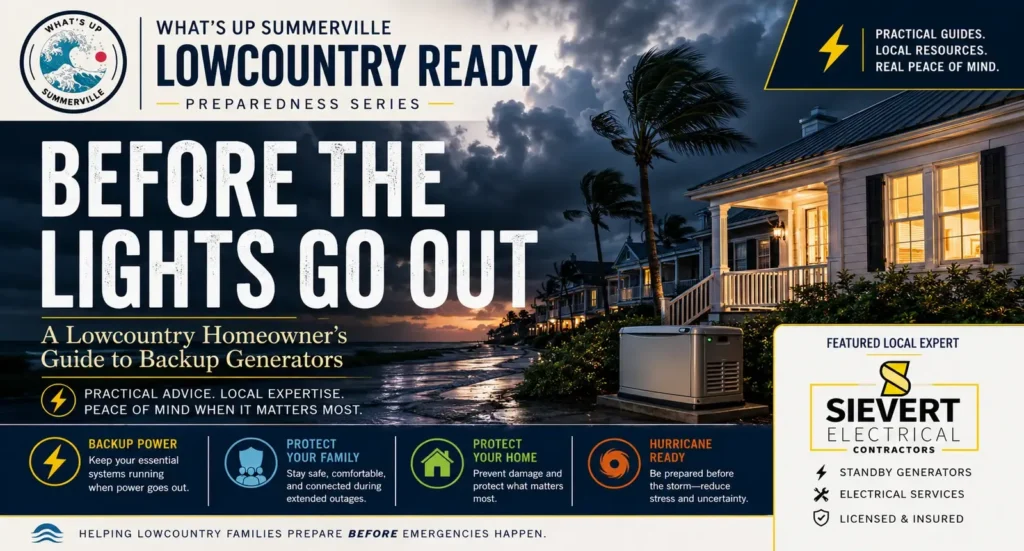
🛡️ What’s Up Summerville Lowcountry Ready Guide
Part of the What’s Up Summerville Lowcountry Ready Series
Featuring Local Expertise from Sievert Electrical Contractors
Living in the Lowcountry means hurricane season is simply part of life.
Whether you’ve weathered Hurricane Hugo, Matthew, Irma, or Ian, or simply one of our summer thunderstorms that knocked out power across the neighborhood, most Lowcountry residents know the feeling of wondering, ‘How long will this outage last?’
Some years, the storms stay well offshore. Other years, we spend days watching weather updates, hoping the forecast shifts just a little farther east. Even when a hurricane never makes landfall nearby, strong winds, saturated ground, and falling trees can still leave entire neighborhoods without power.
And hurricanes aren’t the only cause. Summer thunderstorms, tropical systems, vehicle accidents involving utility poles, and equipment failures can all leave homes without electricity for hours—or even days.
The question isn’t whether another outage will happen. The question is whether your home will be ready when it does.
📋 Quick Facts
- Best For: Homeowners preparing for hurricane season and extended power outages
- Covers: Portable generators, standby generators, installation considerations, maintenance, and hurricane preparedness
- Featured Local Expert: Sievert Electrical Contractors
- Related Guide: What’s Up Summerville Lowcountry Ready Guide
🌴 Lowcountry Lessons
One thing longtime Lowcountry residents learn is that preparation isn’t panic.
Most years, we’ll watch several named storms develop in the Atlantic without experiencing significant impacts here at home. But every few years, one reminds us just how quickly life can change.
The grocery store shelves empty. Gas stations develop long lines. Portable generators disappear overnight. Electrical contractors become booked weeks in advance.
“The families who experience the least stress usually aren’t the luckiest. They’re simply the ones who prepared before hurricane season arrived.”
Why Backup Power Matters
When most people picture a power outage, they imagine sitting in the dark. In reality, electricity powers nearly every part of modern life. Without it, you could lose:
- Climate Control: Losing air conditioning during South Carolina’s hottest months isn’t just uncomfortable; it can be dangerous for seniors and pets.
- Food Safety: Refrigerated food and medications can spoil in just a few hours without power.
- Connectivity: Internet, Wi-Fi, and cell phone charging are your lifelines for news and family updates.
- Medical Security: Medical devices such as CPAP machines or oxygen concentrators require reliable electricity.
- Home Safety: Security systems, cameras, garage door openers, and well pumps all rely on the grid.
- Home Comfort: Keeping refrigerators, freezers, and climate control running can help prevent thousands of dollars in spoiled food and potential damage caused by prolonged outages.
For some families, losing electricity is inconvenient. For others, it can quickly become a safety concern. Backup power isn’t just about comfort—it’s about protecting your home, your family, and your peace of mind.
Portable vs. Whole-Home Generators
Not every homeowner needs the same solution. The right choice depends less on the size of your home and more on how you live in it.

Portable Generators
Portable generators are often the most affordable way to keep essential appliances running during an outage. They’re ideal for powering refrigerators, freezers, a few lights, fans, and charging electronics. However, they require manual setup, safe fueling practices, extension cords or transfer equipment, and ongoing monitoring while they’re operating. Portable generators should never be connected directly to your home’s electrical system without an approved transfer switch. Improper connections can create dangerous backfeeding that puts utility crews and your family at risk.
Whole-Home Standby Generators
Whole-home generators are permanently installed outside your home and automatically restore power within seconds after an outage. Depending on the system you choose, they can power everything from essential circuits to nearly your entire home. For families with young children, aging parents, medical equipment, home offices, or simply those who value uninterrupted comfort, standby generators offer a level of convenience that’s difficult to match. Many standby generators perform a brief self-test automatically each week, helping ensure the system is ready if an outage occurs.
Five Questions to Ask Before Investing
Before purchasing any generator, ask yourself:
- How often does my neighborhood lose power?
- How long can my family comfortably go without electricity?
- Does anyone in my household rely on powered medical equipment?
- Do I work from home?
- Would losing refrigerated food or medications create a significant hardship?
The answers can help determine whether a portable generator is enough—or whether investing in a permanent standby system makes sense.
Think Beyond Hurricane Season
While generators are often associated with hurricanes, they’re useful year-round.
Summer thunderstorms, fallen trees, equipment failures, vehicle accidents involving utility poles, and even unexpected utility maintenance can interrupt power with little warning.
A backup generator isn’t simply hurricane protection. It’s protection from any extended outage.
Common Generator Myths
“I’ll just buy one when a hurricane is announced.”
Unfortunately, that’s exactly when everyone else has the same idea. Inventory becomes limited, installation schedules fill quickly, and homeowners often end up making rushed decisions under pressure. Planning ahead gives you more choices—and far less stress.
“A portable generator can power my entire home.”
While portable generators are incredibly useful, most are designed to power selected appliances—not an entire house. Understanding your home’s electrical needs before purchasing equipment can prevent disappointment when the power goes out.
“Installing one is basically a DIY project.”
Whole-home standby generators involve much more than setting equipment beside your home. Electrical service, transfer switches, fuel supply, permitting, and code compliance all play critical roles in ensuring the system operates safely when your family needs it most.
Why Professional Installation Matters
A generator is one of those investments you hope you’ll never truly need. But if the day comes, it has to work immediately—and safely.
Professional installation ensures your generator is properly sized for your home’s electrical demands, connected through an approved transfer switch, installed according to local building and electrical codes, and thoroughly tested before storm season arrives. That’s not something most homeowners want to discover wasn’t done correctly after the lights have already gone out.

Meet a Local Expert
Online research is a great place to start, but every home is different. When you’re ready to move beyond comparing specifications and prices, it’s helpful to talk with someone who installs these systems every day.
Our friends at Sievert Electrical Contractors have helped homeowners throughout the Lowcountry evaluate backup power options, properly size standby generators, complete professional installations, and ensure every system meets current electrical codes and safety standards.
Whether you’re simply gathering information or you’re ready to prepare before the next hurricane season, their team can help you understand the options available and recommend a solution that fits your home—not just the biggest generator on the lot. A properly sized generator can save money upfront, operate more efficiently, and ensure your home’s most important systems are protected when the power goes out.
Thinking About a Generator?
Every home is different, and there’s no one-size-fits-all solution. A consultation can help you understand what makes sense for your home’s size, electrical demands, and budget—without the guesswork.
Learn More About Sievert Electrical Contractors
Want to learn more about Sievert Electrical Contractors, explore their services, business hours, service area, and contact information?
👉 Visit their What’s Up Summerville Business Listing
You’ll find everything you need to connect with their team, learn more about the services they provide, and explore additional photos, updates, and business information—all in one place.
Get in Touch
📞 Phone: (843) 906-9876
📷 Instagram: @sievertelectrical
🔗 View Their What’s Up Summerville Business Listing
Don’t Forget About Maintenance
A generator is only as dependable as its maintenance. Like any engine, standby generators should be exercised regularly and serviced according to the manufacturer’s recommendations. Run your generator according to the manufacturer’s recommended exercise schedule—even if you haven’t experienced a recent outage. Regular operation helps identify potential issues before they’re discovered during an emergency. Routine maintenance typically includes:
- Annual inspections
- Battery testing
- Oil and filter changes (where applicable)
- Fuel system checks
- Automatic exercise cycle verification
The goal is simple: When the power goes out, your generator should start without hesitation.
Hurricane Preparedness Goes Beyond Backup Power
A generator is only one part of preparing your family for hurricane season. Before the next storm arrives, consider these essential steps:

- ✅ Build a seven-day emergency supply kit. (Water, non-perishables, and meds).
- ✅ Review your homeowners insurance. Ensure you have adequate wind and flood coverage.
- ✅ Charge backup batteries. Keep power banks ready for phones and tablets.
- ✅ Keep cash on hand in case credit card systems are offline.
- ✅ Fill vehicle fuel tanks before a storm arrives.
- ✅ Photograph your home’s exterior and valuables for insurance documentation.
- ✅ Secure the yard. Bring in outdoor furniture and loose items.
- ✅ Know your zone. Understand your evacuation zone and plan your route.
- ✅ Store documents. Keep important papers in waterproof containers.
Looking for more ways to prepare? Explore our complete What’s Up Summerville Lowcountry Ready Hub, featuring hurricane preparation, emergency kits, evacuation resources, pet preparedness, power outage planning, and other guides designed specifically for Lowcountry families.
Whether the next outage comes from a hurricane, a summer thunderstorm, or an unexpected equipment failure, taking time to prepare today can make tomorrow feel far less stressful.
Final Thoughts
We all hope hurricane season passes quietly each year. Most years, it does.
But preparing your home isn’t about living in fear—it’s about reducing stress when the unexpected happens.
Whether your preparedness plan includes emergency supplies, evacuation planning, or investing in backup power, every step you take before the storm is one less decision you’ll have to make during it.
Because once the lights go out, it’s too late to start preparing.
The best time to make a plan is while the skies are still blue.