
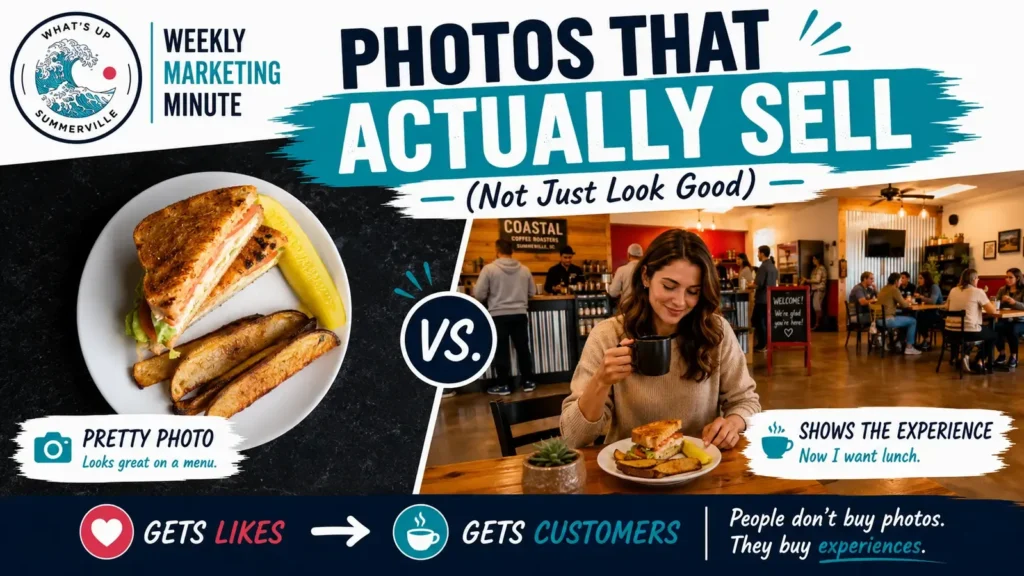
Most small business owners in Summerville spend a lot of time, and sometimes a lot of money, trying to make their photos look professional. We’ve all seen the perfectly staged, high-gloss images in magazines that look like they belong in an art gallery.
But here is a secret from the front lines of local marketing: The best-performing photos aren’t always the prettiest.
In fact, some of the photos that generate the most sales, bookings, and inquiries on our Summerville business directory are the ones that would never win a photography contest.
Why? Because they answer customer questions.
The Difference Between Pretty Photos and Selling Photos
There is a major difference between a “pretty” photo and a “selling” photo. A pretty photo is artistic; it captures a vibe. A selling photo captures an outcome.
Consider these common mistakes:
- Artistic close-ups: A macro shot of a coffee bean is beautiful, but it doesn’t tell me if the shop is a good place to work for the afternoon.
- Empty dining rooms: A wide shot of your restaurant’s interior might show off your new flooring, but it looks lonely. It doesn’t show me that I’ll have a great time there with my friends.
- Isolated products: A single earring on a white background is clear, but I can’t tell how big it is or how it hangs.
The Reality: Customers don’t buy products. They buy outcomes and experiences. They aren’t just buying a loaf of bread from Laila’s Lowcountry Sourdough; they are buying the experience of a slow Sunday morning breakfast with their family.

What Customers Are Actually Looking For
Before someone visits your business, they are mentally “auditioning” you. They are looking for visual proof that you can solve their problem or provide the feeling they want.
Restaurants & Coffee Shops
When someone looks at Coastal Coffee Roasters or a local eatery, they are asking:
- What does the food really look like? (Not the staged version).
- How big are the portions?
- What is the atmosphere like? Is it loud and busy, or quiet and cozy?
Retail & Boutiques
For our local shops, customers want to know:
- What products do you currently have in stock?
- How are the items displayed? Is it easy to browse?
- Can I see myself wearing or using this?
Service Businesses
If you are a contractor, a hair stylist, or a fitness coach, customers are looking for:
- What results can I expect? (The “Before and After”).
- What does the process look like?
- Can I trust these people?
The Five Types of Photos Every Business Should Have
To turn your social media or your business listing into a sales machine, you need a mix of five specific types of photos.
1. Product Photos (The Basics)
This is the “what” of your business. If you’re at the Summerville Farmers Market, this is the crisp shot of your sourdough loaf, your pizza, or your handmade jewelry. Make sure the lighting is clean so the quality is obvious.
2. People Photos
Faces outperform objects every single time. People want to see the owners, the employees, and other happy customers. It builds an immediate human connection that a logo simply cannot provide. People connect with people before they connect with brands.

3. Process Photos
Show the work being done. A photo of dough being shaped by hand at Laila’s or coffee being expertly poured at Coastal Coffee Roasters shows the craftsmanship behind the price tag. It justifies the value of what you do.
4. Experience Photos
This is where many businesses fail. Show your customers enjoying themselves. A photo of a family laughing over a pastry or a client’s “new hair day” smile tells the story of the benefit of your business.
5. Social Proof Photos
Nothing says “this place is great” like seeing a crowd. Photos of a busy Saturday morning at the Farmers Market or a line at a local food truck prove that you are a trusted part of the community.

Why Smartphone Photos Often Outperform Professional Photography
You don’t need a $5,000 camera to sell. In the age of social media, authenticity is currency.
A photo you took on your phone this morning often beats a professional photo from six months ago. Why? Because customers care more about what is true today than what looked polished half a year ago.
They want to know:
- What does it look like right now?
- Is that item still available?
- Is the patio busy today?
- Does the space feel active and current?
Smartphone photos often perform better because they feel real, timely, and trustworthy. They look like something a friend would send. They suggest that this is happening right now, not during a styled shoot from last season. Perfect isn’t always persuasive; sometimes, it creates distance. A slightly imperfect photo of a fresh batch of cookies coming out of the oven can be more convincing than a studio-lit shot that no longer reflects what a customer will actually get.
That does not mean quality does not matter. It means relevance matters more. Good light, a clean lens, and a clear subject on your phone are usually enough to create a photo that helps someone decide to visit, book, or order.
What Not To Post
Some photos make it harder for customers to say yes. Avoid posting:
- Generic stock photos: If people can tell it came from the internet, it does not build trust in your actual business.
- Empty rooms: A spotless dining room or waiting area might look nice, but without people or activity, it can feel cold or unproven.
- Random quote graphics: Inspirational posts rarely help someone understand what you sell, what the experience is like, or why they should choose you today.
If a photo does not show your product, your process, your people, or the customer experience, it is probably not doing much selling.
A Quick Self-Test
Before you hit “post” on your next photo, run through this quick checklist:
- What question does this answer? (e.g., “Yes, we have outdoor seating.”)
- Does it help someone imagine visiting?
- Does it build trust? (Does it show your face or your process?)
- Does it show what makes us different?
- Would this influence a buying decision?
Real-World Example: The “Visit” Test
Imagine you are looking for a place to grab breakfast tomorrow morning. You see two photos:
- Photo A: A beautiful, high-contrast close-up of a coffee cup with steam rising in a dark room.
- Photo B: A bright photo taken on a phone of a customer sitting on a sun-drenched patio with a coffee, a half-eaten pastry, and a dog at their feet.
Photo A is pretty. Photo B makes you want to go there. Photo B answers the questions: “Can I bring my dog?”, “Is there outdoor seating?”, and “Do the pastries look good?”
Local Examples
This week’s examples include:
Your Challenge This Week
Before the end of the week, take and post one of each of these:
- A Product photo
- A People photo
- A Process photo
- An Experience photo
Do not overthink it. Use your phone, find decent light, and focus on showing something real and current.
Then compare the engagement on those posts to your typical content. Look at likes, comments, shares, saves, replies, clicks, or direct messages. The goal is to see which photos actually get people to pay attention and respond.
Final Takeaway
The goal of your marketing photos isn’t to impress other photographers or win design awards. It is to help potential customers make a decision.
The businesses in Summerville that consistently show their products, their people, their process, and the actual experience of being there are the ones that make it easiest for customers to say “yes.” Before you post, ask one practical question: Does this photo make someone want to visit, book, or order? If the answer is no, take a better one today with your phone, find the light, and show what your business actually looks like right now.