🦃 DID YOU KNOW? · SOUTH CAROLINA HISTORY
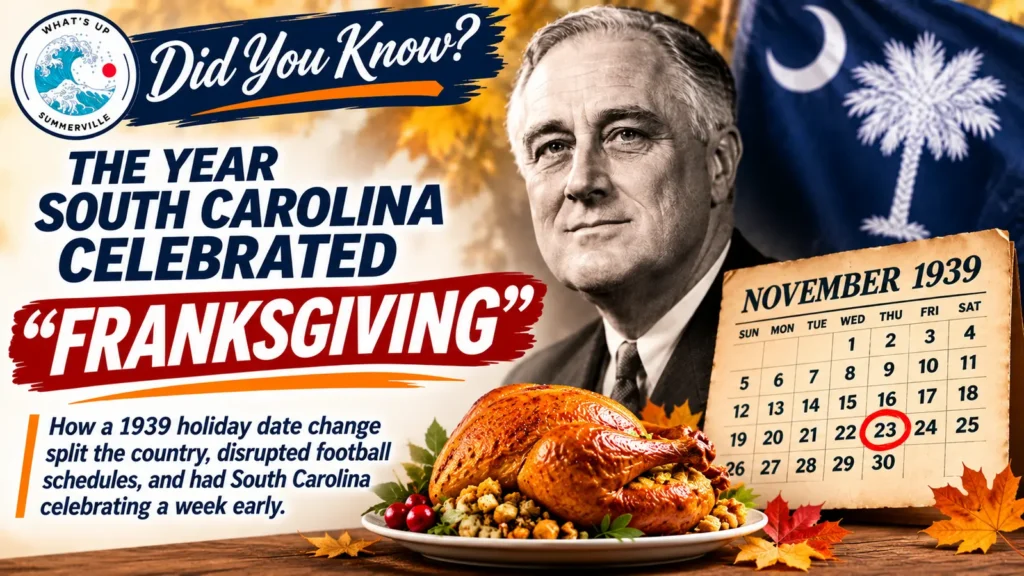
In 1939, the United States had two competing Thanksgiving dates. President Franklin D. Roosevelt wanted an earlier holiday to lengthen the Christmas shopping season. South Carolina went along. North Carolina refused.
Imagine sitting down to Thanksgiving dinner in Summerville while families just across the North Carolina state line still had another week to wait. That was the reality of 1939, when a presidential decision turned a familiar holiday into a nationwide argument.
The dispute disrupted football schedules, frustrated calendar printers and divided governors. It even acquired a nickname: “Franksgiving.”
The short answer
South Carolina celebrated on November 23
In 1939, Thanksgiving traditionally would have fallen on November 30. Roosevelt moved the federal observance to November 23 to give shoppers an extra week before Christmas. South Carolina followed the change under Governor Burnet R. Maybank; North Carolina kept November 30.
Why move Thanksgiving at all?
Since Abraham Lincoln’s 1863 proclamation, the last Thursday in November had been the customary date for the national Thanksgiving observance. But no federal law fixed the holiday to a particular Thursday. Presidents issued proclamations each year.
In 1939, November had five Thursdays. The traditional date would have been November 30, creating an unusually short shopping season between Thanksgiving and Christmas at a time when retailers were still struggling through the Great Depression.
Merchants urged Roosevelt to move the holiday up a week. On August 14, 1939, he announced that Thanksgiving would be observed on November 23. His formal proclamation followed on October 31.
For shoppers and store owners, the change promised more time. For people who regarded the familiar date as a tradition worth protecting, it felt like changing Thanksgiving for commercial reasons.
One country, two Thanksgivings
A presidential proclamation did not automatically determine the legal holiday in every state. Governors and state laws mattered, too—and the states did not agree.
Some adopted November 23. Others stayed with November 30. Colorado, Mississippi and Texas recognized both dates. The disagreement was sometimes framed in partisan terms, with the early holiday dubbed “Democratic Thanksgiving” and the traditional date called “Republican Thanksgiving.”
Football schedules were among the immediate casualties. Thanksgiving games had been planned months in advance. Calendar manufacturers had already printed dates. Schools, businesses and families faced the prospect of different holidays in different states.
The early celebration became known as “Franksgiving,” a play on Franklin Roosevelt’s name. The nickname captured just how unusual the debate had become.
South Carolina chose the early date
South Carolina Governor Burnet R. Maybank, who had previously served as mayor of Charleston, backed Roosevelt’s decision. South Carolina officially observed Thanksgiving on Thursday, November 23, 1939.
The decision is visible in contemporary South Carolina newspapers. Newberry’s The Sun reported that local stores would close on November 23 to observe the state’s Thanksgiving holiday.
The change also affected high school football. In August 1939, the Camden Chronicle reported that Camden High School’s Turkey Day game against Gaffney had been moved from November 30 to November 23 to match the new Thanksgiving date.
The calendar shift was not just a debate in Washington. It changed which day South Carolinians took off work, which day shops closed, and when traditional Thanksgiving events happened.
The Lowcountry connection
South Carolina and North Carolina picked different days
South Carolina observed November 23, 1939, while North Carolina Governor Clyde R. Hoey proclaimed November 30. For families and friends across the state line, Thanksgiving was a week apart.
The experiment did not end in 1939
Roosevelt again chose an earlier Thanksgiving for 1940: November 21. Several states continued to resist, and the dispute over the holiday’s date carried on.
He also selected November 20, 1941 as the federal Thanksgiving date. A 1941 Camden Chronicle proclamation shows that South Carolina observed that earlier date, too.
By May 1941, however, Roosevelt had acknowledged that the retail-sales experiment had not convincingly delivered the hoped-for benefit. He announced plans to return to the traditional timing in 1942. Congress decided it was time for a permanent rule.
Congress finally settles the date
In October 1941, the U.S. House approved legislation to establish Thanksgiving as the last Thursday of November. The Senate proposed a small but important change: make it the fourth Thursday instead.
Most years, those two dates are the same. But in a five-Thursday November—like 1939—they fall a week apart. The Senate’s change avoided the very problem that had started the controversy.
Roosevelt signed the resolution on December 26, 1941. Beginning in 1942, the fourth Thursday in November became the permanent federal Thanksgiving holiday.
Most states eventually aligned with that date, although some continued to observe the traditional last Thursday for years afterward. The nationwide disagreement did not disappear quite overnight.
A strange chapter of Thanksgiving history
This Thanksgiving, when families around Summerville sit down to eat on the fourth Thursday of November, they’ll be following a date that exists in federal law because the country once couldn’t agree on it.
And the South Carolina angle makes the story even more surprising: in 1939, South Carolina celebrated on November 23 while North Carolina waited until November 30.
That’s a piece of local history worth sharing between the turkey, the dressing and the pumpkin pie.
The Franksgiving timeline
- 1863: Abraham Lincoln proclaims Thanksgiving for the last Thursday of November.
- August 14, 1939: Roosevelt announces an earlier Thanksgiving for that year.
- October 31, 1939: Proclamation 2373 formally designates November 23.
- November 1939: South Carolina observes November 23; North Carolina keeps November 30.
- 1940: Roosevelt selects November 21; disagreement among states continues.
- 1941: Federal Thanksgiving falls on November 20; Congress passes a permanent date rule.
- December 26, 1941: Roosevelt signs the fourth-Thursday law.
- 1942: The new federal holiday date takes effect.
Let’s hear from Summerville
Which Thanksgiving would you have celebrated?
If you lived in 1939, would you have followed Roosevelt’s new November 23 date—or stuck with the traditional November 30 holiday? Tell us in the comments.
Sources & further reading
- National Archives — “Thanksgiving: Another FDR Experiment”
- National Archives — “Congress Establishes Thanksgiving”
- Franklin D. Roosevelt — Proclamation 2373 (1939)
- The Sun (Newberry, S.C.), November 17, 1939
- The Camden Chronicle, August 25, 1939
- The Camden Chronicle, October 31, 1941
- The Davie Record (North Carolina), November 15, 1939
Historical note: South Carolina’s observance and the national date controversy are documented in period newspapers and federal archives. The 1941 law standardized the federal holiday; individual state observances took longer to align.