
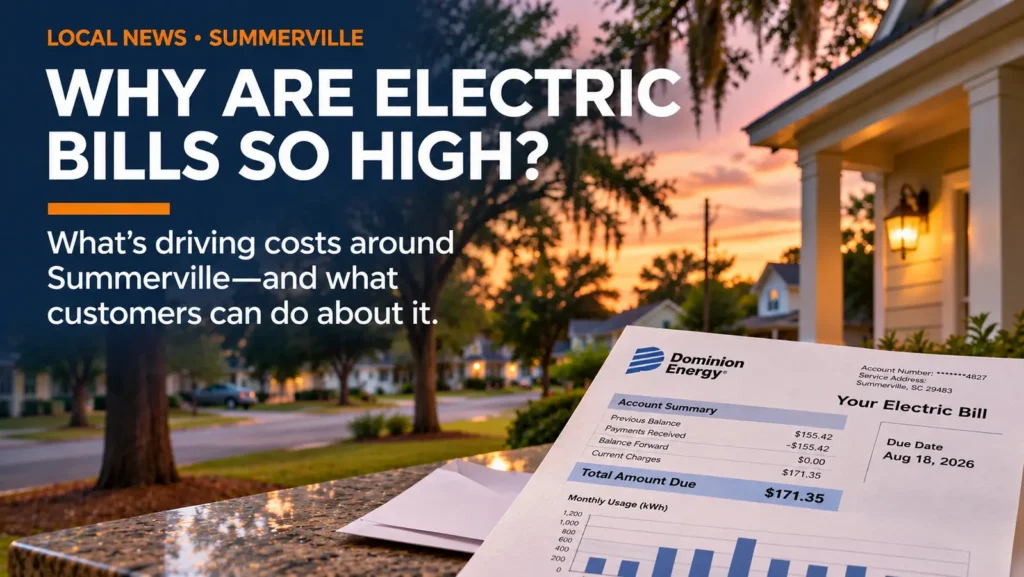
If your electric bill seems to keep getting higher, you’re probably not the only person in your neighborhood wondering what’s going on.
Across the Summerville area, residents regularly share stories about rising utility costs, surprisingly large bills, and the frustration of trying to understand exactly what they’re paying for.
Some households are using more electricity than they did a few years ago. Others say their consumption hasn’t changed much, but the amount they owe certainly has.
So we went looking for the numbers behind those conversations—reviewing utility rate histories, regulatory filings, and customer rights published by South Carolina agencies.
What we found wasn’t one isolated rate increase. It was years of adjustments, including several significant changes affecting Summerville-area customers.
And the story depends partly on which company supplies your electricity.
First, Not Everyone in Summerville Has the Same Electric Provider
Dominion Energy South Carolina serves much of the Summerville area. Berkeley Electric Cooperative also serves substantial portions of the surrounding region, including customers in areas such as Cane Bay, Sangaree, and Nexton.
Those neighborhood examples aren’t exact service boundaries. The provider listed on your bill is the best way to confirm which utility serves your address.
Dominion is an investor-owned utility whose retail electric rates are regulated by the South Carolina Public Service Commission. Berkeley Electric is a member-owned cooperative governed primarily through its elected board.
That distinction matters because the companies use different rate structures, approval processes, and customer complaint procedures.
Dominion Energy: From $124 to More Than $171 for the Same Electricity
One of the clearest ways to understand rising rates is to compare what the same amount of electricity cost at different points in time.
The South Carolina Office of Regulatory Staff (ORS) publishes historical residential billing figures for Dominion Energy’s standard Rate 8 service. Those figures use a consistent example of 1,000 kilowatt-hours (kWh) per month.
This is a standardized billing example, not the average of every customer’s actual bill. It helps show how changes in rates affect the cost of a fixed amount of electricity.
In May 2019, that 1,000-kWh bill was $124.35.
By July 2026, ORS’s updated historical series placed it at $171.35.
May 2019: $124.35
July 2026: $171.35
+$47.00 — approximately 38% higher
That’s roughly $47 more for the same amount of electricity, before considering how a household’s actual consumption may have changed.
But the increase wasn’t a straight line. Some adjustments caused bills to fall temporarily before later increases pushed them higher again.
A Look at the Rate History
| Effective date | Bill at 1,000 kWh |
|---|---|
| May 2019 | $124.35 |
| May 2020 | $122.31 |
| May 2021 | $124.11 |
| September 2021 | $125.92 |
| May 2022 | $132.79 |
| January 2023 | $140.57 |
| May 2023 | $146.30 |
| May 2024 | $132.68 |
| September 2024 | $147.81 |
| May 2025 | $155.42 |
| July 2025 | $157.00 |
| May 2026 | $159.47 |
| July 2026 | $171.35 |
Source: South Carolina Office of Regulatory Staff, Dominion Energy South Carolina Rate 8 historical residential billing series, current edition reviewed November 2026. Figures represent a standardized 1,000-kWh residential bill.
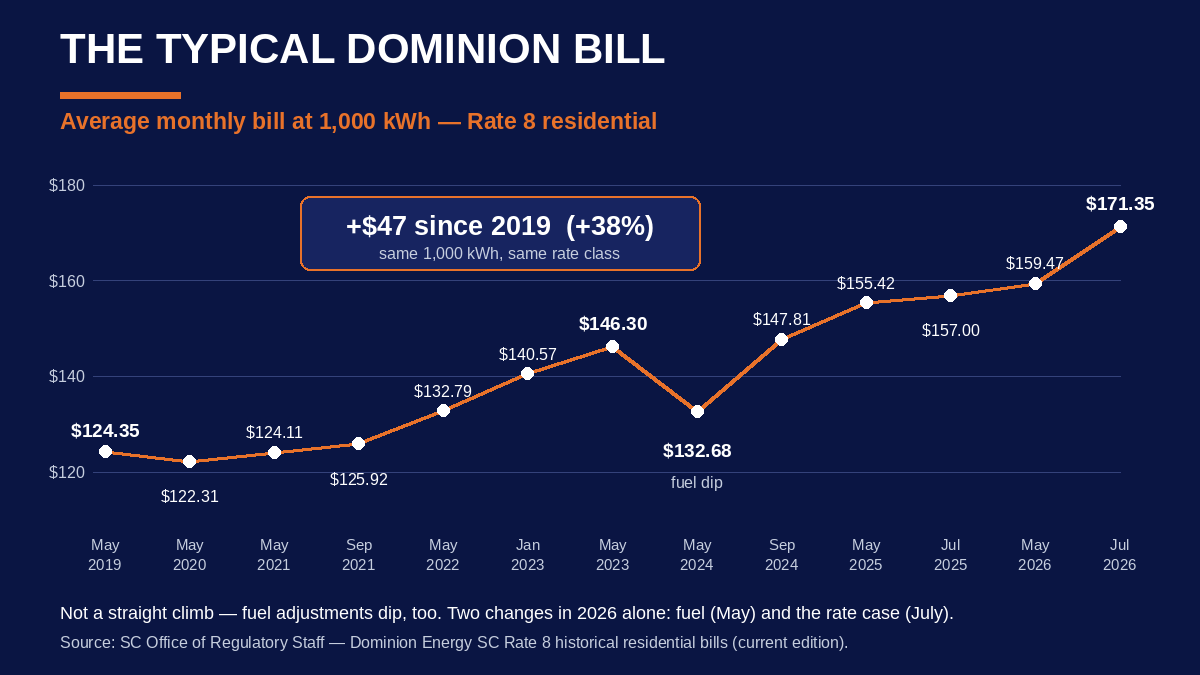
Notice the significant decrease in May 2024, followed by another increase that September. That’s one reason the history is more complicated than simply saying electric rates rise every year.
Fuel costs, energy-efficiency programs, other approved charges, and general rate cases can all affect the amount customers pay.
Some changes provide temporary relief. Others add costs that remain in the rate structure.
Two More Changes in 2026
Dominion customers experienced two additional rate changes in 2026.
In May, fuel-related and other adjustments increased the standardized 1,000-kWh residential bill to $159.47.
Then, in July, a general rate case took effect. Under a settlement approved by the South Carolina Public Service Commission, the standardized bill increased again to $171.35.
The approved settlement included approximately $219.3 million in additional non-fuel base-rate revenue before certain credits and offsets. That figure describes the utility’s broader rate-case revenue adjustment—not an amount added to any individual customer’s bill.
The settlement was smaller than Dominion’s original request, but it still meant higher rates for customers.
For the comparisons in this article, we’re using the standardized bills in the updated ORS historical series rather than mixing in calculations from separate seasonal tariff schedules.
That keeps the comparison consistent from 2019 through July 2026.
Berkeley Electric Customers Have Seen Increases, Too
Residents served by Berkeley Electric Cooperative have their own rate history to consider.
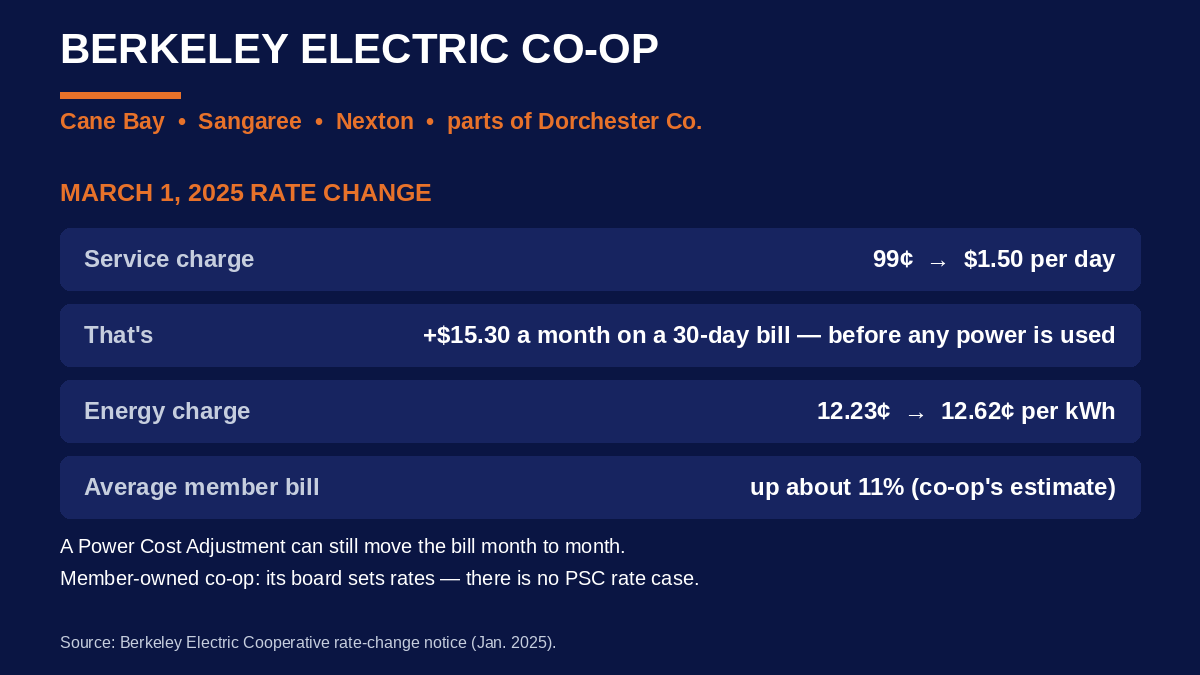
Effective March 1, 2025, Berkeley Electric increased both its residential energy charge and its daily service charge.
The energy charge increased from 12.23 cents to 12.62 cents per kWh.
The daily service charge increased from 99 cents to $1.50.
That daily service charge is particularly significant because it isn’t based on how much electricity a household consumes. It helps cover the cost of maintaining infrastructure such as poles, wires, transformers, and other equipment needed to provide service.
Over a 30-day billing period, the service charge alone increased from $29.70 to $45—a difference of $15.30 before accounting for the electricity used.
Berkeley Electric estimated that the combined rate changes would increase the average member’s bill by approximately 11.1%, although the actual impact varies with consumption.
The cooperative cited rising wholesale electricity costs, higher infrastructure expenses, and the expiration of a rate freeze affecting Santee Cooper as factors behind its decision.
Berkeley Electric bills can also include a Power Cost Adjustment, which reflects changes in the cost of wholesale electricity. Depending on circumstances, that adjustment may be a charge or a credit.
There’s another important difference between the two providers: Berkeley Electric’s board sets its rates as a member-owned cooperative. Its rate changes do not go through the same PSC retail rate-case process used for Dominion.
That’s why it isn’t always useful to compare two electric bills without knowing which company issued them and how the charges are calculated.
Why Your Bill Can Rise Even Without Another Rate Increase
Rate increases explain part of the story. But they don’t explain every unusually large electric bill.
The amount you owe also depends on electricity consumption, billing-period length, seasonal conditions, and your account’s specific rate structure.
Weather Can Change Your Usage
Heating and cooling are major electricity expenses for many households. A colder-than-usual winter or particularly hot summer can cause an HVAC system to run longer even when the thermostat setting hasn’t changed.
Some heat pumps also rely on supplemental electric heat during colder conditions, which can increase consumption.
Not Every Billing Period Is the Same Length
Check how many days your bill covers. A longer billing period can include additional electricity consumption and more daily service charges.
Billing dates can also drift across the calendar. Seeing two due dates in one calendar month doesn’t, by itself, mean the same electricity was billed twice.
Estimated Readings Can Lead to Later Adjustments
If a utility estimates consumption for a billing period, a later actual meter reading may produce an adjustment.
That can make one bill appear unusually high or low. If you suspect an estimated reading or correction, ask the utility to explain the readings and dates used.
Equipment Problems Can Increase Consumption
A malfunctioning water heater, inefficient HVAC equipment, unexpected supplemental heating, or other electrical problems can cause consumption to rise.
If your kilowatt-hours have increased sharply, it’s worth investigating the equipment and usage patterns inside your home as well as checking the meter and billing information.
A higher bill doesn’t automatically mean a billing error. But it also doesn’t mean residents should accept an unexplained increase without asking questions.
And There’s Still the Abandoned V.C. Summer Nuclear Project
There’s another piece of South Carolina’s electricity history that continues to affect Dominion customers.
In 2017, construction was abandoned on two additional nuclear reactors at the V.C. Summer site after billions of dollars had already been spent.
Those two unfinished reactors never generated electricity. They should not be confused with the original V.C. Summer reactor, which continues operating.
The abandoned expansion nevertheless left costs that customers have continued helping pay through their electric bills.
An Office of Regulatory Staff document obtained through a public-records request showed that, as of August 2025, approximately 5.22% of a standardized Dominion residential bill was attributable to costs associated with the abandoned expansion.
That worked out to about $8.20 on the roughly $157 example bill at the time.
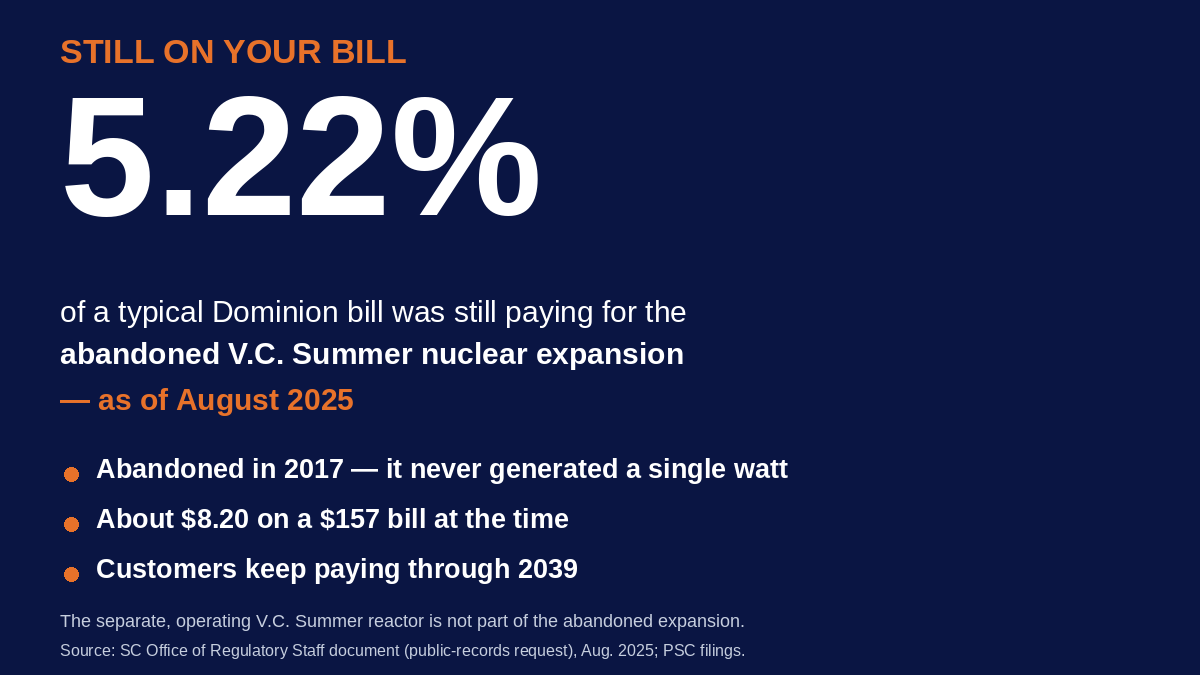
That 5.22% figure is a historical snapshot, not a verified percentage of every bill being issued today.
Regulatory filings identify recovery of certain abandoned-project costs extending through 2039.
It’s worth separating those costs from the newer fuel adjustments and rate cases. The abandoned nuclear project is not the explanation for every recent bill increase, but it remains one of the reasons South Carolina’s electricity history is especially complicated.
Residents are still paying costs associated with a nuclear expansion that was abandoned nearly a decade ago. That’s a legitimate part of the conversation when people ask exactly where their electricity payments are going.
What If Your Electric Bill Looks Wrong?
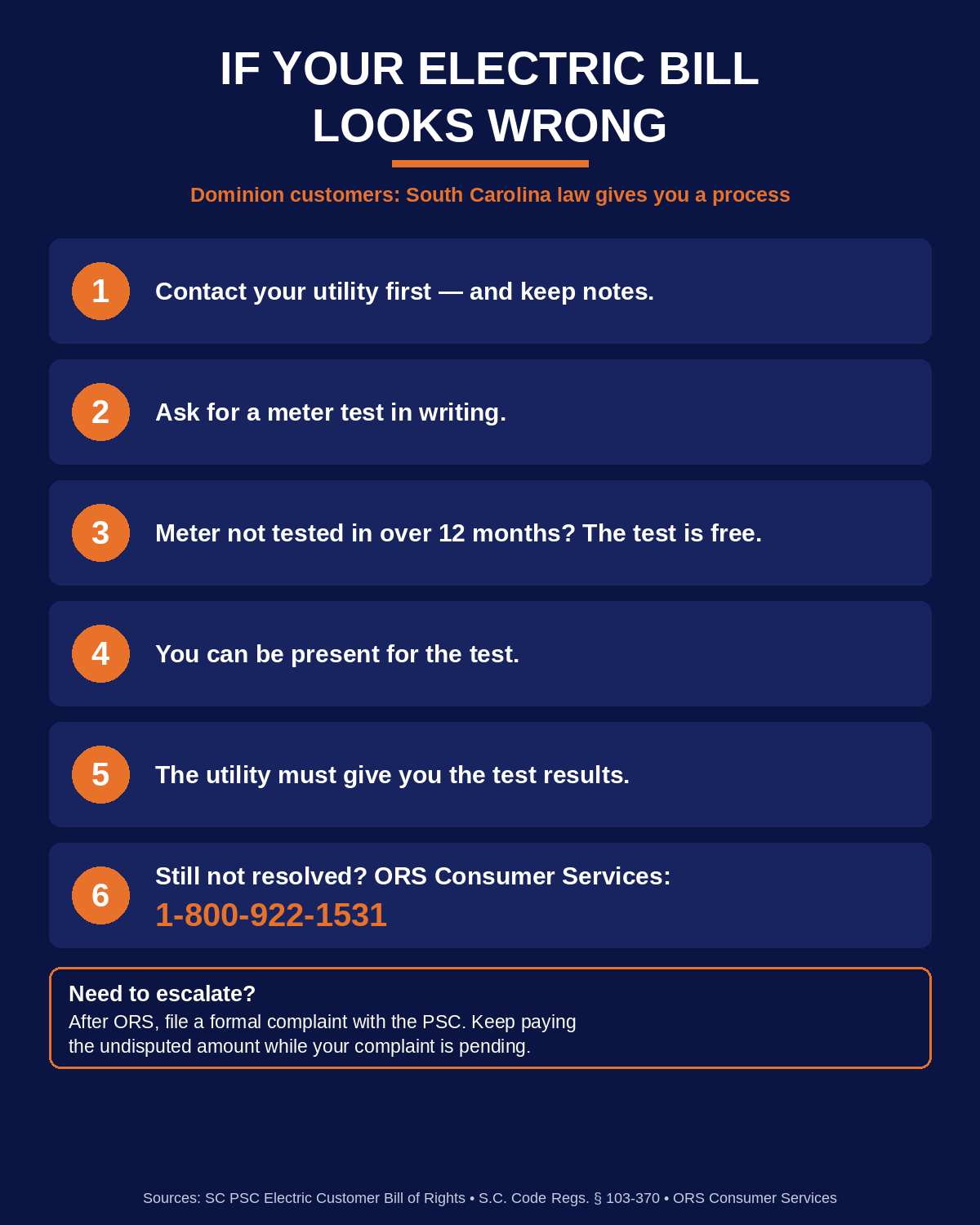
Here’s something that may surprise some customers: South Carolina has specific rules protecting residential customers of electric utilities regulated by the Public Service Commission.
One particularly useful protection is the right to request an accuracy test of your electric meter.
Under South Carolina Regulation 103-370 and the Electric Customer Bill of Rights, customers of PSC-regulated utilities such as Dominion can formally request a meter test.
The important detail is to make the request in writing. That establishes a documented request under the applicable regulatory process rather than relying only on a telephone conversation.
If more than 12 months have passed since the meter was installed or last tested, the accuracy test must be provided without charge.
Customers also have the right to be present, or to appoint someone to attend, and to receive the results.
If a meter is found to register more than 2% fast or slow, applicable billing adjustments may be required under the regulations.
Start With the Utility—and Keep Records
If your bill appears incorrect, contact your utility and explain the issue. Ask for a breakdown of the charges, billing dates, meter readings, and any estimated usage or adjustments.
Write down when you contacted the company, who you spoke with, and what explanation or next steps were provided.
If you suspect a meter problem, submit your accuracy-test request in writing and retain a copy.
If the Problem Isn’t Resolved, Contact ORS
South Carolina’s Office of Regulatory Staff Consumer Services assists customers with complaints involving regulated utilities.
ORS Consumer Services: 1-800-922-1531
ORS encourages customers to contact their utility first. If the issue remains unresolved, ORS can review the complaint and seek a response from the company.
ORS states that it will contact the customer within 30 days after initiating its investigation. That doesn’t guarantee the dispute will be completely resolved within 30 days, but it does provide a formal path for review.
If informal resolution is unsuccessful, customers may pursue a formal complaint through the Public Service Commission.
Important: Continue paying the undisputed portion of your bill while a complaint is pending. Withholding payment entirely can put electric service at risk.
A Different Process for Berkeley Electric Members
The PSC Electric Customer Bill of Rights discussed above applies to regulated electric utilities such as Dominion. Berkeley Electric Cooperative operates under a different oversight structure, so the same testing and complaint requirements should not automatically be assumed to apply.
Berkeley Electric members with billing concerns should contact the cooperative directly, request an explanation of their usage and meter readings, and ask for its specific meter-testing and dispute-resolution procedures.
Members can also ask about the cooperative’s internal escalation procedures and board representation. ORS oversight of electric cooperatives is more limited than its role with investor-owned utilities.
Before Comparing Bills With Your Neighbors, Check These Five Things
We want to hear what residents around Summerville are experiencing. But a dollar amount alone doesn’t always tell the full story.
Two neighbors could both receive a $300 electric bill while using very different amounts of electricity—or paying under different utility rate structures.
Before comparing your bill with someone else’s, check:
- Your electric provider. Are you served by Dominion Energy, Berkeley Electric, or another provider?
- Kilowatt-hours used. Compare actual consumption, not just the dollar amount.
- Billing days. How many days of service does the bill cover?
- Your rate schedule. Dominion’s standard residential plan is Rate 8, but other residential schedules are available.
- Your general area. Knowing the neighborhood can provide useful local context, although it doesn’t prove the exact utility service territory.
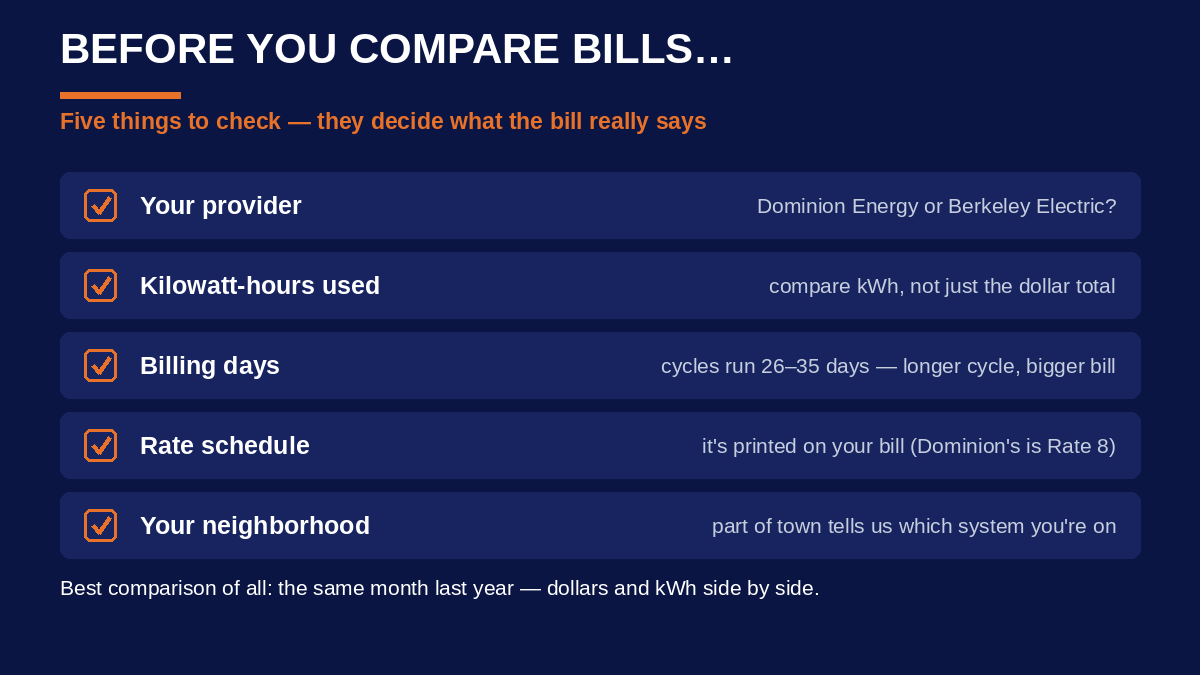
One of the best comparisons is the same billing period last year, with both dollar amounts and electricity consumption side by side.
If your electricity usage stayed approximately the same but your bill increased substantially, that’s useful information to bring into a conversation with your provider.
If your usage increased significantly, the next question is why.
So, Summerville: What Are You Paying?
We’ve looked at the official rate history, the changes affecting different providers, and some of the protections available when a bill doesn’t seem right.
Now we’d like to hear from the people actually paying those bills.
Has your electric bill increased over the past few years?
Are you a Dominion Energy customer or a Berkeley Electric member? What part of the Summerville area are you in?
What’s the highest electric bill you’ve received? Have you noticed higher charges for roughly the same consumption, or has your electricity usage increased, too?
And if you’ve ever challenged a bill or requested a meter test, what was your experience?
Share your experiences in the comments. General neighborhoods are fine, but please don’t post account numbers, full addresses, or other private billing information.
We’re interested in understanding what residents are experiencing, not assuming every high bill is an error or that every utility increase has the same cause.
When the cost of keeping the lights on keeps climbing, asking where the money is going—and what you’re actually paying for—is a perfectly reasonable question.
Sources and Further Reading
This article draws on published rate histories, utility notices, regulatory records, and South Carolina consumer-protection information. The historical Dominion figures follow the updated ORS Rate 8 series reviewed November 15, 2026. Individual bills may differ from the standardized examples.
- South Carolina Office of Regulatory Staff: Historical Electric Residential Bills.
- Dominion Energy: July 2026 Electric Rates Change Notice.
- Dominion Energy: South Carolina Rates and Tariffs.
- Berkeley Electric Cooperative: January 2025 Rate-Change Announcement.
- Berkeley Electric Cooperative: Member Handbook and Billing Information.
- South Carolina Public Service Commission: Electric Customer Bill of Rights.
- South Carolina Office of Regulatory Staff: How to Resolve a Utility Dispute.
- South Carolina Public Service Commission: How to File a Complaint.
Additional regulatory records reviewed include PSC Docket 2025-325-E, Order 2026-374, filings concerning recovery of abandoned V.C. Summer project costs, and an ORS August 2025 public-records document concerning the percentage attributable to that project.
What’s Up Summerville • November 2026. Standardized utility bill examples are provided for comparison and do not represent individual account charges. Actual bills vary based on usage, billing period, rate schedule, applicable adjustments, and taxes.
Support Local • Love Summerville