
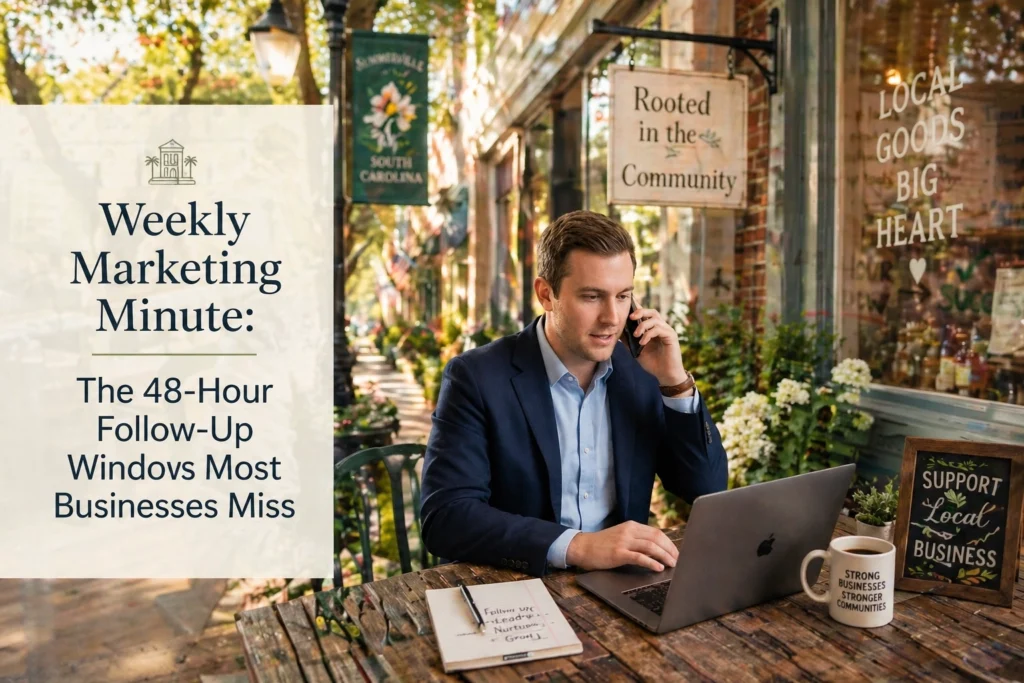
Most local businesses in Summerville aren’t losing leads because they do bad work.
They’re losing them because they wait too long to say "hello."
A potential customer sees your shop downtown, fills out your contact form, sends a Facebook message, asks for a quote, or stops by your booth at the Farmers Market or Mayfest.
And then… silence.
By the time many businesses respond, that customer has already heard back from someone else. In the digital age, speed isn’t just an advantage. It’s the price of admission.
The Hidden Sales Killer: Slow Follow-Up
Studies consistently show that the faster you follow up, the more likely you are to convert that lead into a paying customer. It seems obvious, but the data behind it is staggering. Businesses that respond quickly—especially within the first 24 hours—consistently see dramatically higher conversion rates. If you wait 48 hours, that probability drops significantly, and by the end of the week, your chances are almost zero.
For website visitors specifically, the window is even tighter. If you contact a prospect within two hours of them visiting your site, your conversion rate sits around 23%. Wait until the next day? It drops to 12%. Wait a week? You’re looking at a 3% chance of closing the deal.

But here’s where many small businesses miss the mark: They treat follow-up as an administrative task to be handled "when I get time."
The business owner thinks: "I’ll get back to them on my office day."
The customer thinks: "They must not be interested in my business, or they’re too busy to help me."
That’s the gap where revenue goes to die. The first 48 hours after someone reaches out is your "Golden Window." This is when interest is at its peak, urgency is highest, and trust is easiest to establish. Once that clock passes the 48-hour mark, the "Recency Effect" begins to fade, and your business starts to blend into the background of their busy lives.
The Psychology of the 48-Hour Window
Why is this specific timeframe so vital? It comes down to three psychological factors:
- The Recency Effect: People remember the most recent information they’ve interacted with. If you respond while they are still thinking about their problem, you become the primary solution in their mind.
- Buying Momentum: When someone reaches out, they are in "evaluation mode." They have recognized a need and are actively seeking a solution. If you catch them in this state, the friction to buy is much lower.
- Avoiding Competitor Interference: In a small town like Summerville, word travels fast, but so does the competition. If a customer is looking for a plumber or a florist, they aren't just messaging you; they are likely messaging three other people. The one who responds first often wins by default.
What a "Good" Follow-Up Actually Looks Like
One of the biggest misconceptions local business owners have is that following up quickly feels "pushy" or "desperate."
In reality, a quick follow-up isn't about being a high-pressure salesperson. It’s about being present. It’s a signal of professional courtesy and reliability. If you are quick to respond before you have their money, they can trust you will be quick to respond once the project is underway.
A strong first follow-up should accomplish four simple things:
- Confirm Receipt: Let them know their message didn't disappear into a black hole.
- Answer Immediately: Address their primary question or concern right away.
- Set Expectations: Tell them exactly what happens next and when.
- Keep it Easy: Don't give them homework. Make the next step a simple "yes" or "no."
The "Confidence-Building" Template:
“Hi [Name]! Thanks so much for reaching out about [Service]. I’d love to help you with that. I’m actually out on a job site right now, but I’m reviewing your request and will send over the full pricing options by tomorrow afternoon. In the meantime, did you have a specific date in mind for this?”
That single message, sent within a few hours, builds more trust than a 10-page proposal sent four days later.

The 3-Touch Rule: A System for Success
Most businesses stop after one reply. They send an email, don't hear back, and assume the lead is "dead."
That is a massive mistake. People are busy. Emails get caught in spam filters. Kids get sick. Life happens. Just because they didn't reply to your first message doesn't mean they aren't interested. It often just means they got distracted.
To combat this, we recommend the 3-Touch Rule.
Touch 1: Immediate Response (Within 4-6 Hours)
The goal here is acknowledgment. Even if you don't have all the answers yet, let them know they’ve been seen. Use this time to score the lead: is this a "hot" prospect who needs a call now, or someone just browsing?
Touch 2: The Value Follow-Up (24–48 Hours)
This is where you deliver the goods. Send the quote, the recommendation, or the helpful resource they asked for. If they haven't replied to Touch 1, this acts as a gentle nudge while providing actual value. This is where trust truly starts to grow.
Touch 3: The Friendly Check-In (3–5 Days Later)
If you still haven't heard back, send one final, low-pressure check-in.
“Hi [Name], just checking in to make sure you saw the info I sent over and to see if you had any other questions I can answer for you!”
It’s not aggressive. It’s helpful. And you would be surprised how many sales are closed on the third touch simply because the customer appreciated the persistence.
Turning Memory Into a Repeatable System
The goal for your Summerville business shouldn’t be to "remember to follow up better." We are all human, and we all forget things. The goal is to build a system that does the remembering for you.
You don't need a massive corporate budget to do this. You can use:
- CRM Reminders: Tools like HubSpot (which has a free tier) or even a simple Trello board can track where every lead is in the process.
- Email Templates: Stop typing the same response 50 times a week. Create "Saved Replies" in Gmail or Outlook.
- Automated Sequences: If someone fills out a form on your site, use an automation tool to send that "Touch 1" message instantly.
- Calendar Tasks: If you tell a customer you’ll call them Thursday, put it on your digital calendar with a notification.
When follow-up becomes a process instead of a memory game, your revenue becomes more predictable. You stop wondering where the next job is coming from and start managing the flow of incoming business.

This Week’s Challenge for Summerville Business Owners
Take 15 minutes today and look back at your last 10 leads. Check your email, Facebook DMs, and voicemail.
- How many got a response within 48 hours?
- How many got more than one follow-up "touch"?
- How many are still sitting in "silence"?
The answer will tell you exactly where your next revenue boost is hiding.
You don’t need more leads. You need better follow-up.
Whether someone met you at the Summerville Farmers Market, discovered you during Flowertown Festival season, or found you online at 10 p.m., the businesses that respond first are the ones people remember.
Remember: The 48-hour window is where the magic happens. Don't let it close on you.
Connect & Grow
We love helping local businesses and community organizations stay visible, connected, and involved here in Summerville. If you're ready to reach more neighbors and be part of what’s happening around town, here are a few easy ways to plug in:
- Share Your Events: Post an event on our calendar
- List Your Business: Join our local directory
- Stay in the Loop: Follow us on Facebook, join our Facebook Group, and check us out on Instagram.
What’s Up Summerville Weekly Marketing Minute
Helping local businesses grow smarter, not just louder.