Most people walk past public art without ever asking where it came from.
Even if you’ve never heard of Sculpture in the South, you know the “Rocking Granny.” She sits near downtown, a quiet bronze fixture of our community that locals recognize instantly.
A sculpture in a park.
A bronze figure near downtown.
A piece of art standing quietly beside a walking path.
It becomes part of the background: something familiar, but often unexplored. In Summerville, that quiet familiarity tells a much bigger story. Through Sculpture in the South, public art has become part of the identity of our town: not hidden away inside galleries, but placed where people live, work, gather, and grow.
It’s not just decoration. It’s legacy. It’s storytelling. It’s the people behind the art you see every day.
How It Started: A Vision for the Flowertown
Long before many residents realized it, Summerville began building something unique. In 1999, a nonprofit called Sculpture in the South began a mission to beautify the town and bring fine art into everyday life. Instead of treating art as something separate from daily life, local leaders and artists pushed for something bigger: bringing sculpture into public spaces where everyone could experience it.
What started as a commitment to public art grew into a nationally recognized sculpture initiative, connecting artists, residents, students, and visitors through pieces that live permanently throughout town. These works aren’t temporary attractions; they become part of the landscape.
Children grow up seeing them. Families take photos beside them. Visitors remember them. That’s what public art does: it creates shared memory.
Azalea Park: The Heart of the Collection
If you want to see the crown jewels of our local collection, you head to Azalea Park. It feels like a garden that also happens to be a museum. Here, the art isn’t behind velvet ropes; it’s tucked among the azaleas and beneath the Spanish moss.
One of the most iconic pieces is “Follow the Leader.” You’ve likely seen it: a group of five life-sized children and their dog playing along a low serpentine brick wall. It captures motion and joy in bronze, and kids are naturally drawn to climb and interact with it. It perfectly sums up what Summerville’s public art does best. It invites people in.
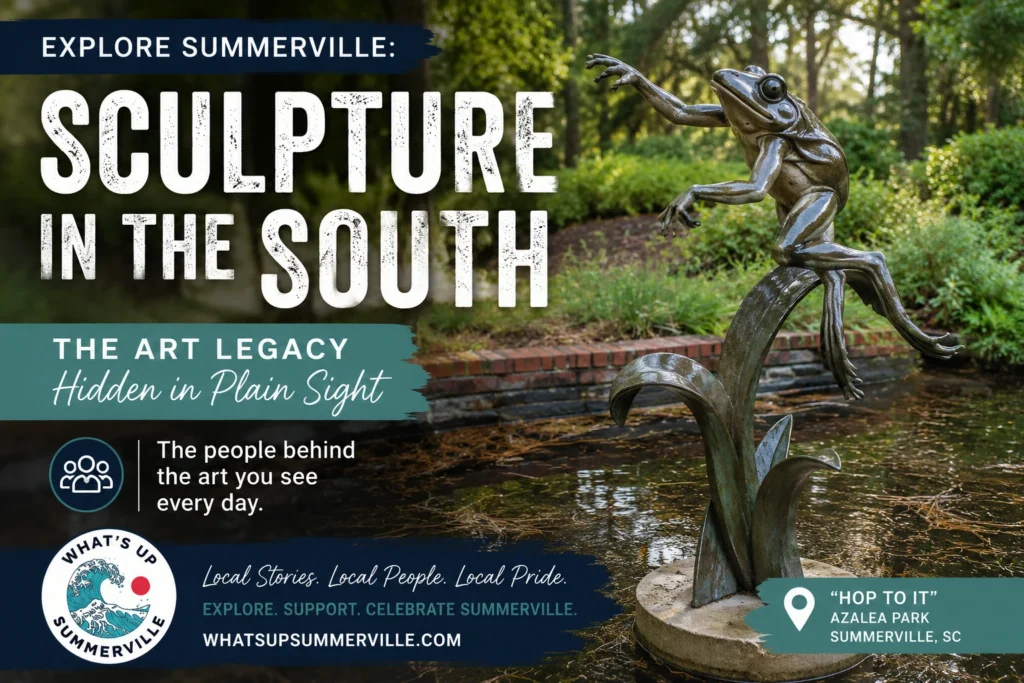
You’ll also find “Hop To It” (Kim Shaklee, 1999). This oversized southern leopard frog, frozen mid-leap across a pond in Azalea Park, was the very first piece purchased for the town’s permanent collection. It set the tone for everything that followed: playful, finely crafted, and perfectly at home in the Lowcountry landscape.
Then there’s “The Garden” by Susie Chisholm in Hutchinson Square: better known around town as the “Rocking Granny.” She’s one of those pieces that feels like she’s always been part of Summerville’s personality, just sitting there quietly stealing the scene.


The B.I.R.D.S. of Downtown: A Local Treasure Hunt
One of the coolest ways to explore our historic downtown is through the B.I.R.D.S. (Birds In Residence Downtown Summerville) trail. This initiative, started in 2013, turned the town into a giant scavenger hunt.
There are more than 20 hidden bronze birds perched in unexpected places, and every one of them represents a species native to South Carolina. Finding them means slowing down, looking up, and paying attention to details you’d probably miss otherwise.
It turns a simple stroll into an artistic adventure. If you’re looking for things to do with the family this weekend, grab the B.I.R.D.S. sculpture trail brochure (usually available at the Visitor Center) and follow the limerick clues. It’s one of the most fun ways to see downtown through a different lens.

Why Public Sculpture Matters
Art inside a museum asks you to visit it. Public sculpture meets you where you already are.
At a park. Outside a local business. Near a school. Along a walking trail. In the middle of an ordinary Tuesday.
That matters because public art changes how a place feels. It creates curiosity. It slows people down. It gives people something to talk about. It makes a town feel intentional. For a place like Summerville: where community identity matters deeply: those details shape how people experience “home.” It reminds people that culture belongs to everyone. Not just ticket holders. Not just gallery visitors. Everyone.
When you see a piece like “Dreamin’ of the Big Game” at the Gahagan Sports Complex, it resonates. It’s a bronze of a young boy with his glove and ball, lost in thought. It captures the exact feeling of every kid who has ever stepped onto those fields. It turns a sports complex into a place of reflection and inspiration.
You can feel that same personality in pieces like “Toby” by W. Sandy Proctor, the bronze Labrador donated to honor John Brooks. It’s the kind of sculpture that makes people smile before they even read the plaque, which is kind of the magic trick public art pulls off when it’s done well.
And near Town Hall, “Everyday Heroes” gives that same sense of grounded meaning. The firefighter figure feels less like decoration and more like a thank-you note cast in bronze.


The Artists Behind the Bronze
Every sculpture has two stories: the one you see, and the one that created it.
Behind every finished piece is an artist who spent months: or years: designing, shaping, welding, carving, casting, and refining something that may stand in place for generations. Through Sculpture in the South, these artists aren’t distant names; they become part of the community story.
For longtime art watchers, “Antonio” by Wayne Salge adds another chapter to that story. The abstract work was moved to the Public Works Art Center in 2023, which is a reminder that even permanent public art can keep evolving with the town around it.
At the Visitor Center, “Fantasy Flight” by Bobbe Gentry adds another graceful stop on the sculpture map, while pieces like “Heron and the Sun” keep reinforcing how often Summerville’s public art borrows from the wildlife and natural beauty that already define the Lowcountry.
Then the tour loosens its collar a little. “River Rapture,” the diving otter, brings motion and wild Lowcountry energy. “Anticipation” and “Whisper on the Wind” add a slightly mythic edge with their fox-or-wolf presence.
And then, because Summerville never takes itself too seriously for too long, you get pieces like “Free Ride” by Paul Rhymer, 2007 in Shepard Park: the hippo with the Purple Gallinule bird riding along like this whole arrangement makes perfect sense. Somehow, it absolutely does.
Same with “Just Chillin’” by Jack Hill, 2023, outside the Saul Alexander Playground. It’s a 7-foot bronze banana, affectionately nicknamed “Lenny,” and yes, it is exactly as delightfully weird and lovable as that sounds.
People protect what they understand, and they value what they feel connected to. By making art accessible, we ensure it remains a protected part of our future.


More Than Art: It’s Education
Public sculpture also teaches without announcing itself.
- Kids ask questions about the materials.
- Students sketch pieces for school projects.
- Visitors stop and read the plaques to learn about the wildlife represented.
That’s education working quietly. Not through lectures, but through presence. Art becomes part of everyday learning. This is especially powerful in a town growing as quickly as Summerville. Preserving culture while building the future is a delicate balance. Public sculpture helps do both by anchoring us to our history and our local wildlife.
If you want to see the community celebrate this legacy in person, mark your calendars for the annual Third Thursday Art & Garden Stroll. This year, it’s happening this coming Thursday, May 21, 2026, as part of Summerville DREAM’s Third Thursday celebration. It’s a day where our love for nature and our passion for public art collide in the most beautiful way possible.
Even better? You’ll have an especially fun chance to connect the sculpture to the sculptor that same evening. From 5:30 PM to 8:30 PM, you can meet Susie Chisholm, the artist behind Summerville’s iconic “Rocking Granny,” in person. Plus, make sure to head over to Hutchinson Square to check out the work of Jim Malecky—he’ll be there as part of the stroll, and it’s a perfect chance to see some incredible talent in action.
The Legacy Hidden in Plain Sight
The best public art does not demand attention; it earns it over time. It becomes part of how people remember a place. Part of how they explain it. Part of how they love it.
That’s what Sculpture in the South has helped create. Not just sculptures, but an identity. The next time you’re exploring downtown Summerville or playing at one of our many parks, stop for a second.
Ask where that piece came from. Ask who made it. Ask why it’s there. Because chances are: it has been telling part of Summerville’s story the entire time.
Local Spotlight: Supporting the Vision
Supporting public art is really about supporting the kind of town we want to be. A town where beauty is public. Where creativity is visible. Where history and progress stand side by side. Where the people behind the art matter just as much as the art itself.
That’s not just good design. That’s community. Some towns hang art on walls. Summerville built it into the streets.
Get in Touch with the Arts
If you want to learn more about the pieces mentioned or find a map of the B.I.R.D.S. trail, visit the local organizations that keep our art scene thriving:
Sculpture in the South
- Website: sculptureinthesouth.com
- Address: 112 W Doty Ave, Summerville, SC 29483
- Phone: 843-851-7800
Summerville Visitor Center
- Website: visitsummerville.com
- Address: 402 N Main St, Summerville, SC 29483
- Phone: 843-873-1077
Monkees of Summerville (Home of the Carolina Chickadees)
- Website: monkeesofsummerville.com
- Address: 140 W Richardson Ave, Summerville, SC 29483
- Phone: 843-871-1155
- Instagram: @monkeesofsummerville