You spent your Saturday sweating through a festival, shaking hands, handing out flyers, and hoping it all pays off.
Then Monday comes…
…and someone asks the million-dollar question:
“So, was it worth it?”
Most business owners answer that question with a simple shrug and a “Yeah, I think so.”
That’s not marketing. That’s guessing.
Whether you run a bakery on Main Street, a salon near Nexton, or a booth at the Summerville Farmers Market, you are investing your most precious resource: time. At What’s Up Summerville, we see local businesses dive into events all the time, ribbon cuttings, vendor fairs, networking lunches, charity fundraisers, downtown festivals, school events, and community pop-ups.
Some of those events are incredible catalysts for growth. Others are just expensive lessons. The difference isn't the event itself; the difference is knowing how to measure what actually happened. Because if you can’t track the return, you can’t improve the strategy.
Let’s talk about how to measure event ROI, your actual impact, the right way.
Stop Measuring Only Immediate Sales
This is the biggest trap local businesses fall into. A business owner spends $500 on an event and asks, “Did we make $500 at the register today?”
If the answer is no, they write the event off as a failure. That’s far too small of a lens.
While some events are designed for immediate sales, many of the most successful community activations in Summerville drive results that show up weeks or months later. You have to look at the total impact.
Think about these growth markers:
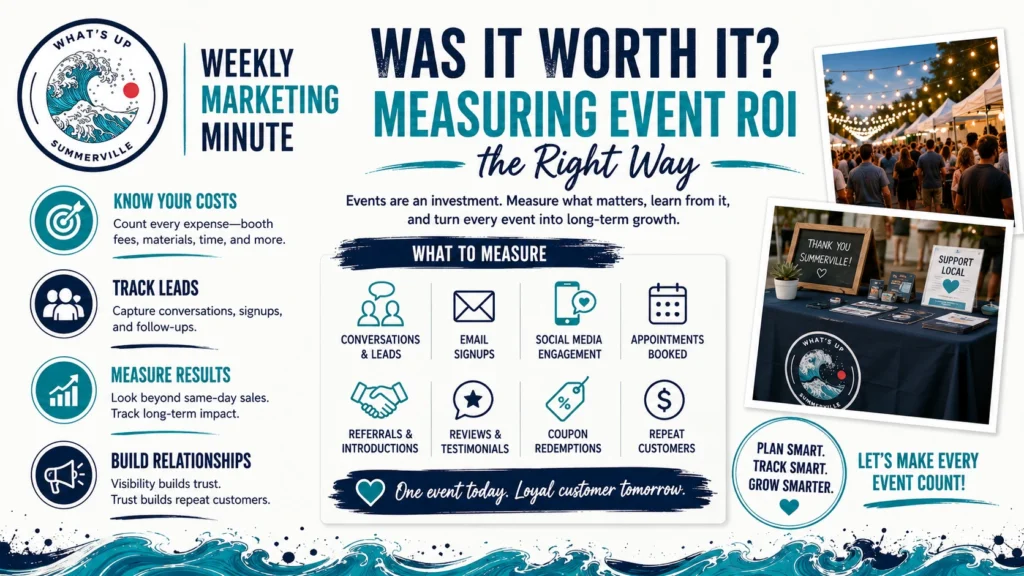
- Future appointments: Did someone book a consultation for next Tuesday?
- Referrals: Did a visitor mention a friend who needs your service?
- Email signups: How many people joined your digital inner circle?
- Social media follows: Did your Instagram audience grow with local fans?
- Brand recognition: Do people now know your name when they see it on Richardson Avenue?
- Long-term trust: Did you prove you’re a real part of the community?
Especially in a town like ours, relationships often matter more than same-day transactions. Sometimes the best return on your investment comes three weeks later when a neighbor realizes they need exactly what you offer. Track the "now," but keep a sharp eye on the "later."
Know Your Real Event Cost
Most people only count the vendor fee. If the booth was $100, they think the event cost $100. That’s dangerous math.
To find your true bottom line, you have to look at the "hidden" numbers. Your real cost includes:
- Booth and sponsorship fees.
- Printed materials (flyers, business cards, stickers).
- Giveaways and "swag."
- New signage or tent weights.
- Staff time (the hourly rate of your team or the value of your own time).
- Prep, setup, and breakdown hours.
- Inventory discounts or free samples given away.
- Travel, gas, and logistics.
That “$200 booth” can easily become an $800 day when you factor in everything. You need the real number, not the comfortable number. Only when you know what you actually spent can you decide if the results were worth the effort.
Track Leads, Not Just Foot Traffic
Ask yourself: How many real conversations happened?
Foot traffic is a "vanity metric." It feels good to say a thousand people walked past your booth at Third Thursday, but if only five of them stopped to talk, the thousand doesn't matter. You are looking for qualified interest.
What does a lead look like for a Summerville business?
- A quote request for a home project.
- A loyalty program signup.
- A DM on Facebook or Instagram after the event.
- A new Google review from someone who met you.
- A direct introduction to another business owner.
Those are measurable. Those have a dollar value attached to them. If you leave an event with 25 strong leads and zero sales, that may actually be far more valuable than five impulse purchases from people you'll never see again.
Event ROI Check:
- Did you collect actual leads (not just foot traffic)?
- Did you calculate your true event cost?
- Do you have a follow-up plan within 48 hours?
- Would you pay to attend this event again?
If not—you’re guessing, not measuring.
Use Simple Attribution
You do not need complicated software or a degree in data science. You just need consistency.
If you don't have a way to know where a customer came from, you’re just throwing spaghetti at the wall. Try these simple "old school" methods:
- The "How'd you hear about us?" question: Train your staff to ask this every single time someone walks into your shop or calls for a quote.
- Event-specific promo codes: Give out a card that says "FESTIVAL20" for a discount. When they use it, you know exactly where they met you.
- QR codes: Link a QR code on your banner to a unique landing page on your website.
- The Clipboard: It sounds basic, but a signup sheet for a giveaway is still one of the most effective ways to capture data in a crowded park.
Guessing later never works. Memory is a blurry filter. Write it down as it happens.

Photo credit: Joseph DeSio Photography
Compare Events Against Each Other
Not all events deserve a repeat investment. Just because an event is "the place to be" doesn't mean it's the place for your business to be.
Take a look at your calendar and ask:
- Which event brought the highest quality leads?
- Which event brought the best long-term customers?
- Which event created the most local visibility?
- Which event drained the most time for the least reward?
Busy does not always equal profitable. Busy booths make people feel successful. Follow-up data tells the truth. Sometimes a quiet, niche networking lunch at a local restaurant results in three high-value contracts, while a massive festival results in 500 people taking your free candy and never looking at your logo. For service-based businesses especially, the smaller, more intimate events often provide a much higher return.
Brand Visibility Has Value Too
We talk a lot about hard numbers, but let's not ignore the "familiarity factor."
Sometimes people do not buy today. They don't even book an appointment. But they see your face. Then they see your logo at the Summerville Farmers Market. Then they see your sponsorship on a school fundraiser banner.
Suddenly, you aren't just another business; you’re a neighbor. You become familiar.
In a local economy, familiar businesses get trusted. Trusted businesses get chosen. That is a form of ROI, too: it just shows up slower. It’s the "brand lift" that makes your digital ads work better and your word-of-mouth spread faster.

Final Thought
Events are not just expenses to be paid; they are investments to be managed.
If you leave every event saying, “I think it went well,” you are likely leaving significant growth on the table. The smartest businesses in Summerville do not just attend events: they study them. They learn who showed up, what they asked for, and what it cost to get them there.
Then, they use that data to make the next event even better.
This Week’s Challenge
Before you book your next booth, audit your last one.
Ask yourself: Which one actually produced the best return for my specific goals? And more importantly: how do I know?
If the answer is "I'm not sure," your next marketing strategy shouldn't be attending more events. It should be building a system to measure the ones you already do.
Featured Local Business: Katie Mae's
A perfect example of understanding real community ROI is Katie Mae's, located right in the heart of Summerville’s downtown shopping district.
For a business like Katie Mae's, showing up at local markets, participating in downtown strolls, and being a visible part of the community isn't just about the number of items handed over the counter in a single afternoon. It’s about building a brand that feels like home. It’s the kind of place people remember because it feels personal, not transactional.
When you see them at a local event, they aren't just selling a product; they are building a relationship. Every person who walks by their booth, steps into their shop a week later, or tells a friend about the "amazing place downtown" is part of a ripple effect. That is what smart event marketing looks like.
They understand that the goal isn't just to ask, "What did we make today?" It's to ask, "How many future regulars did we meet?" That long-term thinking is why they are a staple of our downtown scene.
Get in Touch with Katie Mae's:
- Directory Listing: Katie Mae's on What's Up Summerville
- Facebook: Katie Mae's Facebook Page
- Location: 400 N Gum St, Summerville, SC 29483
Supporting businesses like Katie Mae's is what keeps our town thriving. The next time you're exploring downtown Summerville, skip the big-box mindset. Step into a local business that understands the value of connection, community, and the long-term relationships that make Summerville so special.